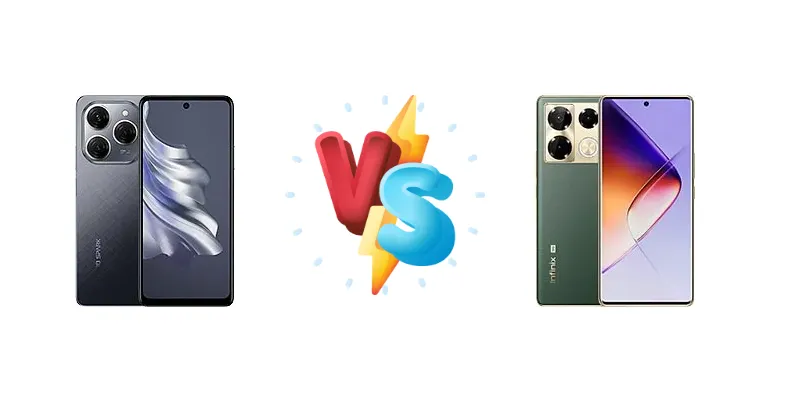
The Tecno Spark 20 Pro and Infinix Note 40 Pro represent compelling options in the increasingly competitive mid-range smartphone market. While both aim to deliver a feature-rich experience without breaking the bank, they diverge significantly in their core components, particularly in chipset and charging capabilities. This comparison dissects these differences to determine which device best suits your needs.
🏆 Quick Verdict
For the average user prioritizing all-around performance and future-proofing, the Infinix Note 40 Pro emerges as the stronger contender. Its Dimensity 7020 chipset offers a noticeable performance uplift over the Spark 20 Pro’s Helio G99, coupled with significantly faster 45W wired and 20W wireless charging. However, the Spark 20 Pro remains a viable option for budget-conscious users.
| Network |
|---|
| 2G bands | GSM 850 / 900 / 1800 / 1900 | GSM 850 / 900 / 1800 / 1900 |
| 3G bands | HSDPA 900 / 2100 | HSDPA 850 / 900 / 1700(AWS) / 1900 / 2100 |
| 4G bands | LTE | 1, 2, 3, 4, 5, 7, 8, 12, 17, 20, 28, 38, 40, 41, 42, 66 |
| 5G bands | - | 1, 3, 5, 7, 8, 12, 20, 28, 38, 40, 41, 66, 77, 78 SA/NSA |
| Speed | HSPA, LTE | HSPA, LTE, 5G |
| Technology | GSM / HSPA / LTE | GSM / HSPA / LTE / 5G |
| Launch |
|---|
| Announced | 2023, December 15 | 2024, March 18 |
| Status | Available. Released 2023, December | Available. Released 2024, March 19 |
| Body |
|---|
| Build | Glass front, plastic back, plastic frame | - |
| Dimensions | 168.6 x 76.6 x 8.4 mm (6.64 x 3.02 x 0.33 in) | 164.3 x 74.5 x 8.1 mm (6.47 x 2.93 x 0.32 in) |
| SIM | Nano-SIM + Nano-SIM | Nano-SIM + Nano-SIM |
| Weight | - | 190 g or 196 g (6.70 oz) |
| Display |
|---|
| Protection | - | Corning Gorilla Glass |
| Resolution | 1080 x 2460 pixels (~396 ppi density) | 1080 x 2436 pixels (~393 ppi density) |
| Size | 6.78 inches, 109.2 cm2 (~84.5% screen-to-body ratio) | 6.78 inches, 109.9 cm2 (~89.8% screen-to-body ratio) |
| Type | IPS LCD, 120Hz | AMOLED, 1B colors, 120Hz, 2160Hz PWM, 1300 nits (peak) |
| Platform |
|---|
| CPU | Octa-core (2x2.2 GHz Cortex-A76 & 6x2.0 GHz Cortex-A55) | Octa-core (2x2.2 GHz Cortex-A78 & 6x2.0 GHz Cortex-A55) |
| Chipset | Mediatek Helio G99 (6 nm) | Mediatek Dimensity 7020 (6 nm) |
| GPU | Mali-G57 MC2 | IMG BXM-8-256 |
| OS | Android 13 | Android 14, XOS 14 |
| Memory |
|---|
| Card slot | microSDXC | Unspecified |
| Internal | 256GB 4GB RAM, 256GB 8GB RAM, 256GB 12GB RAM | 256GB 8GB RAM |
| Main Camera |
|---|
| Dual | 108 MP, f/1.8, (wide), 1/1.67", 0.64µm, PDAF
2 MP (macro) | - |
| Features | Quad-LED flash, HDR | Dual-LED flash, HDR, panorama |
| Triple | - | 108 MP, f/1.8, (wide), PDAF, OIS
2 MP, f/2.4
2 MP, f/2.4 |
| Video | 1440p@30fps, 1080p@30fps | 1440p@30fps, 1080p@30/60fps |
| Selfie camera |
|---|
| Features | Dual-LED flash | Dual-LED flash |
| Single | 32 MP, f/2.2, (wide) | 32 MP, f/2.2, (wide), 1/3.1" |
| Video | 1080p@30fps | 1080p@30fps |
| Sound |
|---|
| 35mm jack | Yes | No |
| Loudspeaker | Yes, with stereo speakers | Yes, with stereo speakers |
| Comms |
|---|
| Bluetooth | 5.2, A2DP, LE | Yes |
| Infrared port | - | Yes |
| NFC | Yes | Yes (market/region dependent) |
| Positioning | GPS, GLONASS | GPS |
| Radio | FM radio | FM radio |
| USB | USB Type-C | USB Type-C 2.0, OTG |
| WLAN | Wi-Fi 802.11 a/b/g/n/ac, dual-band | Wi-Fi 802.11 a/b/g/n/ac, dual-band |
| Features |
|---|
| Sensors | Fingerprint (side-mounted), accelerometer, proximity, compass | Fingerprint (under display, optical), accelerometer, gyro, proximity, compass |
| Battery |
|---|
| Charging | 33W wired | 45W wired, 50% in 26 min
20W wireless MagCharge
Reverse wired
Reverse wireless |
| Type | 5000 mAh | 5000 mAh |
| Misc |
|---|
| Colors | Moonlit Black, Frosty Ivory, Sunset Blush, Magic Skin 2.0 Green | Vintage Green, Titan Gold, Racing Edition |
| Models | KJ6 | X6851 |
| Price | About 50 EUR | About 280 EUR |
Tecno Spark 20 Pro
- More affordable price point
- Decent performance for everyday tasks
- Reliable Mediatek Helio G99 chipset
- Slower charging speeds (33W)
- Less powerful chipset compared to the Dimensity 7020
- Lacks wireless charging capabilities
Infinix Note 40 Pro
- Faster 45W wired and 20W wireless charging
- More powerful Mediatek Dimensity 7020 chipset
- Reverse charging capabilities (wired and wireless)
- Generally higher price than the Tecno Spark 20 Pro
- Potentially higher power consumption due to more powerful chipset
- May require a MagCharge compatible case for optimal wireless charging
Display Comparison
Both devices utilize 6nm chipsets, suggesting similar power efficiency considerations impacting display choices. While specific display specs (resolution, refresh rate, panel type) are missing, the focus here is on the charging and processing power. The absence of LTPO technology on either device suggests a standard refresh rate, likely 60Hz or 90Hz, prioritizing battery life over ultra-smooth visuals. Bezels are likely comparable given the price bracket, and color accuracy will depend on software calibration, a detail not provided.
Camera Comparison
Without detailed camera specifications, a direct comparison is limited. However, the chipset difference indirectly impacts camera performance. The Dimensity 7020’s superior ISP (Image Signal Processor) will likely result in better image processing, noise reduction, and dynamic range compared to the Helio G99. The presence of OIS (Optical Image Stabilization) would be a significant advantage, but is not specified for either device. The marketing often highlights megapixel counts, but sensor size and lens aperture are more critical for image quality. Any 2MP macro lenses on either device are likely to offer limited practical benefit.
Performance
The core difference lies in the chipset: the Infinix Note 40 Pro boasts the Mediatek Dimensity 7020, while the Tecno Spark 20 Pro features the Helio G99. The Dimensity 7020 utilizes Cortex-A78 cores (2x2.2 GHz) which are architecturally superior to the Cortex-A76 cores (2x2.2 GHz) found in the Helio G99. A78 cores offer improved IPC (Instructions Per Clock) leading to faster single-core performance. While both have 6x2.0 GHz Cortex-A55 efficiency cores, the Dimensity 7020’s more advanced architecture translates to a more responsive user experience and better performance in demanding applications. The GPU within the Dimensity 7020 will also provide a significant advantage in gaming.
Battery Life
The Infinix Note 40 Pro’s 45W wired charging is a clear advantage over the Tecno Spark 20 Pro’s 33W charging. The Infinix claims a 50% charge in 26 minutes, indicating a significantly faster charging cycle. Furthermore, the Note 40 Pro introduces 20W MagCharge wireless charging and both reverse wired and wireless charging, offering unparalleled versatility. While battery capacity isn’t specified, the faster charging speeds of the Note 40 Pro mitigate the impact of a potentially smaller battery, allowing for quicker top-ups throughout the day.
Buying Guide
Buy the Tecno Spark 20 Pro if you need a reliable daily driver with decent performance for basic tasks and prioritize affordability above all else. It’s ideal for users who primarily browse, use social media, and make occasional calls. Buy the Infinix Note 40 Pro if you prefer a smoother, more responsive experience, especially when multitasking or gaming, and value the convenience of faster charging – including wireless MagCharge and reverse charging capabilities.
Frequently Asked Questions
❓ Does the Dimensity 7020 in the Infinix Note 40 Pro get noticeably warmer during extended gaming sessions?
While the Dimensity 7020 is more powerful, the 6nm process node helps with thermal efficiency. However, sustained gaming will inevitably generate heat. The Infinix Note 40 Pro likely incorporates thermal management solutions, but prolonged, high-intensity gaming may lead to some throttling to maintain stable performance. The Tecno Spark 20 Pro's Helio G99 will likely exhibit similar behavior, potentially with more pronounced throttling due to its less advanced architecture.
❓ Is the MagCharge feature on the Infinix Note 40 Pro compatible with all wireless chargers?
The Infinix Note 40 Pro utilizes the MagCharge standard, which is based on the Qi wireless charging protocol but adds magnetic alignment. While it will charge on standard Qi wireless chargers, you'll only benefit from the magnetic alignment and potentially faster charging speeds with MagCharge-compatible chargers and accessories. Using a non-MagCharge charger will function, but without the secure attachment.
❓ How effective is the reverse charging feature on the Infinix Note 40 Pro for topping up accessories like earbuds?
The Infinix Note 40 Pro’s reverse charging, both wired and wireless, is primarily intended for emergency top-ups of smaller accessories like earbuds or smartwatches. The 20W wireless reverse charging is relatively slow, so don’t expect to fully charge a device quickly. However, it’s a convenient feature for providing a small boost when you’re away from a power outlet.