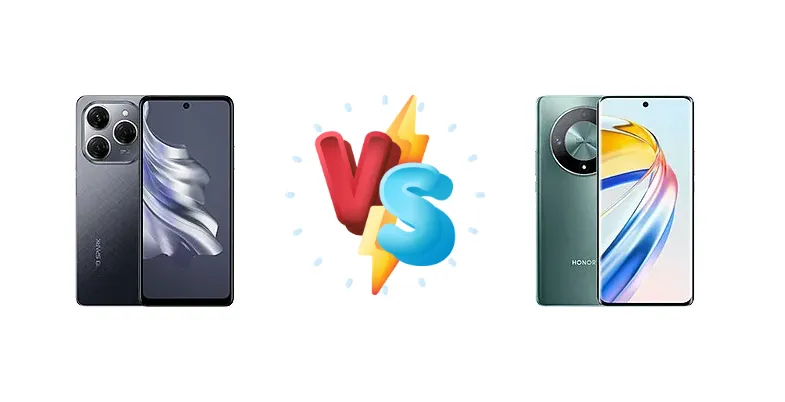
The Tecno Spark 20 Pro and Honor X9b represent compelling options in the increasingly competitive sub-$250 smartphone market. While both aim to deliver a solid experience without breaking the bank, they take different approaches to achieving this, primarily through their chipset choices. This comparison dissects the key differences between the MediaTek Helio G99-powered Spark 20 Pro and the Qualcomm Snapdragon 6 Gen 1-equipped X9b, helping you determine which device best suits your needs.
🏆 Quick Verdict
For the average user prioritizing sustained performance and future-proofing, the Honor X9b emerges as the stronger contender. The Snapdragon 6 Gen 1’s 4nm process and more modern CPU architecture offer a noticeable advantage in efficiency and responsiveness, despite the Tecno Spark 20 Pro’s slightly faster peak CPU clock speeds.
| Network |
|---|
| 2G bands | GSM 850 / 900 / 1800 / 1900 | GSM 850 / 900 / 1800 / 1900 |
| 3G bands | HSDPA 900 / 2100 | HSDPA 850 / 900 / 1900 / 2100 |
| 4G bands | LTE | 1, 2, 3, 4, 5, 7, 8, 20, 28, 32, 38, 40, 41 |
| 5G bands | - | 1, 3, 7, 8, 20, 28, 38, 40, 41, 77, 78 SA/NSA |
| Speed | HSPA, LTE | HSPA, LTE, 5G |
| Technology | GSM / HSPA / LTE | GSM / HSPA / LTE / 5G |
| Launch |
|---|
| Announced | 2023, December 15 | 2023, October 18 |
| Status | Available. Released 2023, December | Available. Released 2023, October |
| Body |
|---|
| Build | Glass front, plastic back, plastic frame | - |
| Dimensions | 168.6 x 76.6 x 8.4 mm (6.64 x 3.02 x 0.33 in) | 163.6 x 75.5 x 8 mm (6.44 x 2.97 x 0.31 in) |
| SIM | Nano-SIM + Nano-SIM | Nano-SIM + Nano-SIM |
| Weight | - | 185 g (6.53 oz) |
| Display |
|---|
| Resolution | 1080 x 2460 pixels (~396 ppi density) | 1220 x 2652 pixels, 19.5:9 ratio (~431 ppi density) |
| Size | 6.78 inches, 109.2 cm2 (~84.5% screen-to-body ratio) | 6.78 inches, 112.6 cm2 (~91.2% screen-to-body ratio) |
| Type | IPS LCD, 120Hz | AMOLED, 1B colors, 120Hz, 1200 nits (peak) |
| Platform |
|---|
| CPU | Octa-core (2x2.2 GHz Cortex-A76 & 6x2.0 GHz Cortex-A55) | Octa-core (4x2.2 GHz Cortex-A78 & 4x1.8 GHz Cortex-A55) |
| Chipset | Mediatek Helio G99 (6 nm) | Qualcomm SM6450 Snapdragon 6 Gen 1 (4 nm) |
| GPU | Mali-G57 MC2 | Adreno 710 |
| OS | Android 13 | Android 13, Magic OS 7.2 |
| Memory |
|---|
| Card slot | microSDXC | No |
| Internal | 256GB 4GB RAM, 256GB 8GB RAM, 256GB 12GB RAM | 256GB 8GB RAM, 256GB 12GB RAM, 512GB 8GB RAM, 512GB 12GB RAM |
| Main Camera |
|---|
| Dual | 108 MP, f/1.8, (wide), 1/1.67", 0.64µm, PDAF
2 MP (macro) | - |
| Features | Quad-LED flash, HDR | LED flash, panorama, HDR |
| Triple | - | 108 MP, f/1.8, (wide), 1/1.67", PDAF
5 MP, f/2.2, (ultrawide)
2 MP (macro) |
| Video | 1440p@30fps, 1080p@30fps | 4K@30fps, 1080p@30fps |
| Selfie camera |
|---|
| Features | Dual-LED flash | - |
| Single | 32 MP, f/2.2, (wide) | 16 MP, f/2.5, (wide) |
| Video | 1080p@30fps | 1080p@30fps |
| Sound |
|---|
| 35mm jack | Yes | No |
| Loudspeaker | Yes, with stereo speakers | Yes |
| Comms |
|---|
| Bluetooth | 5.2, A2DP, LE | 5.1, A2DP, LE |
| Infrared port | - | Yes |
| NFC | Yes | Yes (market/region dependent) |
| Positioning | GPS, GLONASS | GPS, GLONASS, GALILEO, BDS |
| Radio | FM radio | No |
| USB | USB Type-C | USB Type-C 2.0, OTG |
| WLAN | Wi-Fi 802.11 a/b/g/n/ac, dual-band | Wi-Fi 802.11 a/b/g/n/ac, dual-band, Wi-Fi Direct |
| Features |
|---|
| Sensors | Fingerprint (side-mounted), accelerometer, proximity, compass | Fingerprint (under display, optical), accelerometer, gyro, proximity, compass |
| Battery |
|---|
| Charging | 33W wired | 35W wired
Reverse wired |
| Type | 5000 mAh | Li-Po 5800 mAh |
| Misc |
|---|
| Colors | Moonlit Black, Frosty Ivory, Sunset Blush, Magic Skin 2.0 Green | Sunrise Orange, Midnight Black, Emerald Green |
| Models | KJ6 | ALI-NX1 |
| Price | About 50 EUR | About 970 EUR |
Tecno Spark 20 Pro
- Potentially higher peak CPU clock speed for short bursts.
- Competitive price point.
- 33W fast charging.
- Less efficient 6nm process can lead to throttling.
- No reverse wired charging.
- Older CPU architecture.
Honor X9b
- More efficient 4nm process for sustained performance.
- Modern CPU architecture (Cortex-A78).
- Reverse wired charging for added convenience.
- Slightly lower peak CPU clock speed.
- May be marginally more expensive.
Display Comparison
Neither device boasts a standout display, focusing instead on value. While specific display specs (resolution, refresh rate) are missing, the core difference lies beneath the hood. The focus here is on the chipsets' ability to drive the displays efficiently. Both will likely offer adequate viewing experiences for everyday tasks, but demanding graphical applications will be more smoothly handled by the X9b due to its more efficient processor.
Camera Comparison
Without detailed camera specifications, a direct comparison is limited. However, the chipset plays a crucial role in image signal processing (ISP). Qualcomm’s ISPs are generally regarded as more advanced, potentially leading to better image quality, especially in challenging lighting conditions, on the Honor X9b. The efficiency of the Snapdragon 6 Gen 1 also allows for more complex image processing algorithms without significant power drain. The absence of information on sensor sizes and OIS makes a definitive judgment impossible, but the X9b has a processing advantage.
Performance
The core battleground is the chipset. The Honor X9b’s Qualcomm Snapdragon 6 Gen 1 (4nm) represents a significant leap in process technology compared to the Tecno Spark 20 Pro’s MediaTek Helio G99 (6nm). This smaller node translates directly to improved thermal efficiency, meaning the X9b is less likely to throttle under sustained load. While the Spark 20 Pro features a slightly higher peak CPU clock speed (2.2 GHz Cortex-A76 vs 2.2 GHz Cortex-A78 on the X9b), the Snapdragon 6 Gen 1’s Cortex-A78 cores are architecturally superior, offering better instructions-per-clock (IPC) performance. This means the X9b will likely deliver a smoother experience in demanding applications and games. The X9b also benefits from 4 cores at 2.2GHz, compared to the Spark 20 Pro's 2.
Battery Life
Both devices offer fast charging, with the Honor X9b edging out the Tecno Spark 20 Pro with 35W wired charging versus 33W. More importantly, the X9b includes reverse wired charging, a feature absent on the Spark 20 Pro, adding versatility for users who need to top up accessories or share power. The Snapdragon 6 Gen 1’s superior power efficiency will also contribute to longer battery life on the X9b, offsetting any potential capacity differences (which are currently unknown).
Buying Guide
Buy the Tecno Spark 20 Pro if you prioritize maximizing CPU clock speed for bursty tasks and are comfortable with potentially more thermal throttling during extended gaming sessions. Buy the Honor X9b if you value consistent performance, better power efficiency, and the convenience of reverse wired charging, making it ideal for users who frequently share power with friends or accessories.
Frequently Asked Questions
❓ Will the Helio G99 in the Tecno Spark 20 Pro struggle with graphically demanding games like Genshin Impact?
The Helio G99 can run Genshin Impact, but you'll likely need to lower the graphics settings significantly to maintain a playable frame rate. The 6nm process and less efficient CPU architecture mean it's more prone to thermal throttling during extended gaming sessions, leading to frame drops. The Snapdragon 6 Gen 1 in the Honor X9b will provide a smoother, more consistent experience at higher settings.
❓ How much of a real-world difference will the 4nm process of the Snapdragon 6 Gen 1 make in terms of battery life?
The 4nm process is a significant advantage for the Snapdragon 6 Gen 1. It consumes less power at the same performance level, or delivers more performance at the same power consumption. Expect to see a noticeable improvement in battery life on the Honor X9b, potentially adding an hour or more of screen-on time compared to the Tecno Spark 20 Pro, depending on usage patterns.
❓ Is reverse wired charging on the Honor X9b useful, and how fast does it charge other devices?
Reverse wired charging is a convenient feature for topping up accessories like wireless earbuds or smartwatches, or even sharing power with a friend in a pinch. While the exact charging speed depends on the device being charged and the cable used, the Honor X9b's 35W output will provide a faster charge than many other phones offering this feature.