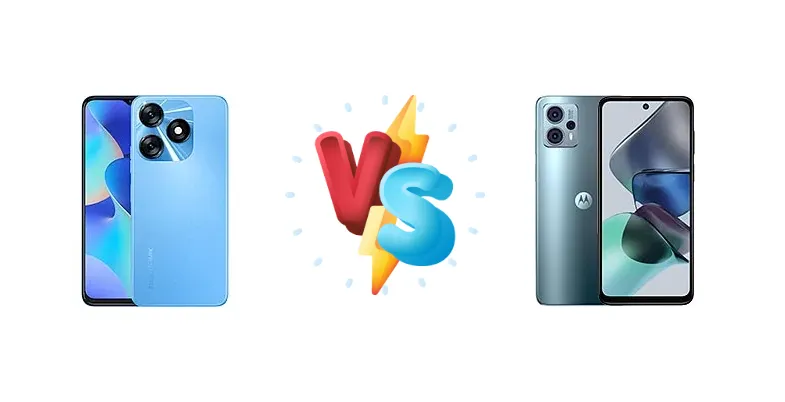
The sub-$200 smartphone market is fiercely competitive. The Motorola Moto G23 and Tecno Spark 10 both aim to deliver essential features at an accessible price point, but they take different approaches. The G23 prioritizes faster charging and a more modern CPU architecture, while the Spark 10 focuses on a streamlined experience. This comparison dissects their key differences to help you choose the right device.
🏆 Quick Verdict
For most users, the Motorola Moto G23 emerges as the better choice. Its Helio G85 chipset, featuring Cortex-A75 cores, provides a noticeable performance uplift over the Spark 10’s Helio G37, and the 30W charging significantly reduces downtime. While the Spark 10 is a capable device, the G23 offers a more responsive experience and quicker power-ups.
| Network |
|---|
| 2G bands | GSM 850 / 900 / 1800 / 1900 | GSM 850 / 900 / 1800 / 1900 |
| 3G bands | HSDPA 850 / 900 / 2100 | HSDPA 850 / 900 / 1900 / 2100 - Europe, AP/MEA |
| 4G bands | LTE | 1, 2, 3, 5, 7, 8, 20, 28, 38, 40, 41 - Europe |
| Speed | HSPA, LTE | HSPA, LTE |
| Technology | GSM / HSPA / LTE | GSM / HSPA / LTE |
| | - | 1, 2, 3, 5, 7, 8, 18, 19, 20, 26, 28, 38, 40, 41 - AP/MEA |
| Launch |
|---|
| Announced | 2023, March 23 | 2023, January 24 |
| Status | Available. Released 2023, April | Available. Released 2023, January 24 |
| Body |
|---|
| Build | Glass front, plastic frame, plastic back | Glass front, plastic frame, plastic back |
| Dimensions | 163.9 x 75.4 x 8.4 mm (6.45 x 2.97 x 0.33 in) | 162.7 x 74.7 x 8.2 mm (6.41 x 2.94 x 0.32 in) |
| SIM | Nano-SIM + Nano-SIM | · Nano-SIM· Nano-SIM + Nano-SIM |
| Weight | - | 184.3 g (6.49 oz) |
| | - | Water-resistant design |
| Display |
|---|
| Protection | - | Panda glass |
| Resolution | 720 x 1612 pixels, 20:9 ratio (~267 ppi density) | 720 x 1600 pixels, 20:9 ratio (~270 ppi density) |
| Size | 6.6 inches, 104.6 cm2 (~84.7% screen-to-body ratio) | 6.5 inches, 102.0 cm2 (~83.9% screen-to-body ratio) |
| Type | IPS LCD, 90Hz | IPS LCD, 90Hz, 400 nits (peak) |
| Platform |
|---|
| CPU | Octa-core (4x2.3 GHz Cortex-A53 & 4x1.7 GHz Cortex-A53) | Octa-core (2x2.0 GHz Cortex-A75 & 6x1.8 GHz Cortex-A55) |
| Chipset | Mediatek MT6765 Helio G37 (12 nm) | Mediatek MT6769Z Helio G85 (12 nm) |
| GPU | PowerVR GE8320 | Mali-G52 MC2 |
| OS | Android 13, HIOS 12 | Android 13, planned upgrade to Android 14 |
| Memory |
|---|
| Card slot | microSDXC | microSDXC (dedicated slot) |
| Internal | 64GB 4GB RAM, 128GB 4GB RAM, 128GB 8GB RAM | 64GB 4GB RAM, 128GB 4GB RAM, 128GB 8GB RAM |
| Main Camera |
|---|
| Dual | 50 MP, (wide), 0.7µm, PDAF
0.08 MP, (depth) | - |
| Features | Dual-LED flash, HDR, panorama | LED flash, HDR, panorama |
| Single | 50 MP, (wide), 0.7µm, PDAF
Auxiliary lens | - |
| Triple | - | 50 MP, f/1.8, (wide), 0.64µm, PDAF
5 MP, f/2.2, 118˚ (ultrawide)
2 MP (macro) |
| Video | 1080p@30fps | 1080p@30fps |
| Selfie camera |
|---|
| Features | Dual-LED flash | HDR |
| Single | 8 MP, (wide) | 16 MP, f/2.5, (wide), 1.0µm |
| Video | 1080p@30fps | 1080p@30fps |
| Sound |
|---|
| 3.5mm jack | Yes | Yes |
| 35mm jack | Yes | Yes |
| Loudspeaker | Yes | Yes, with stereo speakers |
| Comms |
|---|
| Bluetooth | Yes | 5.1, A2DP, LE |
| NFC | Yes | Yes (market/region dependent) |
| Positioning | GPS | GPS, GLONASS, GALILEO |
| Radio | FM radio | FM radio |
| USB | USB Type-C 2.0 | USB Type-C 2.0 |
| WLAN | Wi-Fi 802.11 a/b/g/n/ac, dual-band | Wi-Fi 802.11 a/b/g/n/ac, dual-band |
| Features |
|---|
| Sensors | Fingerprint (side-mounted), accelerometer, proximity, compass | Fingerprint (side-mounted), accelerometer, gyro, proximity |
| Battery |
|---|
| Charging | 18W wired | 30W wired |
| Type | 5000 mAh | 5000 mAh |
| Misc |
|---|
| Colors | Black, Blue, White, Skin Orange | Matte Charcoal, Pearl White, Steel Blue |
| Models | KI5q | XT2333-1 |
| Price | € 151.38 / ₹ 9,899 | About 80 EUR |
Tecno Spark 10
- Potentially lower price point
- Simple and streamlined user experience
- Decent battery life (assuming moderate usage)
- Inferior processor performance
- Slower charging speed
- Less responsive user interface
Motorola Moto G23
- Faster and more efficient processor
- Significantly faster charging
- More responsive user experience
- May be slightly more expensive
- Software bloatware (typical of Motorola)
- Potentially less battery life under heavy load
Display Comparison
Neither device boasts a standout display. Both utilize 12nm chipsets, suggesting similar power constraints impacting display capabilities. While specific display specs (resolution, brightness) are missing, the focus here is on performance. The absence of high refresh rates on either device indicates a cost-saving measure, prioritizing battery life over visual fluidity. Bezels are likely comparable, typical for this price bracket.
Camera Comparison
Without detailed camera specifications, a direct comparison is limited. However, it’s safe to assume both phones feature budget-oriented camera systems. The presence of a 2MP macro lens on both devices suggests a marketing gimmick rather than a genuinely useful feature. Image quality will likely depend more on software processing than sensor size or lens quality. The G23’s ISP (Image Signal Processor) within the Helio G85 may offer slightly better noise reduction and dynamic range compared to the G37’s ISP, but real-world differences will likely be marginal.
Performance
The core difference lies in the chipsets. The Motorola Moto G23’s MediaTek Helio G85 (12nm) is a clear upgrade over the Tecno Spark 10’s Helio G37 (12nm). The G85 features two Cortex-A75 cores clocked at 2.0 GHz alongside six Cortex-A55 cores, while the G37 relies solely on four Cortex-A53 cores clocked at 2.3 GHz and another four at 1.7 GHz. The A75 cores in the G85 offer significantly better single-core performance, translating to snappier app launches and smoother multitasking. While the G37’s higher clock speed on its A53 cores might offer a slight advantage in sustained, multi-threaded workloads, the G85’s architecture is more efficient for typical smartphone usage. The G23 will handle gaming and demanding apps with noticeably less lag.
Battery Life
The Motorola Moto G23’s 30W wired charging is a significant advantage over the Tecno Spark 10’s 18W charging. This translates to a much faster 0-100% charge time, reducing downtime. While battery capacity isn’t specified, the faster charging speed effectively mitigates any potential capacity difference. Users who frequently find themselves needing to top up their phone will greatly benefit from the G23’s faster charging capabilities.
Buying Guide
Buy the Tecno Spark 10 if you prioritize a simple, no-frills Android experience and are less concerned with demanding tasks like gaming or heavy multitasking. Buy the Motorola Moto G23 if you value faster performance for everyday use, quicker charging to minimize downtime, and a more future-proofed processor architecture for potential software updates.
Frequently Asked Questions
❓ Will the Moto G23’s Helio G85 handle popular games like PUBG Mobile smoothly?
Yes, the Helio G85 in the Moto G23 is capable of running PUBG Mobile at medium settings with a stable frame rate. While it won’t deliver a flagship gaming experience, it provides a significantly smoother experience than the Helio G37 in the Tecno Spark 10, which may struggle with consistent performance even at lower settings.
❓ How much faster is the 30W charging on the Moto G23 compared to the 18W charging on the Tecno Spark 10?
The 30W charging on the Moto G23 will likely reduce charging time by approximately 30-50%, depending on the battery capacity. While exact figures aren’t available, you can expect a full charge in around 1.5-2 hours with the G23, compared to 2.5-3 hours with the Spark 10.
❓ Does the Motorola Moto G23 have a noticeable amount of bloatware pre-installed?
Motorola is known for including some pre-installed apps (bloatware) on its devices. While the amount varies, users can typically uninstall or disable most of these apps, freeing up storage space and improving the user experience. The Tecno Spark 10 may also have pre-installed apps, but the extent is unknown.