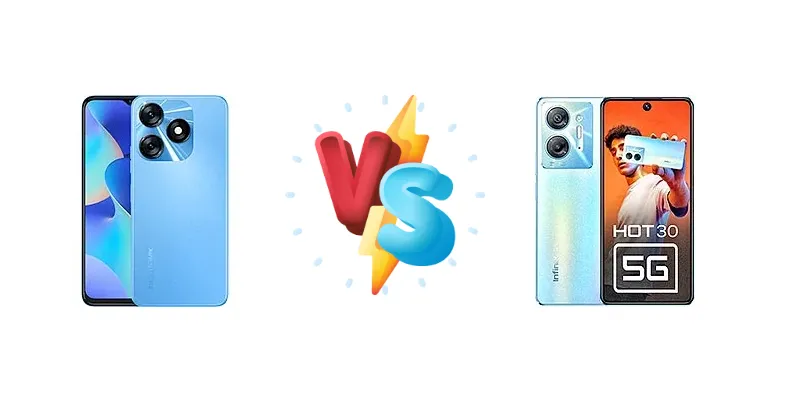
The Tecno Spark 10 and Infinix Hot 30 5G represent compelling options in the ultra-budget smartphone space. While both aim to deliver essential features at accessible price points, they diverge significantly in their core processing power. This comparison dissects these differences, focusing on how the chipset choice impacts real-world performance and user experience.
🏆 Quick Verdict
For the average user prioritizing responsiveness and future-proofing, the Infinix Hot 30 5G is the clear winner. Its MediaTek Dimensity 6020 chipset, built on a more efficient 7nm process, delivers a substantial performance advantage over the Tecno Spark 10’s Helio G37, making it better suited for multitasking and demanding applications.
| Network |
|---|
| 2G bands | GSM 850 / 900 / 1800 / 1900 | GSM 850 / 900 / 1800 / 1900 |
| 3G bands | HSDPA 850 / 900 / 2100 | HSDPA 850 / 900 / 1700(AWS) / 1900 / 2100 |
| 4G bands | LTE | LTE |
| 5G bands | - | 1, 3, 5, 8, 28, 38, 40, 41, 77, 78 SA/NSA |
| Speed | HSPA, LTE | HSPA, LTE, 5G |
| Technology | GSM / HSPA / LTE | GSM / HSPA / LTE / 5G |
| Launch |
|---|
| Announced | 2023, March 23 | 2023, July 14 |
| Status | Available. Released 2023, April | Available. Released 2023, July 18 |
| Body |
|---|
| Build | Glass front, plastic frame, plastic back | Glass front, plastic frame, plastic back |
| Dimensions | 163.9 x 75.4 x 8.4 mm (6.45 x 2.97 x 0.33 in) | 168.5 x 76.5 x 9.2 mm (6.63 x 3.01 x 0.36 in) |
| SIM | Nano-SIM + Nano-SIM | Nano-SIM + Nano-SIM |
| Weight | - | 215 g (7.58 oz) |
| Display |
|---|
| Resolution | 720 x 1612 pixels, 20:9 ratio (~267 ppi density) | 1080 x 2460 pixels (~396 ppi density) |
| Size | 6.6 inches, 104.6 cm2 (~84.7% screen-to-body ratio) | 6.78 inches, 109.2 cm2 (~84.7% screen-to-body ratio) |
| Type | IPS LCD, 90Hz | IPS LCD, 120Hz, 580 nits (peak) |
| Platform |
|---|
| CPU | Octa-core (4x2.3 GHz Cortex-A53 & 4x1.7 GHz Cortex-A53) | Octa-core (2x2.2 GHz Cortex-A76 & 6x2.0 GHz Cortex-A55) |
| Chipset | Mediatek MT6765 Helio G37 (12 nm) | Mediatek Dimensity 6020 (7 nm) |
| GPU | PowerVR GE8320 | Mali-G57 MC2 |
| OS | Android 13, HIOS 12 | Android 13, XOS 13 |
| Memory |
|---|
| Card slot | microSDXC | microSDXC (dedicated slot) |
| Internal | 64GB 4GB RAM, 128GB 4GB RAM, 128GB 8GB RAM | 128GB 4GB RAM, 128GB 8GB RAM |
| Main Camera |
|---|
| Dual | 50 MP, (wide), 0.7µm, PDAF
0.08 MP, (depth) | - |
| Features | Dual-LED flash, HDR, panorama | Quad-LED flash, HDR, panorama |
| Single | 50 MP, (wide), 0.7µm, PDAF
Auxiliary lens | 50 MP, f/1.6, (wide), 1/2.55", AF
Auxiliary lens |
| Video | 1080p@30fps | 1440p@30fps, 1080p@30fps |
| Selfie camera |
|---|
| Features | Dual-LED flash | Dual-LED flash |
| Single | 8 MP, (wide) | 8 MP, f/2.0, (wide) |
| Video | 1080p@30fps | 1080p@30fps |
| Sound |
|---|
| 3.5mm jack | Yes | - |
| 35mm jack | Yes | Yes |
| Loudspeaker | Yes | Yes, with stereo speakers |
| Comms |
|---|
| Bluetooth | Yes | 5.1, A2DP, LE |
| NFC | Yes | No |
| Positioning | GPS | GPS, GLONASS, GALILEO, BDS |
| Radio | FM radio | FM radio |
| USB | USB Type-C 2.0 | USB Type-C 2.0 |
| WLAN | Wi-Fi 802.11 a/b/g/n/ac, dual-band | Wi-Fi 802.11 a/b/g/n/ac, dual-band |
| Features |
|---|
| Sensors | Fingerprint (side-mounted), accelerometer, proximity, compass | Fingerprint (side-mounted), accelerometer, proximity, compass |
| Battery |
|---|
| Charging | 18W wired | 18W wired |
| Type | 5000 mAh | 5000 mAh |
| Misc |
|---|
| Colors | Black, Blue, White, Skin Orange | Knight Black, Aurora Blue |
| Models | KI5q | X6832 |
| Price | € 151.38 / ₹ 9,899 | About 140 EUR |
Tecno Spark 10
- Potentially lower price point.
- Simple and straightforward user experience.
- Adequate for basic smartphone tasks.
- Significantly weaker performance compared to the Infinix.
- Less efficient chipset leading to potential throttling.
- Limited future-proofing.
Infinix Hot 30 5G
- Superior performance thanks to the Dimensity 6020.
- More efficient chipset for better battery life.
- 5G connectivity for faster data speeds.
- May be slightly more expensive than the Tecno Spark 10.
- Camera performance likely similar to the Tecno Spark 10.
- Display quality is likely standard for the price range.
Display Comparison
Neither device boasts a standout display. Both likely feature LCD panels, common in this price bracket. However, detailed specs like resolution and peak brightness are missing. The focus here is on performance, not visual fidelity. Bezels are expected to be noticeable on both, and color accuracy will likely be standard for the segment. Without further data, a direct comparison is difficult, but display quality isn't a key differentiator.
Camera Comparison
Both phones likely feature a multi-camera setup, but detailed sensor information is limited. It's safe to assume both will include a primary camera and potentially depth/macro sensors. Given the price point, image quality will be heavily reliant on software processing. Without knowing sensor sizes or apertures, it’s difficult to declare a winner. The presence of a 2MP macro camera on either device is unlikely to significantly impact image quality; these are often included for marketing purposes rather than practical benefit. The Dimensity 6020’s image signal processor (ISP) *may* offer slightly better processing capabilities, but this is speculative without detailed testing.
Performance
The core difference lies in the chipsets. The Infinix Hot 30 5G’s MediaTek Dimensity 6020 (7nm) is a significant upgrade over the Tecno Spark 10’s Helio G37 (12nm). The 7nm process inherently offers better power efficiency, translating to less heat generation and potentially longer sustained performance. Architecturally, the Dimensity 6020 features two Cortex-A76 cores clocked at 2.2 GHz, providing a substantial boost in single-core performance compared to the Spark 10’s four Cortex-A53 cores at 2.3 GHz. The remaining six Cortex-A55 cores in the Dimensity 6020 further enhance multi-tasking capabilities. This means faster app launches, smoother scrolling, and a more responsive overall experience on the Infinix.
Battery Life
Both devices share the same 18W wired charging capability. While the actual battery capacity isn't specified, 18W charging in this segment typically translates to a 2-3 hour full charge. The Dimensity 6020’s superior power efficiency could offset a potentially smaller battery capacity in the Infinix Hot 30 5G, resulting in comparable or even slightly better real-world battery life. The 7nm process reduces power draw during operation, extending usage time between charges.
Buying Guide
Buy the Tecno Spark 10 if you need a basic smartphone for essential tasks like calls, messaging, and light social media use, and prioritize a potentially lower price point. Buy the Infinix Hot 30 5G if you prefer a smoother, more responsive experience, especially when multitasking or playing mobile games, and value the added benefit of 5G connectivity for faster data speeds where available.
Frequently Asked Questions
❓ Will the Dimensity 6020 in the Infinix Hot 30 5G overheat during prolonged gaming sessions?
The Dimensity 6020's 7nm manufacturing process is designed for improved thermal efficiency compared to the Tecno Spark 10's Helio G37. While some throttling is possible during extended, graphically intensive gaming, it's likely to be less pronounced than on the Spark 10, providing a more consistent gaming experience.
❓ Is the 5G connectivity on the Infinix Hot 30 5G actually useful, or is it just a marketing feature?
The usefulness of 5G depends on your location and carrier support. If 5G is available in your area, you'll experience significantly faster download and upload speeds compared to 4G. However, if 5G coverage is limited, the benefit will be minimal. The inclusion of 5G future-proofs the device for wider network availability.
❓ How much of a performance difference will I realistically notice between the Helio G37 and the Dimensity 6020 in everyday tasks?
You'll notice a significant difference in responsiveness. The Dimensity 6020 will handle multitasking, app launches, and web browsing much more smoothly. The Helio G37 may exhibit noticeable lag when switching between apps or running demanding applications. The difference is most apparent when pushing the phones beyond basic usage.