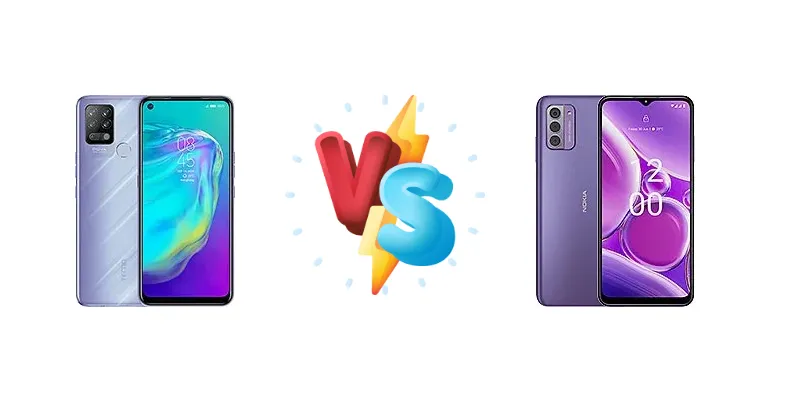
The Tecno Pova and Nokia G42 represent compelling options in the increasingly competitive sub-$200 smartphone market. While both aim to deliver 5G connectivity at an accessible price, they take distinctly different approaches to achieving this. The Pova prioritizes raw processing power with its Helio G80, while the G42 leans on Qualcomm’s more efficient Snapdragon 480+ platform. This comparison will dissect their strengths and weaknesses to determine which device best suits your needs.
🏆 Quick Verdict
For the average user prioritizing 5G connectivity and long-term software support, the Nokia G42 emerges as the better choice. Its Snapdragon 480+ offers a more refined experience, coupled with faster charging and Nokia’s commitment to updates. However, gamers on a tight budget might find the Tecno Pova’s Helio G80 provides a slight edge in sustained performance.
| Network |
|---|
| 2G bands | GSM 850 / 900 / 1800 / 1900 | GSM 850 / 900 / 1800 / 1900 |
| 3G bands | HSDPA 850 / 900 / 2100 | HSDPA 850 / 900 / 1700(AWS) / 1900 / 2100 |
| 4G bands | 1, 3, 5, 8, 38, 40, 41 | 1, 2, 3, 4, 5, 7, 8, 12, 17, 13, 20, 28, 38, 39, 40, 41, 66 |
| 5G bands | - | 1, 2, 3, 5, 7, 8, 28, 40, 41, 66, 77, 78 SA/NSA |
| Speed | HSPA, LTE | HSPA, LTE, 5G |
| Technology | GSM / HSPA / LTE | GSM / HSPA / LTE / 5G |
| Launch |
|---|
| Announced | 2020, October 03. Released 2020, October 16 | 2023, June 28 |
| Status | Discontinued | Available. Released 2023, June 28 |
| Body |
|---|
| Build | - | Glass front, plastic back, plastic frame |
| Dimensions | 171.2 x 77.6 x 9.4 mm (6.74 x 3.06 x 0.37 in) | 165 x 75.8 x 8.6 mm (6.50 x 2.98 x 0.34 in) |
| SIM | Nano-SIM + Nano-SIM | · Nano-SIM· Nano-SIM + Nano-SIM |
| Weight | - | 193.8 g (6.84 oz) |
| Display |
|---|
| Protection | - | Corning Gorilla Glass 3 |
| Resolution | 720 x 1640 pixels (~263 ppi density) | 720 x 1612 pixels, 20:9 ratio (~269 ppi density) |
| Size | 6.8 inches, 109.8 cm2 (~82.7% screen-to-body ratio) | 6.56 inches, 103.4 cm2 (~82.7% screen-to-body ratio) |
| Type | IPS LCD, 480 nits (peak) | IPS LCD, 90Hz, 450 nits (typ), 560 nits (peak) |
| Platform |
|---|
| CPU | Octa-core (2x2.0 GHz Cortex-A75 & 6x1.8 GHz Cortex-A55) | Octa-core (2x2.2 GHz Kryo 460 & 6x1.8 GHz Kryo 460) |
| Chipset | Mediatek MT6769V/CU Helio G80 (12 nm) | Qualcomm SM4350-AC Snapdragon 480+ 5G (8 nm) |
| GPU | Mali-G52 MC2 | Adreno 619 |
| OS | Android 10, HIOS 7.0 | Android 13, upgradable to Android 14 |
| Memory |
|---|
| Card slot | microSDXC (dedicated slot) | microSDXC |
| Internal | 64GB 4GB RAM, 128GB 6GB RAM | 128GB 4GB RAM, 128GB 6GB RAM, 256GB 8GB RAM |
| Main Camera |
|---|
| Features | Quad-LED flash | LED flash, HDR, panorama |
| Quad | 13 MP or 16 MP, f/1.9, (wide), PDAF
2 MP (macro)
Auxiliary lenses | - |
| Triple | - | 50 MP, f/1.8, (wide), AF
2 MP (macro)
Auxiliary lens |
| Video | 1440p@30fps, 1080p@30fps | 1080p@30fps |
| Selfie camera |
|---|
| Features | Dual-LED flash | - |
| Single | 8 MP, f/2.0 | 8 MP |
| Video | 1080p@30fps | Yes |
| Sound |
|---|
| 3.5mm jack | Yes | - |
| 35mm jack | Yes | Yes |
| Loudspeaker | Yes | Yes |
| Comms |
|---|
| Bluetooth | 5.0, A2DP, LE | 5.1, A2DP, LE |
| NFC | No | Yes (market/region dependent) |
| Positioning | GPS, GALILEO, BDS | GPS, GLONASS, GALILEO, BDS |
| Radio | FM radio | FM radio |
| USB | microUSB 2.0, OTG | USB Type-C 2.0, OTG |
| WLAN | Wi-Fi 802.11 a/b/g/n/ac, dual-band | Wi-Fi 802.11 a/b/g/n/ac/6, dual-band |
| Features |
|---|
| Sensors | Fingerprint (rear-mounted), accelerometer, proximity, compass | Fingerprint (side-mounted), accelerometer, proximity, compass |
| Battery |
|---|
| Charging | 18W wired | 20W wired, PD3.0, QC3 |
| Type | 6000 mAh | Li-Po 5000 mAh |
| Misc |
|---|
| Colors | Magic Blue, Speed Purple, Dazzle Black | Gray, Purple, Red |
| Models | LD7, LD7j, MZ-TECNO LD7 | - |
| Price | About 110 EUR | $ 545.00 / £ 124.99 |
Tecno Pova
- Potentially higher raw gaming performance due to Helio G80
- May offer a larger battery capacity (unconfirmed)
- Aggressive pricing could make it the more affordable option
- Less efficient 12nm process leads to higher power consumption
- Slower 18W charging
- Likely shorter software support lifecycle
Nokia G42
- More efficient Snapdragon 480+ (8nm) for better battery life
- Faster 20W charging with PD3.0 and QC3
- Guaranteed software updates from Nokia
- Qualcomm ISP for improved image processing
- Slightly lower CPU clock speeds compared to the Tecno Pova
- May be slightly more expensive
- Potentially less raw gaming horsepower
Display Comparison
Neither device boasts a standout display. Both likely feature LCD panels, typical for this price bracket. The key difference lies under the hood: the Nokia G42’s Snapdragon 480+ benefits from a more efficient 8nm process, potentially leading to slightly better power management even with similar display characteristics. While specific brightness nits aren't provided, the Nokia G42’s Qualcomm ISP likely offers better image processing for display output. Bezels are expected to be comparable, and color accuracy will likely be standard for budget devices.
Camera Comparison
Without detailed camera specs, a direct comparison is difficult. However, the Nokia G42 benefits from Qualcomm’s image signal processor (ISP), known for its computational photography capabilities. This suggests better image processing, particularly in challenging lighting conditions. The Tecno Pova likely relies on MediaTek’s ISP, which is adequate but generally less sophisticated. The absence of information regarding sensor sizes makes it hard to assess low-light performance, but Qualcomm’s ISP can often compensate for smaller sensors through software enhancements. We can assume both phones will include standard features like HDR and portrait modes, but the Nokia G42 is likely to deliver more refined results.
Performance
The performance gap is the most significant differentiator. The Nokia G42’s Qualcomm Snapdragon 480+ (8nm) is built on a smaller node than the Tecno Pova’s MediaTek Helio G80 (12nm). This translates to improved power efficiency and potentially better sustained performance under load. While both CPUs feature a similar core configuration (2x high-performance & 6x efficiency cores), the Snapdragon’s Kryo 460 cores at 2.2 GHz offer a clock speed advantage over the Helio G80’s Cortex-A75 cores at 2.0 GHz. This means faster app loading and smoother multitasking on the Nokia G42. The 8nm process also means less heat generation, reducing the likelihood of thermal throttling during extended gaming sessions.
Battery Life
The Tecno Pova and Nokia G42 take different approaches to battery management. While the Pova’s battery capacity isn’t specified, the G42’s 20W charging with PD3.0 and QC3 support is a clear advantage. The Pova’s 18W charging is slower, meaning longer times to reach a full charge. The Snapdragon 480+’s 8nm process also contributes to better power efficiency, potentially offsetting any capacity difference. The Nokia G42’s support for fast charging protocols ensures compatibility with a wider range of chargers, offering greater convenience.
Buying Guide
Buy the Tecno Pova if you need a phone primarily for casual gaming and don't mind potentially shorter software support cycles. Its Helio G80 chipset offers a performance boost in graphically demanding tasks. Buy the Nokia G42 if you prioritize 5G connectivity, faster charging, and a more streamlined user experience with guaranteed software updates and Qualcomm’s optimized power efficiency.
Frequently Asked Questions
❓ Does the Snapdragon 480+ in the Nokia G42 struggle with demanding games like PUBG Mobile?
While not a flagship chipset, the Snapdragon 480+ is capable of running PUBG Mobile at medium settings with stable frame rates. The 8nm process helps prevent significant thermal throttling, allowing for sustained gameplay. However, users seeking the highest graphical fidelity may need to compromise on settings.
❓ How long can I realistically expect software updates for the Nokia G42?
Nokia typically provides at least 3 years of security updates and 2 major Android OS upgrades for its G-series devices. This commitment to software support is a significant advantage over many competitors in this price range, ensuring your phone remains secure and functional for longer.
❓ Is the 18W charging on the Tecno Pova significantly slower in real-world use?
Yes, 18W charging is noticeably slower than the 20W charging with fast charging protocols on the Nokia G42. Expect a full charge to take considerably longer on the Tecno Pova, potentially adding an hour or more to the charging time.
❓ Will the Helio G80 in the Tecno Pova overheat during extended gaming sessions?
The 12nm process of the Helio G80 is more prone to heat generation than the 8nm Snapdragon 480+. While it won't necessarily become unusable, you may experience thermal throttling, leading to reduced performance during prolonged gaming.