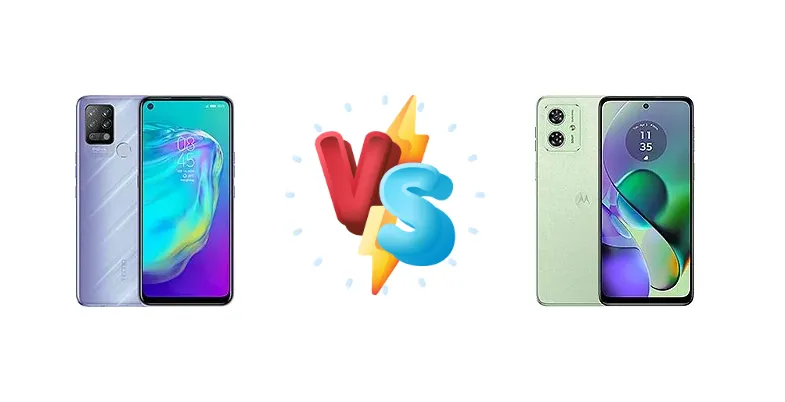
The sub-$200 smartphone market is fiercely competitive. The Tecno Pova, a long-standing player, faces a new challenger in the Motorola Moto G54. While both aim to deliver value, they take drastically different approaches to achieving it, primarily through their chipset choices. This comparison dissects those differences and reveals which phone offers the best experience for your money.
🏆 Quick Verdict
For most users, the Motorola Moto G54 emerges as the superior choice. Its Mediatek Dimensity 7020, built on a more efficient 6nm process, delivers significantly better performance and future-proofing than the Tecno Pova’s Helio G80. While the Pova offers slightly faster wired charging, the G54’s overall package is more compelling.
| Network |
|---|
| 2G bands | GSM 850 / 900 / 1800 / 1900 | GSM 850 / 900 / 1800 / 1900 |
| 3G bands | HSDPA 850 / 900 / 2100 | HSDPA 850 / 900 / 1900 / 2100 |
| 4G bands | 1, 3, 5, 8, 38, 40, 41 | 1, 2, 3, 5, 7, 8, 20, 26, 28, 32, 38, 40, 41, 42 |
| 5G bands | - | 1, 3, 5, 7, 8, 20, 26, 28, 38, 40, 41, 77, 78 SA/NSA |
| Speed | HSPA, LTE | HSPA, LTE, 5G |
| Technology | GSM / HSPA / LTE | GSM / HSPA / LTE / 5G |
| Launch |
|---|
| Announced | 2020, October 03. Released 2020, October 16 | 2023, September 05 |
| Status | Discontinued | Available. Released 2023, September 05 |
| Body |
|---|
| Build | - | Glass front, plastic back or silicone polymer back (eco leather), plastic frame |
| Dimensions | 171.2 x 77.6 x 9.4 mm (6.74 x 3.06 x 0.37 in) | 161.6 x 73.8 x 8 mm (6.36 x 2.91 x 0.31 in) |
| SIM | Nano-SIM + Nano-SIM | · Nano-SIM + eSIM· Nano-SIM + Nano-SIM |
| Weight | - | 177 g (6.24 oz) |
| Display |
|---|
| Resolution | 720 x 1640 pixels (~263 ppi density) | 1080 x 2400 pixels, 20:9 ratio (~405 ppi density) |
| Size | 6.8 inches, 109.8 cm2 (~82.7% screen-to-body ratio) | 6.5 inches, 102.0 cm2 (~85.5% screen-to-body ratio) |
| Type | IPS LCD, 480 nits (peak) | IPS LCD, 120Hz |
| Platform |
|---|
| CPU | Octa-core (2x2.0 GHz Cortex-A75 & 6x1.8 GHz Cortex-A55) | Octa-core (2x2.2 GHz Cortex-A78 & 6x2.0 GHz Cortex-A55) |
| Chipset | Mediatek MT6769V/CU Helio G80 (12 nm) | Mediatek Dimensity 7020 (6 nm) |
| GPU | Mali-G52 MC2 | IMG BXM-8-256 |
| OS | Android 10, HIOS 7.0 | Android 13, upgradable to Android 15 |
| Memory |
|---|
| Card slot | microSDXC (dedicated slot) | microSDXC (dedicated slot) - InternationalmicroSDXC (uses shared SIM slot) - China |
| Internal | 64GB 4GB RAM, 128GB 6GB RAM | 128GB 4GB RAM, 128GB 8GB RAM, 256GB 4GB RAM, 256GB 8GB RAM, 256GB 12GB RAM |
| Main Camera |
|---|
| Dual | - | 50 MP, f/1.8 (wide), 0.61µm, PDAF, OIS
2 MP (macro) |
| Features | Quad-LED flash | Dual-LED dual-tone flash, HDR, panorama |
| Quad | 13 MP or 16 MP, f/1.9, (wide), PDAF
2 MP (macro)
Auxiliary lenses | - |
| Video | 1440p@30fps, 1080p@30fps | 1080p@30/60fps |
| Selfie camera |
|---|
| Features | Dual-LED flash | HDR |
| Single | 8 MP, f/2.0 | 16 MP, f/2.4, (wide), 1.0µm |
| Video | 1080p@30fps | 1080p@30fps |
| Sound |
|---|
| 3.5mm jack | Yes | - |
| 35mm jack | Yes | Yes |
| Loudspeaker | Yes | Yes, with stereo speakers |
| Comms |
|---|
| Bluetooth | 5.0, A2DP, LE | 5.3, A2DP, LE |
| NFC | No | Yes |
| Positioning | GPS, GALILEO, BDS | GPS, GLONASS, GALILEO, BDS, QZSS |
| Radio | FM radio | FM radio (market/region dependent) |
| USB | microUSB 2.0, OTG | USB Type-C 2.0, OTG |
| WLAN | Wi-Fi 802.11 a/b/g/n/ac, dual-band | Wi-Fi 802.11 a/b/g/n/ac, dual-band |
| Features |
|---|
| Sensors | Fingerprint (rear-mounted), accelerometer, proximity, compass | Fingerprint (side-mounted), accelerometer, gyro, proximity, compass |
| Battery |
|---|
| Charging | 18W wired | 15W wired
Reverse wired |
| Type | 6000 mAh | Li-Po 5000 mAh |
| Misc |
|---|
| Colors | Magic Blue, Speed Purple, Dazzle Black | Midnight blue, Indigo blue, Glacier blue, Mint green |
| Models | LD7, LD7j, MZ-TECNO LD7 | XT2343-1, XT2343-2 |
| Price | About 110 EUR | € 147.00 / $ 189.99 / £ 161.57 |
Tecno Pova
- Faster 18W wired charging
- Potentially longer battery life (depending on capacity)
- Generally more affordable
- Older, less efficient Helio G80 chipset
- Inferior CPU performance
- Likely weaker camera image processing
Motorola Moto G54
- More powerful and efficient Dimensity 7020 chipset
- Superior CPU performance for gaming and multitasking
- Reverse wired charging capability
- Slightly slower 15W wired charging
- May be marginally more expensive
- Potentially smaller battery capacity
Display Comparison
Neither device boasts a standout display. Both likely utilize LCD panels, a common cost-saving measure in this segment. However, the Moto G54’s chipset allows for potentially better image processing, leading to slightly more vibrant colors. The Pova’s display specs are not available, but given its price point, it’s unlikely to surpass the G54 in brightness or color accuracy. Bezels are expected to be similar on both, prioritizing affordability over premium aesthetics.
Camera Comparison
Without detailed camera specs, a direct comparison is difficult. However, the chipset difference indirectly impacts camera performance. The Dimensity 7020’s image signal processor (ISP) is more advanced, enabling better noise reduction, dynamic range, and overall image quality. It’s likely the G54 will produce sharper, more detailed photos, especially in challenging lighting conditions. The Pova’s Helio G80 ISP is adequate for basic photography, but will struggle to compete with the G54’s processing capabilities. The presence of a 2MP macro camera on either device is largely irrelevant; image quality from these sensors is typically poor.
Performance
This is where the G54 truly shines. The Mediatek Dimensity 7020, fabricated on a 6nm process, represents a significant leap over the Tecno Pova’s 12nm Helio G80. The Dimensity 7020’s CPU features 2x2.2 GHz Cortex-A78 cores, a more modern and powerful architecture than the Pova’s 2x2.0 GHz Cortex-A75 cores. This translates to faster app loading times, smoother multitasking, and a more enjoyable gaming experience. The 6nm process also contributes to better thermal efficiency, reducing the likelihood of throttling during sustained workloads. While both phones feature 6x Cortex-A55 efficiency cores, the Dimensity 7020’s superior architecture and process node give it a clear advantage.
Battery Life
The Tecno Pova features 18W wired charging, while the Moto G54 offers 15W. While the Pova charges slightly faster, the G54 compensates with reverse wired charging, allowing it to act as a power bank for other devices. The actual battery capacity of both devices is not specified, but the Dimensity 7020’s 6nm efficiency means the G54 will likely achieve comparable, if not better, real-world battery life despite potentially having a smaller battery cell. The difference in charging speed is unlikely to be a major factor for most users.
Buying Guide
Buy the Tecno Pova if your primary need is maximizing battery life and you prioritize a slightly faster charging speed over raw processing power. It’s a reasonable option for very light users who primarily browse social media and make calls. Buy the Motorola Moto G54 if you value a smoother, more responsive user experience, better gaming capabilities, and the added convenience of reverse wireless charging. It’s the better choice for anyone who wants a phone that can handle more demanding tasks without significant slowdowns.
Frequently Asked Questions
❓ Does the Mediatek Dimensity 7020 in the Moto G54 get hot during extended gaming sessions?
The Dimensity 7020’s 6nm process is significantly more thermally efficient than the Helio G80. While some heat generation is inevitable during gaming, the G54 is less prone to throttling and maintains higher sustained performance levels compared to the Pova. Expect playable frame rates for most popular titles, but demanding games at maximum settings may still cause some temperature increase.
❓ Is the reverse wired charging feature on the Moto G54 useful in everyday scenarios?
Yes, reverse wired charging is a surprisingly practical feature. It allows you to use the Moto G54 as a power bank to charge accessories like wireless earbuds, smartwatches, or even another smartphone in an emergency. While the charging speed isn’t incredibly fast, it can be a lifesaver when you’re away from a power outlet.
❓ How does the Helio G80 in the Tecno Pova handle multitasking compared to the Dimensity 7020?
The Helio G80 will struggle with heavy multitasking. Switching between multiple apps will likely result in noticeable lag and app reloading. The Dimensity 7020, with its more powerful CPU and improved memory management, handles multitasking far more smoothly, allowing you to run multiple apps simultaneously without significant performance degradation.