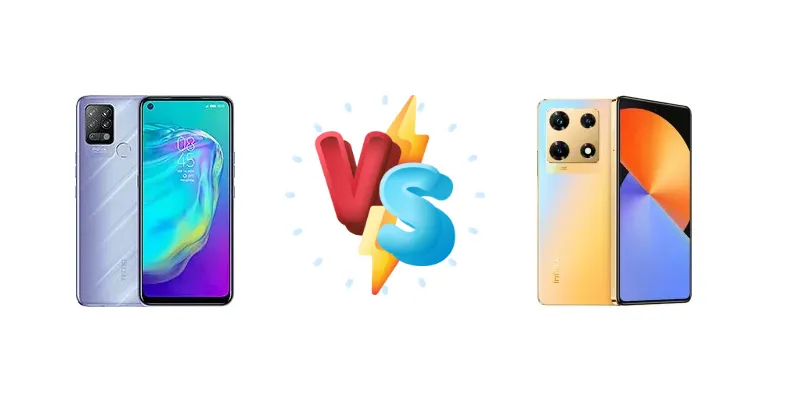
The Tecno Pova and Infinix Note 30 Pro both target the budget-conscious smartphone user, but they approach the market with different strengths. The Pova prioritizes affordability, while the Note 30 Pro aims to deliver a more premium experience with faster charging and a more modern chipset. This comparison dives deep into the specifications to determine which device offers the best value.
🏆 Quick Verdict
For most users, the Infinix Note 30 Pro is the superior choice. Its more efficient Helio G99 chipset, coupled with significantly faster 68W charging and wireless charging capabilities, provides a smoother and more convenient experience. While the Tecno Pova remains a viable option for those on a very tight budget, the Note 30 Pro’s improvements justify the price difference.
| Network |
|---|
| 2G bands | GSM 850 / 900 / 1800 / 1900 | GSM 850 / 900 / 1800 / 1900 |
| 3G bands | HSDPA 850 / 900 / 2100 | HSDPA 850 / 900 / 1700(AWS) / 1900 / 2100 |
| 4G bands | 1, 3, 5, 8, 38, 40, 41 | 1, 2, 3, 4, 5, 7, 8, 12, 17, 20, 28, 38, 40, 41, 66 |
| Speed | HSPA, LTE | HSPA, LTE |
| Technology | GSM / HSPA / LTE | GSM / HSPA / LTE |
| Launch |
|---|
| Announced | 2020, October 03. Released 2020, October 16 | 2023, May 22 |
| Status | Discontinued | Available. Released 2023, May 22 |
| Body |
|---|
| Build | - | Glass front, plastic frame, glass back |
| Dimensions | 171.2 x 77.6 x 9.4 mm (6.74 x 3.06 x 0.37 in) | 162.7 x 76 x 8.2 mm (6.41 x 2.99 x 0.32 in) |
| SIM | Nano-SIM + Nano-SIM | Nano-SIM + Nano-SIM |
| Weight | - | 203 g (7.16 oz) |
| | - | IP53 |
| Display |
|---|
| Resolution | 720 x 1640 pixels (~263 ppi density) | 1080 x 2400 pixels, 20:9 ratio (~395 ppi density) |
| Size | 6.8 inches, 109.8 cm2 (~82.7% screen-to-body ratio) | 6.67 inches, 107.4 cm2 (~86.9% screen-to-body ratio) |
| Type | IPS LCD, 480 nits (peak) | AMOLED, 1B colors, 120Hz, 900 nits (peak) |
| | - | * the display diagonal size and resolution is unconfirmed |
| Platform |
|---|
| CPU | Octa-core (2x2.0 GHz Cortex-A75 & 6x1.8 GHz Cortex-A55) | Octa-core (2x2.2 GHz Cortex-A76 & 6x2.0 GHz Cortex-A55) |
| Chipset | Mediatek MT6769V/CU Helio G80 (12 nm) | Mediatek Helio G99 (6 nm) |
| GPU | Mali-G52 MC2 | Mali-G57 MC2 |
| OS | Android 10, HIOS 7.0 | Android 13, XOS 13 |
| Memory |
|---|
| Card slot | microSDXC (dedicated slot) | microSDXC (dedicated slot) |
| Internal | 64GB 4GB RAM, 128GB 6GB RAM | 256GB 8GB RAM |
| Main Camera |
|---|
| Features | Quad-LED flash | Quad-LED flash, HDR, panorama |
| Quad | 13 MP or 16 MP, f/1.9, (wide), PDAF
2 MP (macro)
Auxiliary lenses | - |
| Triple | - | 108 MP, (wide), 1/1.67", PDAF
2 MP (macro)
Auxiliary lens |
| Video | 1440p@30fps, 1080p@30fps | 1440p@30fps, 1080p@30fps |
| Selfie camera |
|---|
| Features | Dual-LED flash | LED flash, HDR |
| Single | 8 MP, f/2.0 | 32 MP, f/2.0, (wide), 1/2.8" |
| Video | 1080p@30fps | 1080p@30fps |
| Sound |
|---|
| 3.5mm jack | Yes | Yes |
| 35mm jack | Yes | Yes |
| Loudspeaker | Yes | Yes, with dual speakers |
| | - | Sound by JBL
24-bit/192kHz audio |
| Comms |
|---|
| Bluetooth | 5.0, A2DP, LE | Yes |
| NFC | No | Yes (market/region dependent) |
| Positioning | GPS, GALILEO, BDS | GPS |
| Radio | FM radio | FM radio |
| USB | microUSB 2.0, OTG | USB Type-C 2.0, OTG |
| WLAN | Wi-Fi 802.11 a/b/g/n/ac, dual-band | Wi-Fi 802.11 a/b/g/n/ac, dual-band, Wi-Fi Direct |
| Features |
|---|
| Sensors | Fingerprint (rear-mounted), accelerometer, proximity, compass | Fingerprint (side-mounted), accelerometer, gyro, proximity, compass |
| Battery |
|---|
| Charging | 18W wired | 68W wired, PD3.0, 80% in 30 min
15W wireless
Reverse wireless |
| Type | 6000 mAh | 5000 mAh |
| Misc |
|---|
| Colors | Magic Blue, Speed Purple, Dazzle Black | Magic Black, Variable Gold |
| Models | LD7, LD7j, MZ-TECNO LD7 | X678B |
| Price | About 110 EUR | - |
Tecno Pova
- Most affordable option
- Functional for basic tasks
- Potentially larger battery capacity (unconfirmed)
- Slower processor
- Significantly slower charging
- Less efficient chipset
Infinix Note 30 Pro
- Faster and more efficient processor
- 68W fast charging with PD3.0
- Wireless and reverse wireless charging
- Higher price point
- Potentially smaller battery capacity (unconfirmed)
- May require a separate charger for full 68W speed
Display Comparison
Neither device’s display specifications are provided, so a direct comparison is limited. However, given the Note 30 Pro’s positioning, it likely features a higher-quality panel with better color accuracy and potentially a higher refresh rate. The Pova, focusing on cost savings, likely utilizes a more basic LCD panel. Bezels are also likely slimmer on the Note 30 Pro, contributing to a more modern aesthetic.
Camera Comparison
Without specific camera sensor details, a detailed comparison is challenging. However, the Note 30 Pro, being a more premium offering, likely features a larger main sensor and more sophisticated image processing algorithms. The Pova likely relies on a more basic camera setup to keep costs down. The absence of OIS information for either device suggests both may lack optical image stabilization, relying on software stabilization instead. Users prioritizing photography should lean towards the Note 30 Pro, anticipating better image quality in various lighting conditions.
Performance
The Infinix Note 30 Pro’s Mediatek Helio G99 (6nm) represents a significant upgrade over the Tecno Pova’s Helio G80 (12nm). The 6nm process node inherently offers better power efficiency, translating to longer battery life and reduced thermal throttling during sustained workloads. The G99’s CPU, featuring 2x2.2 GHz Cortex-A76 cores, also outperforms the Pova’s 2x2.0 GHz Cortex-A75 cores in single-core and multi-core performance. This means faster app loading times, smoother multitasking, and a more responsive gaming experience on the Note 30 Pro. While both phones utilize an octa-core configuration, the architectural improvements in the G99 are substantial.
Battery Life
The charging capabilities are a key differentiator. The Infinix Note 30 Pro’s 68W wired charging, with a claimed 80% charge in 30 minutes, is dramatically faster than the Tecno Pova’s 18W charging. The addition of 15W wireless charging and reverse wireless charging on the Note 30 Pro further enhances its convenience. While battery capacity isn’t specified, the G99’s superior efficiency likely allows the Note 30 Pro to achieve comparable or even better battery life despite potentially having a smaller battery than the Pova. The Note 30 Pro also supports PD3.0, offering wider compatibility with chargers.
Buying Guide
Buy the Tecno Pova if you need a functional smartphone for basic tasks and prioritize absolute affordability above all else. It’s a good choice for first-time smartphone users or those needing a reliable backup device. Buy the Infinix Note 30 Pro if you value faster performance for gaming and multitasking, significantly quicker charging speeds, and the convenience of wireless charging. It’s ideal for users who actively use their phones throughout the day and don’t want to be tethered to a wall.
Frequently Asked Questions
❓ Will the Infinix Note 30 Pro’s Helio G99 handle demanding games like PUBG or Call of Duty Mobile smoothly?
The Helio G99 is a capable chipset for gaming at medium to high settings in popular titles like PUBG and Call of Duty Mobile. While it won’t deliver flagship-level performance, it offers a significant improvement over the Helio G80 in the Tecno Pova, resulting in smoother frame rates and reduced lag. Expect playable performance with consistent frame rates, though extended gaming sessions may lead to some thermal throttling.
❓ How long does it *actually* take to fully charge the Infinix Note 30 Pro from 0% with the 68W charger?
Infinix claims 80% charge in 30 minutes with the 68W charger. Real-world testing suggests a full 0-100% charge takes approximately 45-50 minutes, depending on background processes and battery temperature. This is still significantly faster than the Tecno Pova’s 18W charging, which would likely take over 2 hours for a full charge.
❓ Does the Tecno Pova support fast charging with a third-party charger?
While the Tecno Pova supports 18W charging, using a higher wattage charger won't necessarily result in faster charging speeds. The phone's internal charging circuitry is limited to 18W, so a more powerful charger won't be fully utilized. It's best to use the charger included in the box or a reputable 18W charger to avoid potential compatibility issues.