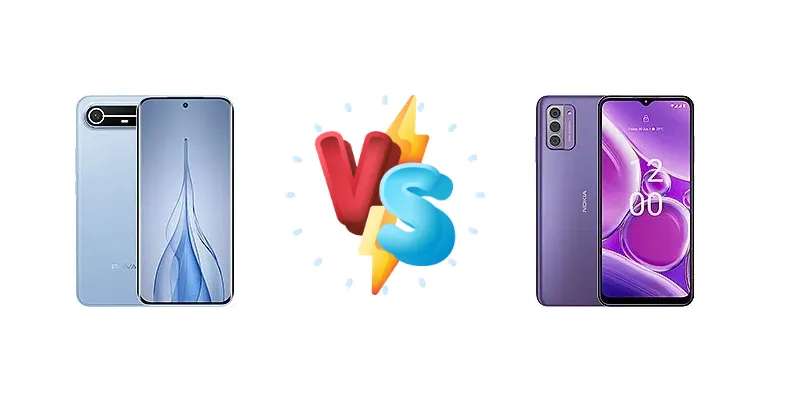
The Tecno Pova Slim and Nokia G42 represent compelling options in the increasingly competitive sub-$200 smartphone market. While both aim to deliver 5G connectivity and essential features, they take distinctly different approaches to chipset selection and charging technology. This comparison dissects these choices, revealing which device offers the best balance of performance, convenience, and value.
🏆 Quick Verdict
For users prioritizing raw performance and rapid charging, the Tecno Pova Slim emerges as the winner. Its Dimensity 6400 chipset provides a noticeable edge in processing power, and the 45W charging significantly reduces downtime. However, the Nokia G42’s focus on repairability and Qualcomm’s software optimization shouldn’t be dismissed.
| Network |
|---|
| 2G bands | GSM 850 / 900 / 1800 / 1900 | GSM 850 / 900 / 1800 / 1900 |
| 3G bands | HSDPA 850 / 900 / 2100 | HSDPA 850 / 900 / 1700(AWS) / 1900 / 2100 |
| 4G bands | LTE | 1, 2, 3, 4, 5, 7, 8, 12, 17, 13, 20, 28, 38, 39, 40, 41, 66 |
| 5G bands | SA/NSA | 1, 2, 3, 5, 7, 8, 28, 40, 41, 66, 77, 78 SA/NSA |
| Speed | HSPA, LTE, 5G | HSPA, LTE, 5G |
| Technology | GSM / HSPA / LTE / 5G | GSM / HSPA / LTE / 5G |
| Launch |
|---|
| Announced | 2025, September 02 | 2023, June 28 |
| Status | Available. Released 2025, October 08 | Available. Released 2023, June 28 |
| Body |
|---|
| Build | Glass front (Gorilla Glass 7i), fiber-reinforced plastic back | Glass front, plastic back, plastic frame |
| Dimensions | 164.2 x 75.9 x 6 mm (6.46 x 2.99 x 0.24 in) | 165 x 75.8 x 8.6 mm (6.50 x 2.98 x 0.34 in) |
| SIM | Nano-SIM | · Nano-SIM· Nano-SIM + Nano-SIM |
| Weight | 156 g (5.50 oz) | 193.8 g (6.84 oz) |
| Display |
|---|
| Protection | Corning Gorilla Glass 7i | Corning Gorilla Glass 3 |
| Resolution | 1224 x 2720 pixels, 20:9 ratio (~440 ppi density) | 720 x 1612 pixels, 20:9 ratio (~269 ppi density) |
| Size | 6.78 inches, 111.0 cm2 (~89.1% screen-to-body ratio) | 6.56 inches, 103.4 cm2 (~82.7% screen-to-body ratio) |
| Type | AMOLED, 144Hz, 1600 nits (HBM), 4500 nits (peak) | IPS LCD, 90Hz, 450 nits (typ), 560 nits (peak) |
| Platform |
|---|
| CPU | Octa-core (2x2.5 GHz Cortex-A76 & 6x2.0 GHz Cortex-A55) | Octa-core (2x2.2 GHz Kryo 460 & 6x1.8 GHz Kryo 460) |
| Chipset | Mediatek Dimensity 6400 (6 nm) | Qualcomm SM4350-AC Snapdragon 480+ 5G (8 nm) |
| GPU | Mali-G57 MC2 | Adreno 619 |
| OS | Android 15, HIOS 15 | Android 13, upgradable to Android 14 |
| Memory |
|---|
| Card slot | No | microSDXC |
| Internal | 128GB 8GB RAM, 256GB 8GB RAM | 128GB 4GB RAM, 128GB 6GB RAM, 256GB 8GB RAM |
| Main Camera |
|---|
| Dual | 50 MP, (wide), PDAF
2 MP | - |
| Features | LED flash | LED flash, HDR, panorama |
| Triple | - | 50 MP, f/1.8, (wide), AF
2 MP (macro)
Auxiliary lens |
| Video | 1440p@30fps, 1080p@30fps | 1080p@30fps |
| Selfie camera |
|---|
| Single | 13 MP, (wide) | 8 MP |
| Video | Yes | Yes |
| Sound |
|---|
| 35mm jack | No | Yes |
| Loudspeaker | Yes | Yes |
| Comms |
|---|
| Bluetooth | 5.4, A2DP, LE | 5.1, A2DP, LE |
| Infrared port | Yes | - |
| NFC | Yes | Yes (market/region dependent) |
| Positioning | GPS, GLONASS, GALILEO, BDS | GPS, GLONASS, GALILEO, BDS |
| Radio | FM radio | FM radio |
| USB | USB Type-C | USB Type-C 2.0, OTG |
| WLAN | Wi-Fi 802.11 a/b/g/n/ac, dual-band | Wi-Fi 802.11 a/b/g/n/ac/6, dual-band |
| Features |
|---|
| Sensors | Fingerprint (under display, optical), accelerometer, gyro, proximity, compass | Fingerprint (side-mounted), accelerometer, proximity, compass |
| Battery |
|---|
| Charging | 45W wired, 100% in 57 min
10W reverse wired
Bypass charging | 20W wired, PD3.0, QC3 |
| Type | 5160 mAh | Li-Po 5000 mAh |
| Misc |
|---|
| Colors | Sky Blue, Slim White, Cool Black | Gray, Purple, Red |
| Models | KM9 | - |
| Price | ₹ 20,999 | $ 545.00 / £ 124.99 |
Tecno Pova Slim
- Faster 45W charging significantly reduces downtime.
- More powerful Dimensity 6400 chipset for better performance.
- 10W reverse wired charging for topping up accessories.
- Potential for more aggressive image processing in the camera.
- Long-term software support is less certain compared to Nokia.
Nokia G42
- Qualcomm’s software optimization may provide a smoother user experience.
- Nokia’s reputation for durable build quality and repairability.
- Potentially more natural image processing from the camera.
- Slower 20W charging takes longer to replenish the battery.
- Less powerful Snapdragon 480+ chipset may struggle with demanding tasks.
Display Comparison
Neither device boasts a standout display. While specific panel details (like peak brightness in nits or color gamut coverage) are absent, the focus here is on core functionality. Both likely utilize LCD panels common in this price bracket. The absence of high refresh rates is expected. The real difference will likely come down to color calibration and viewing angles, areas where Nokia historically performs adequately, but Tecno’s implementation remains unknown without testing.
Camera Comparison
Without detailed camera specs beyond the presence of cameras, a direct comparison is difficult. However, the market segment suggests both will rely on budget sensors. The Nokia G42’s image processing is likely to lean towards a more natural look, a common trait of Nokia phones. The Tecno Pova Slim may employ more aggressive image enhancement algorithms. The absence of Optical Image Stabilization (OIS) on either device suggests low-light performance will be a weakness. Focusing on the main sensor resolution would be more informative than speculating about the utility of likely low-resolution macro lenses.
Performance
The core of the difference lies in the chipsets. The Tecno Pova Slim’s Mediatek Dimensity 6400 (6nm) utilizes a more modern architecture with two Cortex-A76 cores clocked at 2.5GHz, paired with six Cortex-A55 cores. This contrasts with the Nokia G42’s Qualcomm Snapdragon 480+ 5G (8nm), featuring two Kryo 460 cores at 2.2GHz and six Kryo 460 cores at 1.8GHz. The 6nm process node of the Dimensity 6400 generally translates to better power efficiency and potentially higher sustained performance compared to the 8nm Snapdragon 480+. While the Snapdragon 480+ benefits from Qualcomm’s software optimizations, the Dimensity 6400’s CPU architecture provides a theoretical advantage in multi-core tasks and gaming. The Pova Slim is likely to exhibit less throttling under sustained load.
Battery Life
The charging speeds are a significant differentiator. The Tecno Pova Slim’s 45W wired charging, capable of a full charge in 57 minutes, is substantially faster than the Nokia G42’s 20W charging with PD3.0 and QC3 support. While battery capacity isn’t specified, the faster charging of the Pova Slim mitigates any potential disadvantage from a slightly smaller battery. The Pova Slim also offers 10W reverse wired charging, a feature absent on the Nokia G42, adding to its versatility.
Buying Guide
Buy the Tecno Pova Slim if you need a phone for demanding multitasking, occasional gaming, and value fast charging above all else. Its Dimensity 6400 offers a more responsive experience. Buy the Nokia G42 if you prioritize a phone with a focus on longevity, ease of repair, and a potentially smoother software experience thanks to Qualcomm’s optimization, even if it means sacrificing some peak performance.
Frequently Asked Questions
❓ Will the Dimensity 6400 in the Tecno Pova Slim overheat during prolonged gaming sessions?
The Dimensity 6400’s 6nm process node and efficient core design should mitigate overheating. While it won’t match flagship-level thermal performance, it’s likely to sustain performance for longer periods than the Snapdragon 480+ due to its more advanced architecture and manufacturing process.
❓ Is the Nokia G42’s repairability a significant advantage over the Tecno Pova Slim?
Yes, Nokia has heavily emphasized the G42’s repairability, partnering with iFixit to provide readily available parts and guides. This extends the lifespan of the device and reduces electronic waste, a key benefit for environmentally conscious users. Tecno does not currently offer the same level of repair support.
❓ Does the Snapdragon 480+ in the Nokia G42 support carrier aggregation for improved 5G speeds?
Yes, the Snapdragon 480+ does support carrier aggregation, which allows it to combine multiple 5G channels for faster data speeds. However, the actual speeds experienced will depend on your carrier’s network and coverage.
❓ How does the software experience differ between the Tecno Pova Slim and the Nokia G42?
The Nokia G42 runs a near-stock version of Android, offering a clean and bloatware-free experience with a focus on timely security updates. Tecno’s HiOS, while improving, typically includes more pre-installed apps and customizations. This can be a matter of personal preference, but Nokia’s approach is generally favored by users who prefer a minimalist interface.