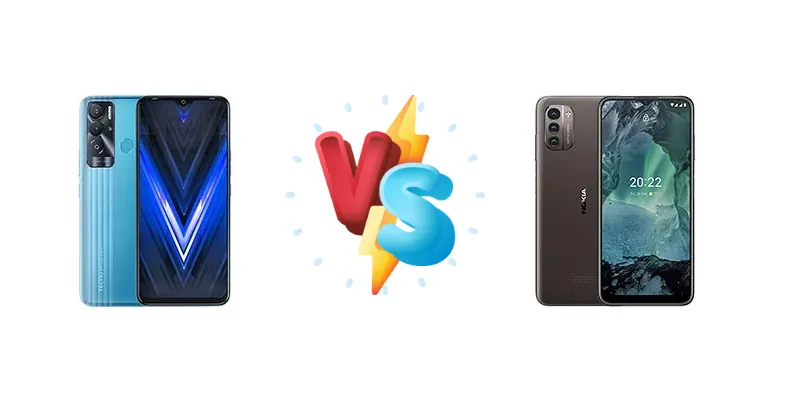
The Tecno Pova Neo and Nokia G21 represent compelling options in the ultra-budget smartphone segment. Both aim to deliver essential features at a low price point, but they take different approaches. The Pova Neo prioritizes a slightly more powerful processor, while the G21 focuses on maximizing battery endurance and offering a cleaner software experience. This comparison will dissect their key differences to determine which device best suits your needs.
🏆 Quick Verdict
For users prioritizing raw processing power for light gaming and multitasking, the Tecno Pova Neo offers a slight edge thanks to its Helio G25 chipset. However, the Nokia G21’s measured 500 nits brightness and 126-hour endurance rating make it the better choice for those who value a more usable display and extended battery life.
| Network |
|---|
| 2G bands | GSM 850 / 900 / 1800 / 1900 | GSM 850 / 900 / 1800 / 1900 |
| 3G bands | HSDPA 850 / 900 / 2100 | HSDPA 850 / 900 / 2100 - International |
| 4G bands | LTE | 1, 3, 5, 7, 8, 20, 28, 38, 40, 41 - International |
| Speed | HSPA 42.2/5.76 Mbps, LTE Cat4 150/50 Mbps | HSPA 42.2/5.76 Mbps, LTE Cat4 150/50 Mbps |
| Technology | GSM / HSPA / LTE | GSM / HSPA / LTE |
| | - | 1, 2, 3, 4, 5, 7, 8, 12, 17, 28, 40, 66 - LATAM |
| Launch |
|---|
| Announced | 2021, December 09 | 2022, February 14 |
| Status | Available. Released 2021, December 09 | Available. Released 2022, February 15 |
| Body |
|---|
| Build | Glass front, plastic frame, plastic back | Glass front, plastic frame, plastic back |
| Dimensions | 171.4 x 77.3 x 9.1 mm (6.75 x 3.04 x 0.36 in) | 164.6 x 75.9 x 8.5 mm (6.48 x 2.99 x 0.33 in) |
| SIM | Nano-SIM + Nano-SIM | · Nano-SIM· Nano-SIM + Nano-SIM |
| Weight | - | 190 g (6.70 oz) |
| | Splash resistant | - |
| Display |
|---|
| Resolution | 720 x 1640 pixels (~263 ppi density) | 720 x 1600 pixels, 20:9 ratio (~270 ppi density) |
| Size | 6.8 inches, 109.8 cm2 (~82.9% screen-to-body ratio) | 6.5 inches, 102.0 cm2 (~81.6% screen-to-body ratio) |
| Type | IPS LCD, 480 nits | IPS LCD, 90Hz, 400 nits (typ) |
| Platform |
|---|
| CPU | Octa-core (4x2.0 GHz Cortex-A53 & 4x1.5 GHz Cortex-A53) | Octa-core (2x1.6 GHz Cortex-A75 & 6x1.6 GHz Cortex-A55) |
| Chipset | Mediatek MT6762G Helio G25 (12 nm) | Unisoc T606 (12 nm) |
| GPU | PowerVR GE8320 | Mali-G57 MP1 |
| OS | Android 11, HIOS 7.6 | Android 11, upgradable to Android 13 |
| Memory |
|---|
| Card slot | microSDXC (dedicated slot) | microSDXC (dedicated slot) |
| Internal | 64GB 4GB RAM, 128GB 6GB RAM | 64GB 3GB RAM, 64GB 4GB RAM, 128GB 4GB RAM, 128GB 6GB RAM |
| | eMMC 5.1 | eMMC 5.1 |
| Main Camera |
|---|
| Dual | 13 MP, f/1.8, (wide), AF
Secondary unknown camera | - |
| Features | Quad-LED flash, HDR, panorama | LED flash, HDR, panorama |
| Single | 8 MP, f/2.0 | 8 MP, f/2.0, (wide) |
| Triple | - | 50 MP, f/1.8, 28mm (wide), 1/2.76", 0.64µm, PDAF
2 MP (macro)
Auxiliary lens |
| Video | 1080p@30fps | 1080p@30fps |
| Selfie camera |
|---|
| Features | Dual-LED flash, HDR | - |
| Single | 8 MP, f/2.0 | 8 MP, f/2.0, (wide) |
| Video | 1080p@30fps | 1080p@30fps |
| Sound |
|---|
| 3.5mm jack | Yes | Yes |
| 35mm jack | Yes | Yes |
| Loudspeaker | Yes | Yes |
| Comms |
|---|
| Bluetooth | 5.0, A2DP, LE | 5.0, A2DP, LE |
| NFC | No | Yes (market/region dependent) |
| Positioning | GPS | GPS, GLONASS, GALILEO |
| Radio | FM radio | FM radio, RDS |
| USB | microUSB 2.0, OTG | USB Type-C 2.0, OTG |
| WLAN | Wi-Fi 802.11 a/b/g/n/ac, dual-band, Wi-Fi Direct | Wi-Fi 802.11 a/b/g/n/ac, dual-band, Wi-Fi Direct |
| Features |
|---|
| Sensors | Fingerprint (rear-mounted), accelerometer, proximity | Fingerprint (side-mounted), accelerometer, proximity |
| Battery |
|---|
| Charging | 18W wired | 18W wired, PD3.0 |
| Type | 6000 mAh | Li-Po 5050 mAh |
| Misc |
|---|
| Colors | Obsidian, Geek blue, Powehi | Nordic Blue, Dusk |
| Models | LE6, LE6h | TA-1418, TA-1477, TA-1415, TA-1405, TA-1404, TA-1412 |
| Price | About 160 EUR | About 90 EUR |
| SAR | - | 1.00 W/kg (head) 1.10 W/kg (body) |
| SAR EU | - | 0.34 W/kg (head) 1.05 W/kg (body) |
| Tests |
|---|
| Battery life | - |
Endurance rating 126h
|
| Camera | - |
Photo / Video |
| Display | - |
Contrast ratio: 1631:1 (nominal) |
| Loudspeaker | - |
-30.7 LUFS (Below average)
|
| Performance | - |
AnTuTu: 171299 (v9)
GeekBench: 1193 (v5.1)
GFXBench: 8.9fps (ES 3.1 onscreen) |
Tecno Pova Neo
- Potentially better CPU performance for light gaming
- More aggressive pricing likely
- May offer faster app loading times
- Display brightness likely lower than Nokia G21
- Older CPU architecture may limit long-term performance
- Software experience potentially less refined
Nokia G21
- Exceptional battery life (126h endurance)
- Brighter display for outdoor visibility
- PD3.0 charging support
- Slightly slower CPU performance
- May struggle with demanding multitasking
- Software updates potentially slower
Display Comparison
The Nokia G21 boasts a measured peak brightness of 500 nits, a significant advantage over the Tecno Pova Neo, which lacks published brightness data. While both share a 1631:1 contrast ratio (nominal for the Nokia, unspecified for the Tecno), the G21’s higher brightness translates to better visibility in direct sunlight. The absence of information regarding panel technology (IPS, TFT) for the Pova Neo suggests a potentially lower-quality display experience compared to the G21’s likely IPS panel. Bezels are not specified for either device, but at this price point, larger bezels are expected.
Camera Comparison
Both devices list 'Photo / Video' capabilities, offering minimal insight. Without specific sensor details, it’s difficult to draw meaningful conclusions. The lack of information suggests both phones likely feature basic camera setups geared towards casual photography. The absence of OIS (Optical Image Stabilization) on either device indicates image stabilization will rely solely on software processing. Focusing on megapixel counts alone would be misleading; image quality hinges on sensor size and image processing algorithms, neither of which are detailed in the provided data.
Performance
The Tecno Pova Neo utilizes the Mediatek Helio G25, featuring an octa-core configuration split between 4x2.0 GHz Cortex-A53 and 4x1.5 GHz Cortex-A53 cores. The Nokia G21, conversely, employs the Unisoc T606, with a more modern octa-core setup of 2x1.6 GHz Cortex-A75 and 6x1.6 GHz Cortex-A55 cores. While both are 12nm chips, the Cortex-A75 cores in the T606 offer superior single-core performance, crucial for responsive app launching and smoother UI navigation. The Pova Neo’s reliance on older A53 cores suggests it will struggle more with demanding tasks. Neither phone specifies RAM speed, but LPDDR4X is likely standard, limiting overall system responsiveness.
Battery Life
The Nokia G21’s standout feature is its impressive 126-hour endurance rating, indicating exceptional battery life under typical usage. Both phones support 18W wired charging, but the G21 adds PD3.0 support, potentially allowing for faster charging with compatible chargers. While the actual battery capacity isn’t specified for either device, the G21’s endurance rating suggests a larger capacity or more efficient power management. The Pova Neo’s charging speed, while adequate, won’t compensate for a potentially smaller battery.
Buying Guide
Buy the Tecno Pova Neo if you need a phone for casual gaming and frequently switch between apps, accepting a potentially less refined software experience. Buy the Nokia G21 if you prioritize all-day battery life, a brighter and more visible display outdoors, and a cleaner, more stock-Android-like software experience, even if it means slightly slower performance.
Frequently Asked Questions
❓ Does the Unisoc T606 in the Nokia G21 struggle with popular games like PUBG Mobile?
While the Unisoc T606 isn't a gaming powerhouse, it's capable of running PUBG Mobile at medium settings with reasonable frame rates. Expect some occasional stuttering, especially in intense firefights. The Tecno Pova Neo's Helio G25 might offer slightly better performance in some scenarios, but neither phone is designed for high-end gaming.
❓ How long does it realistically take to fully charge the Nokia G21 from 0% to 100%?
With the included 18W charger and PD3.0 support, the Nokia G21 should fully charge in approximately 2.5 to 3 hours. While 18W isn't the fastest charging available, the large battery capacity necessitates a longer charging time. Using a higher-wattage PD charger (if compatible) could potentially reduce this time.
❓ Is the software on the Tecno Pova Neo heavily customized with bloatware?
Tecno phones are known for their HiOS software, which includes a significant degree of customization and pre-installed apps (bloatware). This can impact the overall user experience and consume storage space. The Nokia G21, running a cleaner version of Android, offers a more streamlined software experience.
❓ Will either phone receive significant software updates and security patches?
Software update support is a concern in this price segment. Nokia generally provides more consistent software updates and security patches than Tecno, but even with Nokia, updates may be limited to a few major Android versions. Expect the Tecno Pova Neo to receive fewer updates over its lifespan.