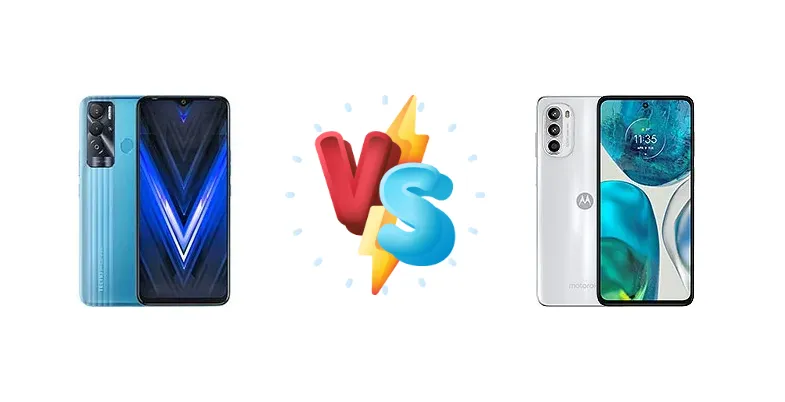
The sub-$200 smartphone market is fiercely competitive. The Tecno Pova Neo and Motorola Moto G52 both aim to deliver essential features at an accessible price point, but they take different approaches. The Pova Neo prioritizes raw processing power with its Helio G25, while the Moto G52 focuses on efficiency and a more refined experience with the Snapdragon 680. This comparison will dissect their key differences to help you choose the right device.
🏆 Quick Verdict
For the average user prioritizing all-around efficiency and a smoother experience, the Motorola Moto G52 is the better choice. Its Snapdragon 680, built on a 6nm process, offers superior power efficiency and sustained performance compared to the Tecno Pova Neo’s Helio G25. While the Pova Neo boasts faster charging, the G52’s overall package is more compelling.
| Network |
|---|
| 2G bands | GSM 850 / 900 / 1800 / 1900 | GSM 850 / 900 / 1800 / 1900 |
| 3G bands | HSDPA 850 / 900 / 2100 | HSDPA 850 / 900 / 1700(AWS) / 1900 / 2100 |
| 4G bands | LTE | LTE |
| Speed | HSPA 42.2/5.76 Mbps, LTE Cat4 150/50 Mbps | HSPA, LTE |
| Technology | GSM / HSPA / LTE | GSM / HSPA / LTE |
| Launch |
|---|
| Announced | 2021, December 09 | 2022, April 12 |
| Status | Available. Released 2021, December 09 | Available. Released 2022, April 20 |
| Body |
|---|
| Build | Glass front, plastic frame, plastic back | - |
| Dimensions | 171.4 x 77.3 x 9.1 mm (6.75 x 3.04 x 0.36 in) | 160.1 x 74.5 x 8 mm (6.30 x 2.93 x 0.31 in) |
| SIM | Nano-SIM + Nano-SIM | Nano-SIM + Nano-SIM |
| Weight | - | 169 g (5.96 oz) |
| | Splash resistant | Water-repellent design |
| Display |
|---|
| Resolution | 720 x 1640 pixels (~263 ppi density) | 1080 x 2400 pixels, 20:9 ratio (~402 ppi density) |
| Size | 6.8 inches, 109.8 cm2 (~82.9% screen-to-body ratio) | 6.6 inches, 103.6 cm2 (~86.9% screen-to-body ratio) |
| Type | IPS LCD, 480 nits | AMOLED, 90Hz |
| Platform |
|---|
| CPU | Octa-core (4x2.0 GHz Cortex-A53 & 4x1.5 GHz Cortex-A53) | Octa-core (4x2.4 GHz Kryo 265 Gold & 4x1.9 GHz Kryo 265 Silver) |
| Chipset | Mediatek MT6762G Helio G25 (12 nm) | Qualcomm SM6225 Snapdragon 680 4G (6 nm) |
| GPU | PowerVR GE8320 | Adreno 610 |
| OS | Android 11, HIOS 7.6 | Android 12, planned upgrade to Android 13 |
| Memory |
|---|
| Card slot | microSDXC (dedicated slot) | microSDXC (uses shared SIM slot) |
| Internal | 64GB 4GB RAM, 128GB 6GB RAM | 64GB 4GB RAM, 128GB 4GB RAM, 128GB 6GB RAM, 256GB 6GB RAM |
| | eMMC 5.1 | - |
| Main Camera |
|---|
| Dual | 13 MP, f/1.8, (wide), AF
Secondary unknown camera | - |
| Features | Quad-LED flash, HDR, panorama | LED flash, HDR, panorama |
| Single | 8 MP, f/2.0 | - |
| Triple | - | 50 MP, f/1.8 (wide), 1/2.76", 0.64µm, PDAF
8 MP, f/2.2, 118˚ (ultrawide), 1/4.0", 1.12µm
2 MP (macro) |
| Video | 1080p@30fps | 1080p@30fps |
| Selfie camera |
|---|
| Features | Dual-LED flash, HDR | - |
| Single | 8 MP, f/2.0 | 16 MP, f/2.5, (wide), 1.0µm |
| Video | 1080p@30fps | 1080p@30fps |
| Sound |
|---|
| 3.5mm jack | Yes | Yes |
| 35mm jack | Yes | Yes |
| Loudspeaker | Yes | Yes, with stereo speakers |
| Comms |
|---|
| Bluetooth | 5.0, A2DP, LE | 5.0, A2DP, LE |
| NFC | No | Yes (market/region dependent) |
| Positioning | GPS | GPS, GLONASS, GALILEO |
| Radio | FM radio | Unspecified |
| USB | microUSB 2.0, OTG | USB Type-C 2.0 |
| WLAN | Wi-Fi 802.11 a/b/g/n/ac, dual-band, Wi-Fi Direct | Wi-Fi 802.11 a/b/g/n/ac, dual-band, Wi-Fi Direct |
| Features |
|---|
| Sensors | Fingerprint (rear-mounted), accelerometer, proximity | Fingerprint (side-mounted), accelerometer, gyro, proximity, compass |
| Battery |
|---|
| Charging | 18W wired | 30W wired |
| Type | 6000 mAh | Li-Po 5000 mAh |
| Misc |
|---|
| Colors | Obsidian, Geek blue, Powehi | Charcoal Gray, Porcelain White |
| Models | LE6, LE6h | XT2221-1, XT2221-2 |
| Price | About 160 EUR | About 470 EUR |
Tecno Pova Neo
- Faster charging speed (18W)
- Potentially lower price point
- Helio G25 offers decent performance for basic tasks
- Less efficient Helio G25 chipset
- Likely lower sustained performance
- Potentially shorter battery life
Motorola Moto G52
- More efficient Snapdragon 680 chipset
- Better sustained performance
- Likely longer battery life
- Superior image processing capabilities
- Slower charging speed (30W)
- Potentially higher price point
Display Comparison
Neither device boasts a standout display. Details regarding panel type (IPS vs AMOLED) and resolution are missing, but both likely feature standard LCD panels for this price bracket. The key difference lies in processing efficiency; the Snapdragon 680’s 6nm fabrication allows for more efficient display power management. While peak brightness isn't specified, the G52's more modern chipset suggests potentially better outdoor visibility. Bezels are expected to be comparable, typical of budget devices.
Camera Comparison
Without detailed sensor information, a direct camera comparison is difficult. However, the Snapdragon 680’s ISP (Image Signal Processor) is generally more advanced than the Helio G25’s, leading to better image processing, particularly in low-light conditions. The Moto G52 is likely to produce more detailed and accurate photos. The prevalence of 2MP macro lenses on both devices suggests they are largely marketing features and offer limited practical benefit. Focusing on the main sensor’s quality and the ISP’s capabilities, the Moto G52 has the edge.
Performance
The core difference here is the chipset. The Motorola Moto G52’s Qualcomm Snapdragon 680 (6nm) significantly outperforms the Tecno Pova Neo’s MediaTek Helio G25 (12nm). The 6nm process node is far more efficient, translating to less heat generation and better sustained performance. While both are octa-core CPUs, the Snapdragon 680’s Kryo 265 Gold cores (2.4 GHz) offer a substantial clock speed advantage over the Pova Neo’s Cortex-A53 cores (2.0 GHz). This means faster app loading times, smoother multitasking, and a more responsive user interface on the Moto G52. The G52 is likely to handle graphically demanding tasks with greater ease.
Battery Life
The Tecno Pova Neo’s 18W charging is faster than the Motorola Moto G52’s 30W charging. However, this doesn’t automatically translate to a better battery experience. The Snapdragon 680’s superior power efficiency means the Moto G52 will likely achieve longer battery life on a single charge. While the Pova Neo can charge faster, the G52’s more efficient processor reduces the frequency of charging needed. The actual battery capacity of both devices is not specified, but the G52’s chipset advantage will likely result in longer real-world usage.
Buying Guide
Buy the Tecno Pova Neo if you absolutely need the lowest possible price and prioritize occasional gaming bursts over sustained performance. Its 18W charging is a plus for quick top-ups. Buy the Motorola Moto G52 if you value a more balanced experience, longer battery life, and a more efficient processor for everyday tasks. The G52 is ideal for users who stream videos, browse the web, and use social media frequently.
Frequently Asked Questions
❓ Will the Tecno Pova Neo struggle with demanding games like PUBG Mobile?
The Helio G25 is capable of running PUBG Mobile, but likely at lower graphics settings and frame rates to avoid significant lag. Sustained performance will be a challenge, potentially leading to frame drops during extended gaming sessions. The Motorola Moto G52, with its Snapdragon 680, will offer a smoother and more consistent gaming experience.
❓ How much faster is the Motorola Moto G52's Snapdragon 680 compared to the Tecno Pova Neo's Helio G25 in everyday tasks?
The Snapdragon 680 offers a noticeable improvement in everyday tasks like app loading, web browsing, and multitasking. The 6nm process and faster CPU cores result in a more responsive and fluid user experience. While the Pova Neo is adequate for basic use, the G52 feels significantly snappier.
❓ Does the faster charging on the Tecno Pova Neo make up for a potentially smaller battery?
Not necessarily. While 18W charging is faster, the Snapdragon 680's efficiency means the Moto G52 will likely require less frequent charging. A smaller battery with faster charging might reach 100% quicker, but a larger, more efficient battery will provide longer overall usage between charges.