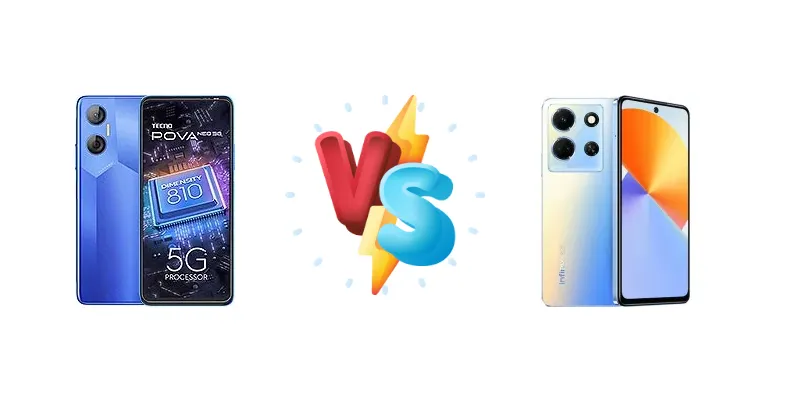
Both the Tecno Pova Neo 5G and the Infinix Note 30 5G target the increasingly competitive budget 5G market. While both leverage Mediatek Dimensity chipsets, they diverge significantly in charging capabilities and display quality, creating a clear distinction for potential buyers. This comparison dives deep into these differences to determine which device offers the best value.
🏆 Quick Verdict
For the average user prioritizing fast charging and a brighter display, the Infinix Note 30 5G is the better choice. Its 45W charging and 607 nit display offer a tangible advantage over the Pova Neo 5G’s 18W charging and unspecified display characteristics. However, the Pova Neo 5G remains a viable option for those on a tighter budget.
| Network |
|---|
| 2G bands | GSM 850 / 900 / 1800 / 1900 | GSM 850 / 900 / 1800 / 1900 |
| 3G bands | HSDPA 850 / 900 / 2100 | HSDPA 850 / 900 / 1700(AWS) / 1900 / 2100 |
| 4G bands | LTE | 1, 2, 3, 4, 5, 7, 8, 12, 17, 20, 28, 38, 40, 41, 66 |
| 5G bands | SA/NSA | 1, 3, 5, 7, 8, 12, 22, 28, 38, 40, 41, 66, 77, 78 |
| Speed | HSPA 42.2/5.76 Mbps, LTE Cat4 150/50 Mbps, 5G | HSPA, LTE, 5G |
| Technology | GSM / HSPA / LTE / 5G | GSM / HSPA / LTE / 5G |
| Launch |
|---|
| Announced | 2022, September 23 | 2023, May 22 |
| Status | Available. Released 2022, September 26 | Available. Released 2023, May 22 |
| Body |
|---|
| Build | Glass front, plastic frame, plastic back | Glass front, plastic frame, glass or leather back |
| Dimensions | 170.8 x 77.9 x 9.5 mm (6.72 x 3.07 x 0.37 in) | 168.5 x 76.5 x 8.5 mm (6.63 x 3.01 x 0.33 in) |
| SIM | Nano-SIM + Nano-SIM | Nano-SIM + Nano-SIM |
| Weight | - | 205 g (7.23 oz) |
| | Splash resistant | - |
| Display |
|---|
| Resolution | 1080 x 2460 pixels (~395 ppi density) | 1080 x 2460 pixels (~396 ppi density) |
| Size | 6.8 inches, 109.8 cm2 (~82.5% screen-to-body ratio) | 6.78 inches, 109.2 cm2 (~84.7% screen-to-body ratio) |
| Type | IPS LCD, 120Hz, 500 nits | IPS LCD, 120Hz, 580 nits (peak) |
| Platform |
|---|
| CPU | Octa-core (2x2.4 GHz Cortex-A76 & 6x2.0 GHz Cortex-A55) | Octa-core (2x2.4 GHz Cortex-A76 & 6x2.0 GHz Cortex-A55) |
| Chipset | Mediatek Dimensity 810 (6 nm) | Mediatek Dimensity 6080 (6 nm) |
| GPU | Mali-G57 MC2 | Mali-G57 MC2 |
| OS | Android 12, HIOS 8.6 | Android 13 |
| Memory |
|---|
| Card slot | microSDXC (dedicated slot) | microSDXC (dedicated slot) |
| Internal | 128GB 4GB RAM | 128GB 4GB RAM, 256GB 8GB RAM |
| Main Camera |
|---|
| Dual | 50 MP, (wide), AF
Auxiliary lens | - |
| Features | Quad-LED flash, HDR, panorama | Quad-LED flash, HDR, panorama |
| Single | 8 MP | - |
| Triple | - | 108 MP, f/1.75, 26mm (wide), 1/1.67", 0.64µm, PDAF
Auxiliary lenses |
| Video | 1440p@30fps | 1440p@30fps, 1080p@30/60fps |
| Selfie camera |
|---|
| Features | Dual-LED flash, HDR | Dual-LED flash, HDR |
| Single | 8 MP | 16 MP, f/2.0, (wide) |
| Video | 1440p@30fps | 1080p@30fps |
| Sound |
|---|
| 3.5mm jack | Yes | - |
| 35mm jack | Yes | Yes |
| Loudspeaker | Yes, with stereo speakers | Yes, with dual speakers |
| Comms |
|---|
| Bluetooth | 5.0, A2DP, LE | Yes |
| NFC | No | Yes |
| Positioning | GPS | GPS |
| Radio | FM radio | FM radio |
| USB | USB Type-C 2.0, OTG | USB Type-C 2.0, OTG |
| WLAN | Wi-Fi 802.11 a/b/g/n/ac, dual-band | Wi-Fi 802.11 a/b/g/n/ac, dual-band, Wi-Fi Direct |
| Features |
|---|
| Sensors | Fingerprint (side-mounted), accelerometer, gyro, proximity, compass | Fingerprint (side-mounted), accelerometer, gyro, proximity, compass |
| Battery |
|---|
| Charging | 18W wired | 45W wired, bypass charging |
| Type | 6000 mAh | 5000 mAh |
| Misc |
|---|
| Colors | Sprint Blue, Sapphire Black | Magic Black, Interstellar Blue, Sunset Gold |
| Models | LE6j | X6711 |
| Price | About 190 EUR | - |
Tecno Pova Neo 5G
- Potentially lower price point
- 5G connectivity
- Decent CPU performance for everyday tasks
- Slow 18W charging
- Unspecified display brightness
- Likely basic camera system
Infinix Note 30 5G
- 45W fast charging with bypass charging
- Bright 607 nit display
- Slightly more efficient Dimensity 6080 chipset
- Higher price than the Pova Neo 5G
- Still utilizes an IPS LCD panel
- Camera performance relies heavily on software
Display Comparison
The Infinix Note 30 5G boasts a significantly brighter display, measured at 607 nits, compared to the Tecno Pova Neo 5G, which lacks published brightness data. This difference translates to better visibility outdoors and a more vibrant viewing experience. The Note 30 5G’s 1521:1 contrast ratio further enhances image quality. While both likely utilize IPS LCD panels given their price points, the Note 30 5G’s superior brightness makes it the clear winner for users who consume media on the go.
Camera Comparison
Detailed camera specifications are limited for both devices. However, given their price bracket, it’s safe to assume both rely on primary sensors around the 50MP mark. The absence of Optical Image Stabilization (OIS) on either device suggests image processing will be crucial for low-light performance. Without further data, it’s difficult to definitively declare a winner, but the Note 30 5G’s potential for more advanced image signal processing (ISP) capabilities within the Dimensity 6080 could give it a slight edge.
Performance
Both devices are powered by Mediatek Dimensity chipsets featuring the same CPU configuration: an octa-core setup with 2x2.4 GHz Cortex-A76 cores and 6x2.0 GHz Cortex-A55 cores. However, the Infinix Note 30 5G utilizes the Dimensity 6080, a slightly newer and more efficient chip built on the same 6nm process as the Pova Neo 5G’s Dimensity 810. While real-world performance differences will be minimal for everyday tasks, the 6080 may offer slightly improved sustained performance due to its newer architecture. Both phones will likely pair this with LPDDR4X RAM, limiting memory bandwidth.
Battery Life
The charging disparity is the most significant difference between these two phones. The Infinix Note 30 5G supports 45W wired charging with bypass charging, allowing for faster top-ups and the ability to use the phone while charging. The Tecno Pova Neo 5G is limited to 18W charging, resulting in considerably longer charging times. While battery capacity isn’t specified, the faster charging of the Note 30 5G effectively mitigates any potential disadvantage from a slightly smaller battery size.
Buying Guide
Buy the Tecno Pova Neo 5G if you need a functional 5G phone at the absolute lowest possible price point and aren't concerned with rapid charging or a premium display experience. Buy the Infinix Note 30 5G if you prioritize faster charging speeds, a brighter and more usable display in sunlight, and a generally more refined user experience, even if it means spending a bit more.
Frequently Asked Questions
❓ Does the Dimensity 6080 in the Infinix Note 30 5G get noticeably warmer than the Dimensity 810 during extended gaming sessions?
While both chips are 6nm, the Dimensity 6080's slightly newer architecture and potentially improved thermal management could result in marginally lower temperatures during prolonged gaming. However, both phones are likely to experience some throttling under heavy load, as neither features advanced cooling solutions.
❓ Is the 45W charging on the Infinix Note 30 5G compatible with Power Delivery (PD) chargers?
Infinix typically implements its own charging protocols. While the Note 30 5G may work with some PD chargers, it's best to use the included charger to ensure optimal charging speeds and compatibility. Using a non-compatible charger may result in slower charging times.
❓ How does the display quality of the Infinix Note 30 5G compare to more expensive phones with AMOLED displays?
The Infinix Note 30 5G utilizes an IPS LCD panel, which inherently lacks the vibrant colors and perfect blacks of AMOLED displays. While the 607 nit brightness is good for an IPS LCD, it won't match the contrast and viewing angles of an AMOLED screen found in higher-end devices.