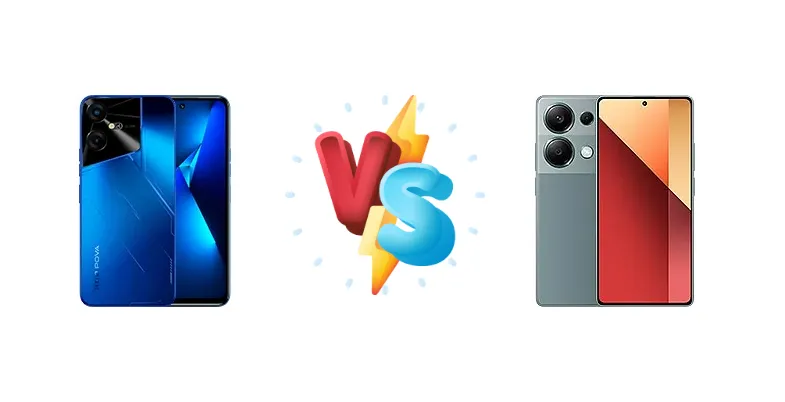
The Tecno Pova Neo 3 and Xiaomi Redmi Note 13 Pro 4G represent compelling options in the competitive sub-$250 4G smartphone market. The Pova Neo 3 aims for affordability, while the Redmi Note 13 Pro 4G prioritizes a more refined experience with faster charging and a brighter display. This comparison dissects their key differences to help you choose the right device.
🏆 Quick Verdict
For the average user, the Xiaomi Redmi Note 13 Pro 4G is the superior choice. Its significantly faster 67W charging, coupled with a brighter 1047 nit display, provides a more convenient and visually pleasing experience. While the Pova Neo 3 offers a lower entry price, the Redmi Note 13 Pro 4G’s improvements justify the price difference.
| Network |
|---|
| 2G bands | GSM 850 / 900 / 1800 / 1900 | GSM 850 / 900 / 1800 / 1900 |
| 3G bands | HSDPA 850 / 900 / 2100 | HSDPA 850 / 900 / 1700(AWS) / 1900 / 2100 |
| 4G bands | LTE | 1, 2, 3, 4, 5, 7, 8, 12, 13, 17, 18, 19, 20, 26, 28, 38, 40, 41, 66 |
| Speed | HSPA, LTE | HSPA, LTE |
| Technology | GSM / HSPA / LTE | GSM / HSPA / LTE |
| Launch |
|---|
| Announced | 2023, June 29 | 2024, January 15 |
| Status | Available. Released 2023, July | Available. Released 2024, January 15 |
| Body |
|---|
| Build | Glass front, plastic frame, plastic back | Glass front (Gorilla Glass 5), plastic frame, plastic back |
| Dimensions | 170.7 x 77.6 x 9.3 mm (6.72 x 3.06 x 0.37 in) | 161.1 x 75 x 8 mm (6.34 x 2.95 x 0.31 in) |
| SIM | Nano-SIM + Nano-SIM | Nano-SIM + Nano-SIM |
| Weight | - | 188 g (6.63 oz) |
| Display |
|---|
| Protection | - | Corning Gorilla Glass 5 |
| Resolution | 720 x 1640 pixels (~263 ppi density) | 1080 x 2400 pixels, 20:9 ratio (~395 ppi density) |
| Size | 6.82 inches, 110.5 cm2 (~83.4% screen-to-body ratio) | 6.67 inches, 107.4 cm2 (~88.9% screen-to-body ratio) |
| Type | IPS LCD, 90Hz | AMOLED, 1B colors, 120Hz, 500 nits (typ), 1000 nits (HBM), 1300 nits (peak) |
| Platform |
|---|
| CPU | Octa-core (2x2.0 GHz Cortex-A75 & 6x1.8 GHz Cortex-A55) | Octa-core (2x2.2 GHz Cortex-A76 & 6x2.0 GHz Cortex-A55) |
| Chipset | Mediatek MT6769Z Helio G85 (12 nm) | Mediatek Helio G99 Ultra |
| GPU | Mali-G52 MC2 | Mali-G57 MC2 |
| OS | Android 13, HIOS | Android 13, up to 3 major Android upgrades, HyperOS |
| Memory |
|---|
| Card slot | microSDXC (dedicated slot) | microSDXC (uses shared SIM slot) |
| Internal | 128GB 4GB RAM, 128GB 8GB RAM | 128GB 8GB RAM, 256GB 8GB RAM, 256GB 12GB RAM, 512GB 8GB RAM, 512GB 12GB RAM |
| Main Camera |
|---|
| Features | Dual-LED flash, HDR, panorama | LED flash, HDR, panorama |
| Single | 16 MP, (wide), AF
Auxiliary lens | - |
| Triple | - | 200 MP, f/1.7, 23mm (wide), 1/1.4", 0.56µm, multi-directional PDAF, OIS
8 MP, f/2.2, 15mm, 120˚ (ultrawide), 1/4.4", 1.0µm
2 MP (macro) |
| Video | 1080p@30fps | 1080p@30/60fps |
| Selfie camera |
|---|
| Features | LED flash | - |
| Single | 8 MP | 16 MP, f/2.4, (wide), 1/3.0", 1.0µm |
| Video | Yes | 1080p@30/60fps |
| Sound |
|---|
| 35mm jack | Yes | Yes |
| Loudspeaker | Yes | Yes, with dual speakers |
| Comms |
|---|
| Bluetooth | Yes | 5.2, A2DP, LE |
| Infrared port | - | Yes |
| NFC | Yes | Yes (market/region dependent) |
| Positioning | GPS, GLONASS, GALILEO, BDS | GPS, GLONASS, GALILEO, BDS |
| Radio | FM radio | FM radio |
| USB | USB Type-C 2.0, OTG | USB Type-C 2.0, OTG |
| WLAN | Wi-Fi 802.11 a/b/g/n/ac, dual-band | Wi-Fi 802.11 a/b/g/n/ac, dual-band |
| Features |
|---|
| Sensors | Fingerprint (side-mounted), accelerometer, proximity, compass | Fingerprint (under display, optical), accelerometer, gyro, compass |
| Battery |
|---|
| Charging | 18W wired | 67W wired, 50% in 16 min, 100% in 46 min |
| Type | 7000 mAh | 5000 mAh |
| Misc |
|---|
| Colors | Amber Gold, Mecha Black, Hurricane Blue | Midnight Black, Lavender Purple, Forest Green |
| Models | LH6n | 23117RA68G, 2312FPCA6G |
| Price | - | € 92.00 / $ 269.99 / £ 299.99 |
| SAR | - | 1.09 W/kg (head) 1.09 W/kg (body) |
| SAR EU | - | 0.99 W/kg (head) 0.99 W/kg (body) |
Tecno Pova Neo 3
- Most affordable option
- Decent performance for basic tasks
- Potentially larger battery capacity (unconfirmed)
- Slow 18W charging
- Dimmer display
- Less powerful chipset
Xiaomi Redmi Note 13 Pro 4G
- 67W fast charging
- Bright 1047 nit display
- More powerful Helio G99 Ultra chipset
- Higher price point
- May not include a charger in the box (region dependent)
- Potentially less battery life than Pova Neo 3 (depending on capacity)
Display Comparison
The Xiaomi Redmi Note 13 Pro 4G boasts a significantly brighter display, reaching a measured 1047 nits. This is crucial for outdoor visibility, a clear advantage over the Tecno Pova Neo 3, which lacks published brightness data but is expected to be considerably dimmer given its price point. While both likely utilize IPS LCD panels, the Redmi’s higher peak brightness translates to a more enjoyable viewing experience in all lighting conditions. The Redmi Note 13 Pro 4G’s panel is also likely to have better color accuracy and viewing angles, though detailed calibration data is unavailable.
Camera Comparison
Detailed camera analysis is limited by the provided data. However, the Redmi Note 13 Pro 4G is expected to offer a more versatile camera system, likely featuring a higher resolution main sensor and potentially optical image stabilization (OIS). While the Pova Neo 3 may suffice for casual photography, the Redmi Note 13 Pro 4G’s superior sensor and image processing capabilities will deliver better image quality, especially in low-light conditions. The presence or absence of OIS on the Redmi Note 13 Pro 4G would be a significant differentiator, enabling sharper photos and more stable videos.
Performance
Both devices utilize MediaTek Helio chipsets, but the Redmi Note 13 Pro 4G’s Helio G99 Ultra offers a performance edge over the Pova Neo 3’s Helio G85. The G99 Ultra features a more modern CPU architecture – Cortex-A76 cores clocked at 2.2 GHz versus the G85’s Cortex-A75 cores at 2.0 GHz – resulting in faster application loading and smoother multitasking. While both are octa-core designs, the architectural improvements in the G99 Ultra provide a noticeable performance uplift. The Redmi Note 13 Pro 4G is better suited for demanding applications and light gaming.
Battery Life
The Redmi Note 13 Pro 4G excels in charging speed with its 67W wired charging, achieving 50% charge in just 16 minutes and a full charge in 46 minutes. This is a massive advantage over the Tecno Pova Neo 3’s slower 18W charging. While the Pova Neo 3’s battery capacity isn’t specified, the Redmi Note 13 Pro 4G’s active use score of 11:36h demonstrates excellent battery life. The faster charging of the Redmi Note 13 Pro 4G mitigates any potential concerns about battery drain, offering a more convenient user experience.
Buying Guide
Buy the Tecno Pova Neo 3 if you absolutely need the lowest possible price and are willing to compromise on charging speed and display quality. It’s a viable option for basic smartphone tasks. Buy the Xiaomi Redmi Note 13 Pro 4G if you value faster charging, a brighter and more vibrant display, and a generally smoother user experience, even if it means spending a bit more.
Frequently Asked Questions
❓ Does the Helio G99 Ultra in the Redmi Note 13 Pro 4G get hot during prolonged gaming sessions?
The Helio G99 Ultra is a relatively efficient chipset. While some heat generation is inevitable during gaming, the Redmi Note 13 Pro 4G’s thermal design should prevent significant throttling. However, sustained high-intensity gaming will likely lead to some performance reduction over time.
❓ Is the 18W charging on the Tecno Pova Neo 3 slow enough to be a major inconvenience?
Yes, 18W charging is considerably slower than the 67W charging on the Redmi Note 13 Pro 4G. Expect a significantly longer time to fully charge the Pova Neo 3, potentially taking over two hours. This can be a major inconvenience for users who frequently need to top up their battery quickly.
❓ What type of storage does the Redmi Note 13 Pro 4G use, and does it support expansion?
While not specified in the provided data, Redmi Note series phones typically utilize UFS 2.2 storage for faster read/write speeds. The Redmi Note 13 Pro 4G likely includes a dedicated microSD card slot for storage expansion, allowing you to increase the available storage capacity.
❓ How does the camera performance of the Redmi Note 13 Pro 4G compare in low-light conditions?
The Redmi Note 13 Pro 4G is expected to perform better in low-light conditions due to its likely larger main sensor and potentially OIS. These features allow the camera to capture more light and reduce blur, resulting in brighter and clearer images in challenging lighting environments.