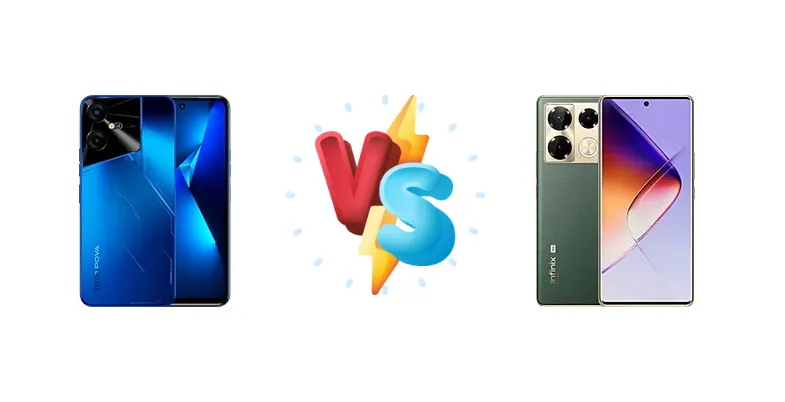
The Tecno Pova Neo 3 and Infinix Note 40 Pro represent distinct approaches to the budget and mid-range smartphone market. The Pova Neo 3 aims to deliver a playable gaming experience at an extremely competitive price point, while the Note 40 Pro prioritizes a more refined experience with faster charging, a more powerful processor, and added convenience features like wireless charging. This comparison dissects the key differences to help you determine which device best suits your needs.
🏆 Quick Verdict
For the average user, the Infinix Note 40 Pro is the superior choice. Its Dimensity 7020 chipset provides a substantial performance uplift over the Pova Neo 3’s Helio G85, and the 45W charging with MagCharge support significantly reduces downtime. While the Pova Neo 3 offers value, the Note 40 Pro delivers a more complete and future-proof experience.
| Network |
|---|
| 2G bands | GSM 850 / 900 / 1800 / 1900 | GSM 850 / 900 / 1800 / 1900 |
| 3G bands | HSDPA 850 / 900 / 2100 | HSDPA 850 / 900 / 1700(AWS) / 1900 / 2100 |
| 4G bands | LTE | 1, 2, 3, 4, 5, 7, 8, 12, 17, 20, 28, 38, 40, 41, 42, 66 |
| 5G bands | - | 1, 3, 5, 7, 8, 12, 20, 28, 38, 40, 41, 66, 77, 78 SA/NSA |
| Speed | HSPA, LTE | HSPA, LTE, 5G |
| Technology | GSM / HSPA / LTE | GSM / HSPA / LTE / 5G |
| Launch |
|---|
| Announced | 2023, June 29 | 2024, March 18 |
| Status | Available. Released 2023, July | Available. Released 2024, March 19 |
| Body |
|---|
| Build | Glass front, plastic frame, plastic back | - |
| Dimensions | 170.7 x 77.6 x 9.3 mm (6.72 x 3.06 x 0.37 in) | 164.3 x 74.5 x 8.1 mm (6.47 x 2.93 x 0.32 in) |
| SIM | Nano-SIM + Nano-SIM | Nano-SIM + Nano-SIM |
| Weight | - | 190 g or 196 g (6.70 oz) |
| Display |
|---|
| Protection | - | Corning Gorilla Glass |
| Resolution | 720 x 1640 pixels (~263 ppi density) | 1080 x 2436 pixels (~393 ppi density) |
| Size | 6.82 inches, 110.5 cm2 (~83.4% screen-to-body ratio) | 6.78 inches, 109.9 cm2 (~89.8% screen-to-body ratio) |
| Type | IPS LCD, 90Hz | AMOLED, 1B colors, 120Hz, 2160Hz PWM, 1300 nits (peak) |
| Platform |
|---|
| CPU | Octa-core (2x2.0 GHz Cortex-A75 & 6x1.8 GHz Cortex-A55) | Octa-core (2x2.2 GHz Cortex-A78 & 6x2.0 GHz Cortex-A55) |
| Chipset | Mediatek MT6769Z Helio G85 (12 nm) | Mediatek Dimensity 7020 (6 nm) |
| GPU | Mali-G52 MC2 | IMG BXM-8-256 |
| OS | Android 13, HIOS | Android 14, XOS 14 |
| Memory |
|---|
| Card slot | microSDXC (dedicated slot) | Unspecified |
| Internal | 128GB 4GB RAM, 128GB 8GB RAM | 256GB 8GB RAM |
| Main Camera |
|---|
| Features | Dual-LED flash, HDR, panorama | Dual-LED flash, HDR, panorama |
| Single | 16 MP, (wide), AF
Auxiliary lens | - |
| Triple | - | 108 MP, f/1.8, (wide), PDAF, OIS
2 MP, f/2.4
2 MP, f/2.4 |
| Video | 1080p@30fps | 1440p@30fps, 1080p@30/60fps |
| Selfie camera |
|---|
| Features | LED flash | Dual-LED flash |
| Single | 8 MP | 32 MP, f/2.2, (wide), 1/3.1" |
| Video | Yes | 1080p@30fps |
| Sound |
|---|
| 35mm jack | Yes | No |
| Loudspeaker | Yes | Yes, with stereo speakers |
| Comms |
|---|
| Bluetooth | Yes | Yes |
| Infrared port | - | Yes |
| NFC | Yes | Yes (market/region dependent) |
| Positioning | GPS, GLONASS, GALILEO, BDS | GPS |
| Radio | FM radio | FM radio |
| USB | USB Type-C 2.0, OTG | USB Type-C 2.0, OTG |
| WLAN | Wi-Fi 802.11 a/b/g/n/ac, dual-band | Wi-Fi 802.11 a/b/g/n/ac, dual-band |
| Features |
|---|
| Sensors | Fingerprint (side-mounted), accelerometer, proximity, compass | Fingerprint (under display, optical), accelerometer, gyro, proximity, compass |
| Battery |
|---|
| Charging | 18W wired | 45W wired, 50% in 26 min
20W wireless MagCharge
Reverse wired
Reverse wireless |
| Type | 7000 mAh | 5000 mAh |
| Misc |
|---|
| Colors | Amber Gold, Mecha Black, Hurricane Blue | Vintage Green, Titan Gold, Racing Edition |
| Models | LH6n | X6851 |
| Price | - | About 280 EUR |
Tecno Pova Neo 3
- Most affordable option
- Decent gaming performance for the price
- Large battery capacity (likely)
- Slow 18W charging
- Less powerful processor
- Potentially lower-quality display
Infinix Note 40 Pro
- Significantly faster 45W charging with MagCharge
- More powerful Dimensity 7020 processor
- Wireless charging and reverse charging capabilities
- Higher price point
- Potentially smaller battery capacity
- May not be the absolute cheapest option
Display Comparison
Neither device’s display specifications are provided, so a direct comparison is limited. However, given the Note 40 Pro’s positioning, it likely features a higher resolution and potentially a higher refresh rate panel than the Pova Neo 3. The Note 40 Pro’s more premium build quality likely translates to smaller bezels and a more immersive viewing experience. The Pova Neo 3 will likely prioritize cost savings in this area.
Camera Comparison
Without detailed camera specs, analysis is limited. However, the Note 40 Pro, being a more premium device, likely features a larger main sensor and more sophisticated image processing algorithms. While both phones likely include multiple rear cameras, the Pova Neo 3 may rely heavily on lower-resolution sensors for features like depth sensing. The Note 40 Pro’s image processing will likely prioritize detail and dynamic range, while the Pova Neo 3 will focus on providing acceptable results in good lighting conditions.
Performance
The core difference lies in the chipsets. The Infinix Note 40 Pro’s Mediatek Dimensity 7020, built on a 6nm process, offers a significant advantage over the Tecno Pova Neo 3’s Mediatek Helio G85 (12nm). The Dimensity 7020 utilizes more modern CPU cores – 2x2.2 GHz Cortex-A78 vs 2x2.0 GHz Cortex-A75 in the Helio G85 – resulting in faster application loading times and smoother multitasking. The 6nm process also contributes to better thermal efficiency, meaning the Note 40 Pro is less likely to throttle under sustained load. Gamers will see a noticeable difference in frame rates and graphical fidelity.
Battery Life
The Infinix Note 40 Pro’s charging capabilities are a standout feature. Its 45W wired charging, capable of delivering 50% charge in 26 minutes, is significantly faster than the Pova Neo 3’s 18W charging. Furthermore, the Note 40 Pro adds 20W wireless MagCharge, reverse wired charging, and reverse wireless charging, offering unparalleled convenience. While the Pova Neo 3 may have a comparable or even slightly larger battery capacity, the Note 40 Pro’s faster charging mitigates any potential battery life concerns.
Buying Guide
Buy the Tecno Pova Neo 3 if you absolutely need the lowest possible price for basic smartphone functionality and light gaming. It’s a good option for first-time smartphone users or those on a very tight budget. Buy the Infinix Note 40 Pro if you prioritize performance, fast charging, and convenience features like wireless charging. It’s ideal for users who stream videos, play demanding games, or simply want a phone that keeps up with their fast-paced lifestyle.
Frequently Asked Questions
❓ Does the Dimensity 7020 in the Infinix Note 40 Pro get hot during extended gaming sessions?
The Dimensity 7020’s 6nm process is more efficient than the Helio G85’s 12nm process, resulting in lower heat generation. While some heat is inevitable during prolonged gaming, the Note 40 Pro is less prone to significant throttling compared to the Pova Neo 3, maintaining higher frame rates for longer periods.
❓ Is the 20W MagCharge on the Infinix Note 40 Pro truly useful, or is it just a gimmick?
The 20W MagCharge is a genuinely useful feature, offering a convenient way to top up your battery without cables. While not as fast as the 45W wired charging, it’s significantly faster than standard wireless charging and provides a hassle-free charging experience, especially when on the go.
❓ Can the Tecno Pova Neo 3 handle demanding games like PUBG Mobile at high settings?
The Pova Neo 3 can run PUBG Mobile, but you’ll likely need to compromise on graphics settings to achieve a smooth frame rate. The Helio G85 is capable, but it will struggle with consistently high frame rates at maximum settings, especially in intense firefights. Expect to play at medium or low settings for a more stable experience.
❓ Does the Infinix Note 40 Pro support 5G connectivity?
The Mediatek Dimensity 7020 chipset *does* support 5G connectivity. This means the Infinix Note 40 Pro can take advantage of faster data speeds where 5G networks are available, offering a significant improvement over the Pova Neo 3 if you live in an area with 5G coverage.