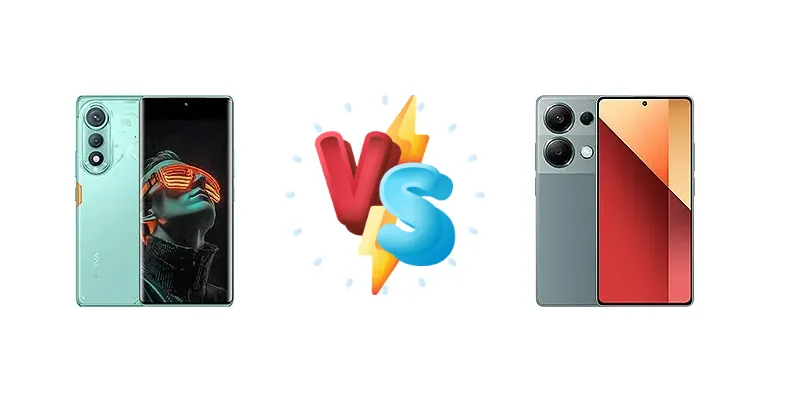
The Tecno Pova Curve and Xiaomi Redmi Note 13 Pro 4G represent compelling options in the competitive mid-range smartphone market. The Pova Curve aims for performance with its newer Dimensity 7300 Ultimate chipset, while the Redmi Note 13 Pro 4G prioritizes all-day battery life and a bright display. This comparison dissects their key differences to determine which device best suits your needs.
🏆 Quick Verdict
For users prioritizing raw performance and faster charging, the Tecno Pova Curve is the better choice. Its Dimensity 7300 Ultimate offers a significant CPU and GPU advantage. However, the Xiaomi Redmi Note 13 Pro 4G excels in battery endurance, providing over 11 hours of active use, making it ideal for heavy users who don't want to constantly reach for a charger.
| Network |
|---|
| 2G bands | GSM 850 / 900 / 1800 / 1900 | GSM 850 / 900 / 1800 / 1900 |
| 3G bands | HSDPA 850 / 900 / 1700(AWS) / 1900 / 2100 | HSDPA 850 / 900 / 1700(AWS) / 1900 / 2100 |
| 4G bands | LTE | 1, 2, 3, 4, 5, 7, 8, 12, 13, 17, 18, 19, 20, 26, 28, 38, 40, 41, 66 |
| 5G bands | SA/NSA | - |
| Speed | HSPA, LTE, 5G | HSPA, LTE |
| Technology | GSM / HSPA / LTE / 5G | GSM / HSPA / LTE |
| Launch |
|---|
| Announced | 2025, May 29 | 2024, January 15 |
| Status | Available. Released 2025, June 05 | Available. Released 2024, January 15 |
| Body |
|---|
| Build | Glass front (Gorilla Glass 7i), plastic frame, plastic back | Glass front (Gorilla Glass 5), plastic frame, plastic back |
| Dimensions | 164.3 x 74.6 x 7.5 mm (6.47 x 2.94 x 0.30 in) | 161.1 x 75 x 8 mm (6.34 x 2.95 x 0.31 in) |
| SIM | Nano-SIM + Nano-SIM | Nano-SIM + Nano-SIM |
| Weight | 188.5 g (6.67 oz) | 188 g (6.63 oz) |
| Display |
|---|
| Protection | Corning Gorilla Glass 7i | Corning Gorilla Glass 5 |
| Resolution | 1080 x 2436 pixels (~393 ppi density) | 1080 x 2400 pixels, 20:9 ratio (~395 ppi density) |
| Size | 6.78 inches, 109.9 cm2 (~89.7% screen-to-body ratio) | 6.67 inches, 107.4 cm2 (~88.9% screen-to-body ratio) |
| Type | AMOLED, 144Hz, 2304Hz PWM, 1300 nits (peak) | AMOLED, 1B colors, 120Hz, 500 nits (typ), 1000 nits (HBM), 1300 nits (peak) |
| Platform |
|---|
| CPU | Octa-core (4x2.5 GHz Cortex-A78 & 4x2.0 GHz Cortex-A55) | Octa-core (2x2.2 GHz Cortex-A76 & 6x2.0 GHz Cortex-A55) |
| Chipset | Mediatek Dimensity 7300 Ultimate (4 nm) | Mediatek Helio G99 Ultra |
| GPU | Mali-G615 MC2 | Mali-G57 MC2 |
| OS | Android 15, planned upgrade to Android 16, HIOS 15 | Android 13, up to 3 major Android upgrades, HyperOS |
| Memory |
|---|
| Card slot | No | microSDXC (uses shared SIM slot) |
| Internal | 128GB 6GB RAM, 128GB 8GB RAM | 128GB 8GB RAM, 256GB 8GB RAM, 256GB 12GB RAM, 512GB 8GB RAM, 512GB 12GB RAM |
| Main Camera |
|---|
| Dual | 64 MP, f/1.8, (wide), 1/1.73", 0.8µm, PDAF
Auxiliary lens | - |
| Features | LED flash, HDR, panorama | LED flash, HDR, panorama |
| Triple | - | 200 MP, f/1.7, 23mm (wide), 1/1.4", 0.56µm, multi-directional PDAF, OIS
8 MP, f/2.2, 15mm, 120˚ (ultrawide), 1/4.4", 1.0µm
2 MP (macro) |
| Video | 4K@30fps, 1080p@30fps | 1080p@30/60fps |
| Selfie camera |
|---|
| Single | 13 MP | 16 MP, f/2.4, (wide), 1/3.0", 1.0µm |
| Video | 4K@30fps, 1080p@30fps | 1080p@30/60fps |
| Sound |
|---|
| 35mm jack | No | Yes |
| Loudspeaker | Yes, with stereo speakers (with Dolby Atmos) | Yes, with dual speakers |
| Comms |
|---|
| Bluetooth | 5.4, A2DP, LE | 5.2, A2DP, LE |
| Infrared port | Yes | Yes |
| NFC | Yes | Yes (market/region dependent) |
| Positioning | GPS | GPS, GLONASS, GALILEO, BDS |
| Radio | FM radio | FM radio |
| USB | USB Type-C 2.0, OTG | USB Type-C 2.0, OTG |
| WLAN | Wi-Fi 802.11 a/b/g/n/ac/6, dual-band | Wi-Fi 802.11 a/b/g/n/ac, dual-band |
| Features |
|---|
| Sensors | Fingerprint (under display, optical), accelerometer, proximity, compass | Fingerprint (under display, optical), accelerometer, gyro, compass |
| Battery |
|---|
| Charging | 45W wired, 50% in 15 min, 100% in 45 min | 67W wired, 50% in 16 min, 100% in 46 min |
| Type | Li-Po 5500 mAh | 5000 mAh |
| Misc |
|---|
| Colors | Neon Cyan, Magic Silver, Geek Black | Midnight Black, Lavender Purple, Forest Green |
| Models | LJ8k | 23117RA68G, 2312FPCA6G |
| Price | About 170 EUR | € 92.00 / $ 269.99 / £ 299.99 |
| SAR | - | 1.09 W/kg (head) 1.09 W/kg (body) |
| SAR EU | - | 0.99 W/kg (head) 0.99 W/kg (body) |
Tecno Pova Curve
- Superior processing power with Dimensity 7300 Ultimate
- Faster CPU clock speeds for improved responsiveness
- Potentially faster 50% charge time
- Battery life is currently unknown and may be lower than the Redmi
- Display brightness is unconfirmed and may be less vibrant
Xiaomi Redmi Note 13 Pro 4G
- Excellent battery life with over 11 hours of active use
- Very bright display (1047 nits) for outdoor visibility
- Faster full charge time (46 minutes)
- Less powerful chipset (Helio G99 Ultra)
- Older CPU architecture may limit performance in demanding tasks
Display Comparison
The Xiaomi Redmi Note 13 Pro 4G boasts a significantly brighter display, reaching a measured 1047 nits. This translates to superior visibility outdoors under direct sunlight. While the Pova Curve’s display specs are currently unavailable, the Redmi’s brightness is a clear advantage. The Redmi Note 13 Pro 4G likely utilizes an AMOLED panel, common in this price range, offering vibrant colors and deep blacks, while the Pova Curve’s panel type remains unknown. Bezels are expected to be comparable, but the Redmi’s brightness is a standout feature.
Camera Comparison
Detailed camera analysis is limited by the provided data. However, the Redmi Note 13 Pro 4G’s camera system is likely to be more versatile, assuming it follows Xiaomi’s typical configuration. While the Pova Curve’s chipset suggests capable image processing, the Redmi’s potential for features like OIS (Optical Image Stabilization) and a more refined software algorithm could yield better image quality, particularly in low-light conditions. The absence of sensor size information makes a definitive judgment impossible, but the Redmi’s brand reputation in camera performance gives it an edge.
Performance
The Tecno Pova Curve’s Mediatek Dimensity 7300 Ultimate (4nm) represents a substantial leap in processing power compared to the Redmi Note 13 Pro 4G’s Helio G99 Ultra. The Dimensity 7300 Ultimate features a more modern CPU architecture – four Cortex-A78 cores clocked at 2.5 GHz versus the Redmi’s two Cortex-A76 cores at 2.2 GHz. This architectural difference, combined with the smaller 4nm process node, results in significantly improved multi-core performance and power efficiency. Gamers and power users will notice a considerable difference in responsiveness and frame rates on the Pova Curve.
Battery Life
The Xiaomi Redmi Note 13 Pro 4G shines in battery life, achieving 11 hours and 36 minutes of active use. While the Tecno Pova Curve’s battery capacity is unknown, the Redmi’s endurance is a significant advantage for users who heavily rely on their phones throughout the day. Charging speeds are competitive, with the Redmi’s 67W wired charging completing a full charge in 46 minutes, slightly slower than the Pova Curve’s 45W which reaches 100% in 45 minutes. However, the Pova Curve reaches 50% in 15 minutes, slightly faster than the Redmi’s 16 minutes.
Buying Guide
Buy the Tecno Pova Curve if you need a phone for demanding tasks like gaming, video editing, or multitasking, and value faster charging speeds. Buy the Xiaomi Redmi Note 13 Pro 4G if you prioritize all-day battery life, a bright and vivid display for media consumption, and a more established brand ecosystem.
Frequently Asked Questions
❓ Will the Dimensity 7300 Ultimate in the Tecno Pova Curve handle demanding games like Genshin Impact at high settings?
Yes, the Dimensity 7300 Ultimate is a capable chipset that should handle Genshin Impact and other graphically intensive games at medium to high settings. The 4nm process and Cortex-A78 cores provide the necessary processing power and efficiency for a smooth gaming experience, though sustained performance will depend on the phone's thermal management.
❓ How does the Helio G99 Ultra in the Redmi Note 13 Pro 4G perform with multitasking and app switching?
The Helio G99 Ultra is a solid mid-range processor, but it's not as powerful as the Dimensity 7300 Ultimate. It will handle everyday multitasking and app switching without issue, but you might experience slight slowdowns when running many apps simultaneously or switching between very demanding applications.
❓ Is the 67W charging on the Redmi Note 13 Pro 4G significantly faster in real-world use compared to the 45W charging on the Tecno Pova Curve?
While the Redmi Note 13 Pro 4G has higher wattage charging, the difference in full charge time is minimal (46 minutes vs 45 minutes). The Pova Curve charges to 50% slightly faster (15 minutes vs 16 minutes). The practical difference in charging speed is unlikely to be a major deciding factor for most users.