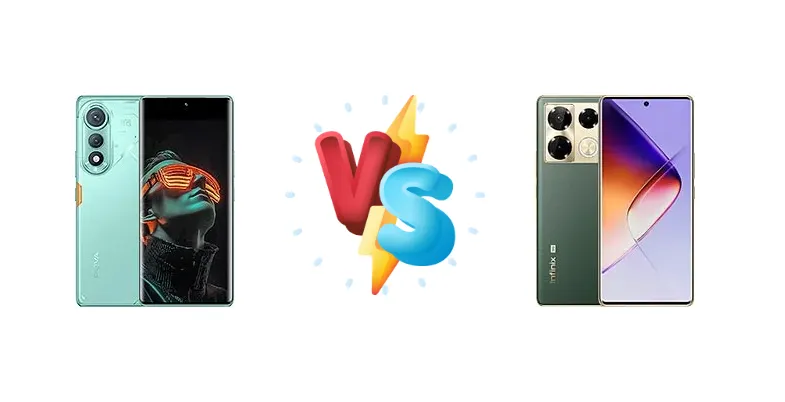
Tecno and Infinix are aggressively competing in the sub-$300 segment, and the Pova Curve and Note 40 Pro represent their latest efforts. Both phones center around MediaTek Dimensity chipsets, but significant differences in architecture and features – particularly around charging – create a clear distinction for potential buyers. This comparison dissects those differences to help you choose the right device.
🏆 Quick Verdict
For users prioritizing raw performance and faster wired charging, the Tecno Pova Curve emerges as the winner. Its Dimensity 7300 Ultimate, built on a more efficient 4nm process, offers a noticeable edge. However, the Infinix Note 40 Pro’s MagCharge wireless charging and reverse charging capabilities provide unique convenience features.
| Network |
|---|
| 2G bands | GSM 850 / 900 / 1800 / 1900 | GSM 850 / 900 / 1800 / 1900 |
| 3G bands | HSDPA 850 / 900 / 1700(AWS) / 1900 / 2100 | HSDPA 850 / 900 / 1700(AWS) / 1900 / 2100 |
| 4G bands | LTE | 1, 2, 3, 4, 5, 7, 8, 12, 17, 20, 28, 38, 40, 41, 42, 66 |
| 5G bands | SA/NSA | 1, 3, 5, 7, 8, 12, 20, 28, 38, 40, 41, 66, 77, 78 SA/NSA |
| Speed | HSPA, LTE, 5G | HSPA, LTE, 5G |
| Technology | GSM / HSPA / LTE / 5G | GSM / HSPA / LTE / 5G |
| Launch |
|---|
| Announced | 2025, May 29 | 2024, March 18 |
| Status | Available. Released 2025, June 05 | Available. Released 2024, March 19 |
| Body |
|---|
| Build | Glass front (Gorilla Glass 7i), plastic frame, plastic back | - |
| Dimensions | 164.3 x 74.6 x 7.5 mm (6.47 x 2.94 x 0.30 in) | 164.3 x 74.5 x 8.1 mm (6.47 x 2.93 x 0.32 in) |
| SIM | Nano-SIM + Nano-SIM | Nano-SIM + Nano-SIM |
| Weight | 188.5 g (6.67 oz) | 190 g or 196 g (6.70 oz) |
| Display |
|---|
| Protection | Corning Gorilla Glass 7i | Corning Gorilla Glass |
| Resolution | 1080 x 2436 pixels (~393 ppi density) | 1080 x 2436 pixels (~393 ppi density) |
| Size | 6.78 inches, 109.9 cm2 (~89.7% screen-to-body ratio) | 6.78 inches, 109.9 cm2 (~89.8% screen-to-body ratio) |
| Type | AMOLED, 144Hz, 2304Hz PWM, 1300 nits (peak) | AMOLED, 1B colors, 120Hz, 2160Hz PWM, 1300 nits (peak) |
| Platform |
|---|
| CPU | Octa-core (4x2.5 GHz Cortex-A78 & 4x2.0 GHz Cortex-A55) | Octa-core (2x2.2 GHz Cortex-A78 & 6x2.0 GHz Cortex-A55) |
| Chipset | Mediatek Dimensity 7300 Ultimate (4 nm) | Mediatek Dimensity 7020 (6 nm) |
| GPU | Mali-G615 MC2 | IMG BXM-8-256 |
| OS | Android 15, planned upgrade to Android 16, HIOS 15 | Android 14, XOS 14 |
| Memory |
|---|
| Card slot | No | Unspecified |
| Internal | 128GB 6GB RAM, 128GB 8GB RAM | 256GB 8GB RAM |
| Main Camera |
|---|
| Dual | 64 MP, f/1.8, (wide), 1/1.73", 0.8µm, PDAF
Auxiliary lens | - |
| Features | LED flash, HDR, panorama | Dual-LED flash, HDR, panorama |
| Triple | - | 108 MP, f/1.8, (wide), PDAF, OIS
2 MP, f/2.4
2 MP, f/2.4 |
| Video | 4K@30fps, 1080p@30fps | 1440p@30fps, 1080p@30/60fps |
| Selfie camera |
|---|
| Features | - | Dual-LED flash |
| Single | 13 MP | 32 MP, f/2.2, (wide), 1/3.1" |
| Video | 4K@30fps, 1080p@30fps | 1080p@30fps |
| Sound |
|---|
| 35mm jack | No | No |
| Loudspeaker | Yes, with stereo speakers (with Dolby Atmos) | Yes, with stereo speakers |
| Comms |
|---|
| Bluetooth | 5.4, A2DP, LE | Yes |
| Infrared port | Yes | Yes |
| NFC | Yes | Yes (market/region dependent) |
| Positioning | GPS | GPS |
| Radio | FM radio | FM radio |
| USB | USB Type-C 2.0, OTG | USB Type-C 2.0, OTG |
| WLAN | Wi-Fi 802.11 a/b/g/n/ac/6, dual-band | Wi-Fi 802.11 a/b/g/n/ac, dual-band |
| Features |
|---|
| Sensors | Fingerprint (under display, optical), accelerometer, proximity, compass | Fingerprint (under display, optical), accelerometer, gyro, proximity, compass |
| Battery |
|---|
| Charging | 45W wired, 50% in 15 min, 100% in 45 min | 45W wired, 50% in 26 min
20W wireless MagCharge
Reverse wired
Reverse wireless |
| Type | Li-Po 5500 mAh | 5000 mAh |
| Misc |
|---|
| Colors | Neon Cyan, Magic Silver, Geek Black | Vintage Green, Titan Gold, Racing Edition |
| Models | LJ8k | X6851 |
| Price | About 170 EUR | About 280 EUR |
Tecno Pova Curve
- Faster wired charging (15 min to 50%)
- More powerful Dimensity 7300 Ultimate chipset
- Potentially better thermal management
- Lacks wireless charging
- No reverse charging
Infinix Note 40 Pro
- 20W MagCharge wireless charging
- Reverse wired and wireless charging
- More versatile charging options
- Less powerful Dimensity 7020 chipset
- Slower wired charging (26 min to 50%)
Display Comparison
Neither device's display specifications are provided, so a direct comparison is limited. However, given the price bracket, we can expect both to feature AMOLED panels with at least 90Hz refresh rates. The absence of LTPO technology suggests neither will offer dynamically variable refresh rates for optimal power saving. Bezels are likely to be similar, and color accuracy will depend on software calibration – a key area where Tecno and Infinix often differentiate themselves. Expect both to target a similar peak brightness, likely around 800-1000 nits.
Camera Comparison
Without detailed camera specs, analysis is limited. However, the market positioning suggests both will feature a primary camera in the 50-108MP range. The Pova Curve’s superior processing power from the Dimensity 7300 Ultimate could translate to better image processing, particularly in low-light conditions. The absence of information regarding OIS (Optical Image Stabilization) makes it difficult to assess video recording capabilities. It's likely both phones will include standard ultra-wide and macro lenses, but their quality will be secondary to the main sensor.
Performance
The core difference lies in the chipsets. The Tecno Pova Curve’s Dimensity 7300 Ultimate (4nm) boasts a more modern architecture and a smaller fabrication process than the Infinix Note 40 Pro’s Dimensity 7020 (6nm). This translates to improved power efficiency and potentially higher sustained performance under load. The CPU configuration – 4x2.5 GHz Cortex-A78 & 4x2.0 GHz Cortex-A55 on the Pova Curve versus 2x2.2 GHz Cortex-A78 & 6x2.0 GHz Cortex-A55 on the Note 40 Pro – favors the Pova Curve in multi-core tasks. While both utilize LPDDR5x RAM, the more efficient chipset in the Pova Curve will likely allow for better thermal management, reducing throttling during extended gaming sessions.
Battery Life
Both phones feature 45W wired charging, but the time-to-charge differs significantly. The Tecno Pova Curve reaches 50% in 15 minutes and 100% in 45 minutes, while the Infinix Note 40 Pro takes 26 minutes for 50%. This indicates a more efficient charging implementation on the Pova Curve. The Note 40 Pro’s standout feature is 20W MagCharge wireless charging, a convenience the Pova Curve lacks. Furthermore, the Note 40 Pro offers both reverse wired and wireless charging, allowing it to function as a power bank for other devices.
Buying Guide
Buy the Tecno Pova Curve if you need a phone for demanding tasks like gaming or video editing, and value the fastest possible wired charging speeds. Buy the Infinix Note 40 Pro if you prioritize wireless charging convenience, reverse charging for accessories, and a more versatile charging ecosystem, even if it means a slight performance trade-off.
Frequently Asked Questions
❓ Will the Dimensity 7020 in the Infinix Note 40 Pro struggle with graphically intensive games like Genshin Impact?
While the Dimensity 7020 is capable, it's likely to require lower graphics settings and may experience more noticeable frame drops compared to the Tecno Pova Curve's Dimensity 7300 Ultimate, especially during prolonged gaming sessions. The 6nm process and less powerful CPU core configuration will contribute to higher temperatures and potential throttling.
❓ How practical is the 20W MagCharge wireless charging on the Infinix Note 40 Pro in real-world use?
The 20W MagCharge is convenient for topping up the battery throughout the day, but it's significantly slower than the 45W wired charging. It's best suited for overnight charging or quick boosts when a cable isn't readily available. The magnetic attachment ensures a secure connection, but charging speeds will still be slower than wired alternatives.
❓ Does the Tecno Pova Curve support any form of fast charging protocol other than 45W?
While the official specification lists 45W wired charging, Tecno phones often support Power Delivery (PD) and Quick Charge (QC) protocols. However, achieving the full 45W speed requires a compatible charger. Using a standard charger will result in slower charging times.
❓ Is the reverse charging feature on the Infinix Note 40 Pro useful for accessories like earbuds or smartwatches?
Yes, the reverse charging feature is quite practical for accessories. While the charging speed isn't exceptionally fast, it's sufficient to provide a significant boost to earbuds, smartwatches, or other small devices when you're away from a power outlet. The wireless reverse charging adds an extra layer of convenience.