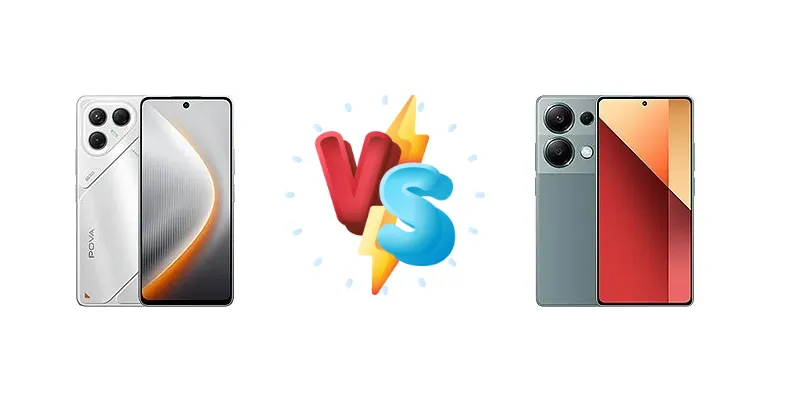
The Tecno Pova 7 and Xiaomi Redmi Note 13 Pro 4G represent compelling options in the increasingly competitive mid-range smartphone market. While both aim to deliver a feature-rich experience without breaking the bank, they take distinctly different approaches – the Pova 7 prioritizing raw processing power with the Dimensity 7300 Ultimate, while the Redmi Note 13 Pro 4G focuses on a balanced package with optimized efficiency and a bright display.
🏆 Quick Verdict
For users prioritizing gaming and demanding tasks, the Tecno Pova 7 emerges as the winner thanks to its significantly more powerful Dimensity 7300 Ultimate chipset. However, the Xiaomi Redmi Note 13 Pro 4G offers a more refined experience with its brighter display and faster wired charging, making it ideal for everyday users and media consumers.
| Network |
|---|
| 2G bands | GSM 850 / 900 / 1800 / 1900 | GSM 850 / 900 / 1800 / 1900 |
| 3G bands | HSDPA 850 / 900 / 2100 | HSDPA 850 / 900 / 1700(AWS) / 1900 / 2100 |
| 4G bands | LTE | 1, 2, 3, 4, 5, 7, 8, 12, 13, 17, 18, 19, 20, 26, 28, 38, 40, 41, 66 |
| 5G bands | SA/NSA | - |
| Speed | HSPA, LTE, 5G | HSPA, LTE |
| Technology | GSM / HSPA / LTE / 5G | GSM / HSPA / LTE |
| Launch |
|---|
| Announced | 2025, July 04 | 2024, January 15 |
| Status | Available. Released 2025, July 10 | Available. Released 2024, January 15 |
| Body |
|---|
| Build | - | Glass front (Gorilla Glass 5), plastic frame, plastic back |
| Dimensions | 167.3 x 75.6 x 8.9 mm (6.59 x 2.98 x 0.35 in) | 161.1 x 75 x 8 mm (6.34 x 2.95 x 0.31 in) |
| SIM | Nano-SIM + Nano-SIM | Nano-SIM + Nano-SIM |
| Weight | 207 g (7.30 oz) | 188 g (6.63 oz) |
| Display |
|---|
| Protection | - | Corning Gorilla Glass 5 |
| Resolution | 1080 x 2460 pixels (~396 ppi density) | 1080 x 2400 pixels, 20:9 ratio (~395 ppi density) |
| Size | 6.78 inches, 109.2 cm2 (~86.3% screen-to-body ratio) | 6.67 inches, 107.4 cm2 (~88.9% screen-to-body ratio) |
| Type | IPS LCD, 144Hz | AMOLED, 1B colors, 120Hz, 500 nits (typ), 1000 nits (HBM), 1300 nits (peak) |
| Platform |
|---|
| CPU | Octa-core (4x2.5 GHz Cortex-A78 & 4x2.0 GHz Cortex-A55) | Octa-core (2x2.2 GHz Cortex-A76 & 6x2.0 GHz Cortex-A55) |
| Chipset | Mediatek Dimensity 7300 Ultimate (4 nm) | Mediatek Helio G99 Ultra |
| GPU | Mali-G615 MC2 | Mali-G57 MC2 |
| OS | Android 15, HIOS 15 | Android 13, up to 3 major Android upgrades, HyperOS |
| Memory |
|---|
| Card slot | microSDXC (uses shared SIM slot) | microSDXC (uses shared SIM slot) |
| Internal | 128GB 8GB RAM, 256GB 8GB RAM | 128GB 8GB RAM, 256GB 8GB RAM, 256GB 12GB RAM, 512GB 8GB RAM, 512GB 12GB RAM |
| Main Camera |
|---|
| Features | Dual-LED flash | LED flash, HDR, panorama |
| Single | 50 MP, (wide), PDAF | - |
| Triple | - | 200 MP, f/1.7, 23mm (wide), 1/1.4", 0.56µm, multi-directional PDAF, OIS
8 MP, f/2.2, 15mm, 120˚ (ultrawide), 1/4.4", 1.0µm
2 MP (macro) |
| Video | 4K@30fps, 1080p@30fps | 1080p@30/60fps |
| Selfie camera |
|---|
| Single | 13 MP, (wide) | 16 MP, f/2.4, (wide), 1/3.0", 1.0µm |
| Video | Yes | 1080p@30/60fps |
| Sound |
|---|
| 35mm jack | Yes | Yes |
| Loudspeaker | Yes, with stereo speakers | Yes, with dual speakers |
| Comms |
|---|
| Bluetooth | Yes | 5.2, A2DP, LE |
| Infrared port | Yes | Yes |
| NFC | Yes | Yes (market/region dependent) |
| Positioning | GPS, GLONASS, GALILEO, BDS | GPS, GLONASS, GALILEO, BDS |
| Radio | FM radio, recording | FM radio |
| USB | USB Type-C 2.0, OTG | USB Type-C 2.0, OTG |
| WLAN | Wi-Fi 802.11 a/b/g/n/ac/6, dual-band | Wi-Fi 802.11 a/b/g/n/ac, dual-band |
| Features |
|---|
| Sensors | Accelerometer, gyro, proximity, compass | Fingerprint (under display, optical), accelerometer, gyro, compass |
| Battery |
|---|
| Charging | 45W wired, 50% in 29 min, 100% in 69 min
30W wireless (magnetic)
10W reverse wired | 67W wired, 50% in 16 min, 100% in 46 min |
| Type | Li-Po 6000 mAh | 5000 mAh |
| Misc |
|---|
| Colors | Geek Black, Magic Silver, Oasis Green | Midnight Black, Lavender Purple, Forest Green |
| Models | LJ7 | 23117RA68G, 2312FPCA6G |
| Price | ₹ 17,999 | € 92.00 / $ 269.99 / £ 299.99 |
| SAR | - | 1.09 W/kg (head) 1.09 W/kg (body) |
| SAR EU | - | 0.99 W/kg (head) 0.99 W/kg (body) |
Tecno Pova 7
- Significantly more powerful processor (Dimensity 7300 Ultimate)
- Faster wireless charging (30W magnetic)
- Reverse wired charging capability
- Slower wired charging (45W)
- Display brightness data unavailable, potentially lower than Redmi Note 13 Pro 4G
Xiaomi Redmi Note 13 Pro 4G
- Brighter display (1047 nits)
- Faster wired charging (67W)
- Excellent battery life (11:36h active use)
- Less powerful processor (Helio G99 Ultra)
- No wireless charging
Display Comparison
The Xiaomi Redmi Note 13 Pro 4G boasts a significantly brighter display, reaching a measured 1047 nits. This is crucial for outdoor visibility, a clear advantage over the Tecno Pova 7 (brightness data unavailable). While the Pova 7’s panel technology isn’t specified, the Redmi Note 13 Pro 4G’s brightness suggests a well-optimized LCD or AMOLED panel. Bezels are likely comparable given the price points, and color accuracy will depend on software calibration, a factor not detailed in the provided data.
Camera Comparison
Camera details are limited, but the focus should be on the main sensors. Without sensor size information, it’s difficult to make a definitive judgment. However, the Redmi Note 13 Pro 4G’s camera is marketed with photo and video capabilities, suggesting a focus on image quality. The Pova 7’s camera is not detailed, and any 2MP macro lenses on either device should be considered marketing filler rather than significant photographic tools. Image processing algorithms will play a key role, and user reviews will be essential to determine which phone delivers more pleasing results.
Performance
The core difference lies in the chipsets. The Tecno Pova 7’s Mediatek Dimensity 7300 Ultimate, built on a 4nm process, offers a substantial performance leap over the Redmi Note 13 Pro 4G’s Helio G99 Ultra. The Dimensity 7300 Ultimate’s Cortex-A78 cores, clocked at 2.5 GHz, provide significantly higher single-core performance than the G99 Ultra’s 2.2 GHz Cortex-A76 cores. The 4nm node also translates to improved thermal efficiency, potentially reducing throttling during sustained workloads. While the Redmi Note 13 Pro 4G is capable for everyday tasks, the Pova 7 is demonstrably better suited for gaming and resource-intensive applications.
Battery Life
The Redmi Note 13 Pro 4G excels in charging speed, achieving 50% charge in just 16 minutes and 100% in 46 minutes with its 67W wired charging. The Tecno Pova 7, with 45W charging, takes 29 minutes for 50% and 69 minutes for a full charge. The Pova 7 also introduces 30W wireless (magnetic) and 10W reverse wired charging, features absent in the Redmi Note 13 Pro 4G. The Redmi Note 13 Pro 4G’s active use score of 11:36h indicates excellent battery life, but the Pova 7’s battery capacity isn’t specified, making a direct comparison difficult. The faster charging of the Redmi Note 13 Pro 4G is a significant convenience factor.
Buying Guide
Buy the Tecno Pova 7 if you need a phone capable of handling demanding games and applications, and value the flexibility of both fast wired and wireless charging. Buy the Xiaomi Redmi Note 13 Pro 4G if you prioritize a vibrant display for media consumption, exceptionally fast wired charging, and all-day battery life for typical daily use.
Frequently Asked Questions
❓ Does the Dimensity 7300 Ultimate in the Tecno Pova 7 get hot during prolonged gaming sessions?
The Dimensity 7300 Ultimate's 4nm process is designed for improved thermal efficiency. While some heat is inevitable during intense gaming, it should be better managed than the Helio G99 Ultra in the Redmi Note 13 Pro 4G, leading to less throttling and more consistent performance over extended periods.
❓ How does the 67W charging on the Redmi Note 13 Pro 4G compare to other phones in this price range?
67W charging is exceptionally fast for a phone in this price bracket. It significantly reduces charging times compared to the 33W or 45W charging commonly found in competitors, allowing you to quickly top up your battery and minimize downtime.
❓ Is the lack of wireless charging on the Redmi Note 13 Pro 4G a significant drawback?
For users who frequently utilize wireless charging, the absence of this feature on the Redmi Note 13 Pro 4G is a notable omission. However, the significantly faster wired charging speed may compensate for this, as topping up the battery via cable is much quicker.
❓ What kind of gaming performance can I expect from the Helio G99 Ultra in the Redmi Note 13 Pro 4G?
The Helio G99 Ultra is capable of running most popular mobile games at medium settings. However, demanding titles may require lower graphics settings to maintain a smooth frame rate. It's best suited for casual gamers rather than those seeking a high-end gaming experience.