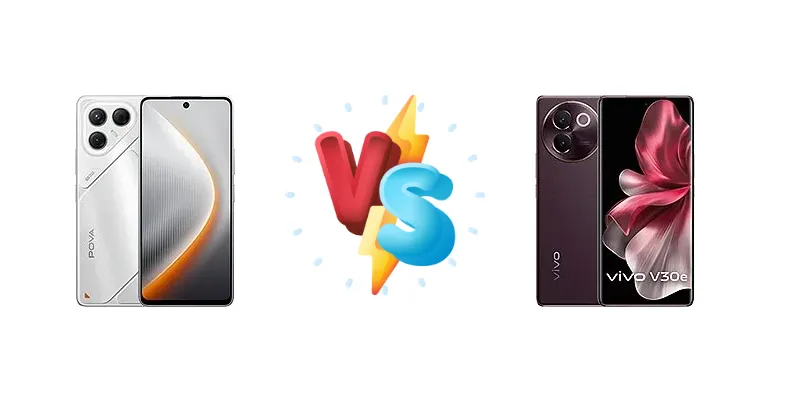
The Tecno Pova 7 and vivo V30e represent compelling options in the increasingly competitive mid-range smartphone market. The Pova 7 aggressively targets gamers with its powerful Mediatek Dimensity 7300 Ultimate, while the V30e prioritizes a balanced experience with Qualcomm’s Snapdragon 6 Gen 1. This comparison dissects their key differences to help you determine which device best suits your needs.
🏆 Quick Verdict
For users prioritizing gaming and raw performance, the Tecno Pova 7 is the clear winner. Its Dimensity 7300 Ultimate chipset delivers a significant performance uplift. However, the vivo V30e offers a more refined, efficient experience for everyday tasks and benefits from Qualcomm’s optimized software integration.
| Network |
|---|
| 2G bands | GSM 850 / 900 / 1800 / 1900 | GSM 850 / 900 / 1800 / 1900 |
| 3G bands | HSDPA 850 / 900 / 2100 | HSDPA 850 / 900 / 1700(AWS) / 1900 / 2100 - Malaysia |
| 4G bands | LTE | 1, 2, 3, 4, 5, 7, 8, 18, 19, 20, 26, 28, 38, 39, 40, 41 - Malaysia |
| 5G bands | SA/NSA | 1, 3, 5, 7, 8, 20, 28, 38, 40, 41, 77, 78 SA/NSA - Malaysia |
| Speed | HSPA, LTE, 5G | HSPA, LTE, 5G |
| Technology | GSM / HSPA / LTE / 5G | GSM / HSPA / LTE / 5G |
| Launch |
|---|
| Announced | 2025, July 04 | 2024, May 02 |
| Status | Available. Released 2025, July 10 | Available. Released 2024, May 09 |
| Body |
|---|
| Build | - | Glass front, plastic frame, glass back or plastic back |
| Dimensions | 167.3 x 75.6 x 8.9 mm (6.59 x 2.98 x 0.35 in) | 164.4 x 74.8 x 7.7 mm (6.47 x 2.94 x 0.30 in) |
| SIM | Nano-SIM + Nano-SIM | Nano-SIM + Nano-SIM |
| Weight | 207 g (7.30 oz) | 179 g or 188 g (6.31 oz) |
| Display |
|---|
| Protection | - | Schott Xensation |
| Resolution | 1080 x 2460 pixels (~396 ppi density) | 1080 x 2400 pixels, 20:9 ratio (~388 ppi density) |
| Size | 6.78 inches, 109.2 cm2 (~86.3% screen-to-body ratio) | 6.78 inches, 111.0 cm2 (~90.3% screen-to-body ratio) |
| Type | IPS LCD, 144Hz | AMOLED, 1B colors, 120Hz, 1300 nits (peak) |
| Platform |
|---|
| CPU | Octa-core (4x2.5 GHz Cortex-A78 & 4x2.0 GHz Cortex-A55) | Octa-core (4x2.2 GHz Cortex-A78 & 4x1.8 GHz Cortex-A55) |
| Chipset | Mediatek Dimensity 7300 Ultimate (4 nm) | Qualcomm SM6450 Snapdragon 6 Gen 1 (4 nm) |
| GPU | Mali-G615 MC2 | Adreno 710 |
| OS | Android 15, HIOS 15 | Android 14, Funtouch 14 |
| Memory |
|---|
| Card slot | microSDXC (uses shared SIM slot) | microSDXC (uses shared SIM slot) |
| Internal | 128GB 8GB RAM, 256GB 8GB RAM | 128GB 8GB RAM, 256GB 8GB RAM, 256GB 12GB RAM |
| Main Camera |
|---|
| Dual | - | 50 MP, f/1.8, 26mm (wide), 1/1.95", 0.8µm, PDAF, OIS (India only)
8 MP, f/2.2, 120˚ (ultrawide), 1/4.0", 1.12µm |
| Features | Dual-LED flash | Ring-LED flash, panorama, HDR |
| Single | 50 MP, (wide), PDAF | - |
| Video | 4K@30fps, 1080p@30fps | 4K@30fps, 1080p@30fps |
| Selfie camera |
|---|
| Single | 13 MP, (wide) | 50 MP, f/2.5, 25mm (wide), AF - India
32 MP, f/2.0, 24mm (wide) - Malaysia |
| Video | Yes | 4K@30fps (India only), 1080p@30fps |
| Sound |
|---|
| 35mm jack | Yes | No |
| Loudspeaker | Yes, with stereo speakers | Yes |
| Comms |
|---|
| Bluetooth | Yes | 5.1, A2DP, LE |
| Infrared port | Yes | - |
| NFC | Yes | Yes (market/region dependent) |
| Positioning | GPS, GLONASS, GALILEO, BDS | GPS, GLONASS, GALILEO, BDS, QZSS, NavIC |
| Radio | FM radio, recording | No |
| USB | USB Type-C 2.0, OTG | USB Type-C 2.0, OTG |
| WLAN | Wi-Fi 802.11 a/b/g/n/ac/6, dual-band | Wi-Fi 802.11 a/b/g/n/ac, dual-band |
| Features |
|---|
| Sensors | Accelerometer, gyro, proximity, compass | Fingerprint (under display, optical), accelerometer, gyro, proximity, compass |
| Battery |
|---|
| Charging | 45W wired, 50% in 29 min, 100% in 69 min
30W wireless (magnetic)
10W reverse wired | 44W wired, PD
Reverse wired |
| Type | Li-Po 6000 mAh | Li-Ion 5500 mAh |
| Misc |
|---|
| Colors | Geek Black, Magic Silver, Oasis Green | Velvet Red (Coco Brown), Silk Blue, Sky Mirror |
| Models | LJ7 | V2339 |
| Price | ₹ 17,999 | ₹ 23,999 |
Tecno Pova 7
- Significantly faster charging speeds (45W wired, 30W wireless)
- More powerful processor (Dimensity 7300 Ultimate) for gaming
- Reverse wireless charging capability
- Potential for more thermal throttling under sustained load
- Software experience may be less refined than vivo
vivo V30e
- More efficient processor (Snapdragon 6 Gen 1) for daily tasks
- Potentially better camera image processing
- Streamlined user experience with vivo’s software
- Slower charging speeds (44W wired)
- Less powerful processor for demanding games
Display Comparison
Neither device's display specifications are provided, so a direct comparison is limited. However, given the Pova series' history, we can expect the Pova 7 to prioritize a high refresh rate for gaming, potentially at the expense of color accuracy. The V30e, aligning with vivo’s focus, likely emphasizes color calibration and viewing angles. The absence of LTPO technology on either device suggests both will rely on adaptive refresh rate scaling rather than variable refresh rates for power efficiency.
Camera Comparison
Without detailed camera specs, analysis is limited. However, the market positioning suggests the V30e will likely focus on image processing and software enhancements, a hallmark of vivo’s camera experience. The Pova 7 may lean towards larger sensors to capture more light, but potentially with less sophisticated image processing. The absence of information regarding OIS (Optical Image Stabilization) on either device suggests both may rely heavily on electronic image stabilization, which can introduce artifacts in video recording. We can assume both will include standard wide and ultrawide lenses, but the Pova 7 might prioritize a higher resolution main sensor.
Performance
The core difference lies in the chipsets. The Tecno Pova 7’s Mediatek Dimensity 7300 Ultimate (4nm) boasts a more powerful CPU configuration – 4x2.5 GHz Cortex-A78 cores versus the vivo V30e’s 4x2.2 GHz Cortex-A78 cores. This, combined with the Dimensity’s generally more potent GPU, translates to noticeably faster frame rates in demanding games. While both are built on a 4nm process, the Dimensity 7300 Ultimate’s architecture provides a performance advantage. The Snapdragon 6 Gen 1 in the V30e prioritizes efficiency, potentially leading to better sustained performance under lighter loads and improved thermal management. The Pova 7 will likely exhibit more throttling during extended gaming sessions.
Battery Life
The Tecno Pova 7’s 45W wired charging, reaching 50% in 29 minutes and 100% in 69 minutes, is significantly faster than the vivo V30e’s 44W PD charging. The Pova 7 also introduces 30W wireless (magnetic) charging and 10W reverse wired charging, features absent on the V30e. While battery capacity isn’t specified, the faster charging speeds on the Pova 7 suggest a focus on minimizing downtime, crucial for gamers. The V30e’s PD support ensures compatibility with a wider range of chargers, but it won’t match the Pova 7’s charging speed.
Buying Guide
Buy the Tecno Pova 7 if you need a phone primarily for gaming, demanding multitasking, and fast charging speeds, and are willing to trade some software polish for raw power. Buy the vivo V30e if you prefer a more streamlined user experience, efficient power consumption for all-day use, and a generally more balanced feature set, even if it means sacrificing some peak performance.
Frequently Asked Questions
❓ Will the Dimensity 7300 Ultimate in the Tecno Pova 7 overheat during prolonged gaming sessions?
While the 4nm process helps mitigate heat, the Dimensity 7300 Ultimate is a powerful chip. Expect some thermal throttling during extended gaming, potentially leading to a slight drop in frame rates. The Pova 7 may require active cooling solutions (like a gaming cooler) for optimal sustained performance.
❓ Does the vivo V30e support high frame rate gaming (90fps or higher) in popular titles like PUBG Mobile?
The Snapdragon 6 Gen 1 is capable of running PUBG Mobile, but achieving consistently high frame rates (90fps+) will depend on the game settings and the specific device optimization. Expect to likely play at 60fps with balanced graphics settings for a smoother experience.
❓ How useful is the reverse wired charging feature on the Tecno Pova 7?
The 10W reverse wired charging is primarily useful for topping up accessories like wireless earbuds or smartwatches in emergencies. It's not designed for quickly charging another phone, but provides a convenient way to share power in a pinch.