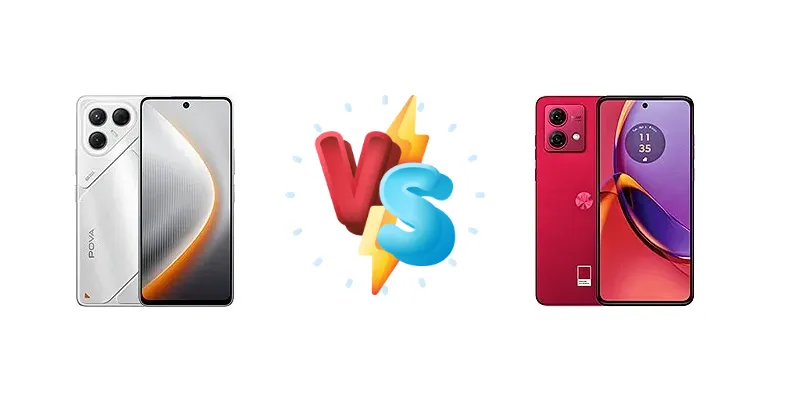
The Tecno Pova 7 and Motorola Moto G84 represent distinct approaches to the mid-range smartphone market. The Pova 7 aggressively targets performance with the Mediatek Dimensity 7300 Ultimate, while the Moto G84 prioritizes a balanced experience with a focus on battery life and a bright display. This comparison dissects their key differences to help you determine which device best suits your needs.
🏆 Quick Verdict
For users prioritizing raw processing power and rapid charging, the Tecno Pova 7 is the clear winner. However, the Motorola Moto G84 offers a more refined, all-day experience with its excellent battery endurance and bright display, making it ideal for everyday users.
| Network |
|---|
| 2G bands | GSM 850 / 900 / 1800 / 1900 | GSM 850 / 900 / 1800 / 1900 |
| 3G bands | HSDPA 850 / 900 / 2100 | HSDPA 850 / 900 / 1700(AWS) / 1900 / 2100 - LATAM |
| 4G bands | LTE | 1, 2, 3, 4, 5, 7, 8, 12, 13, 17, 25, 26, 28, 38, 40, 41, 42, 66 - LATAM |
| 5G bands | SA/NSA | 1, 2, 3, 5, 7, 26, 28, 40, 66, 78 SA/NSA/Sub6 - LATAM |
| Speed | HSPA, LTE, 5G | HSPA, LTE, 5G |
| Technology | GSM / HSPA / LTE / 5G | GSM / HSPA / LTE / 5G |
| Launch |
|---|
| Announced | 2025, July 04 | 2023, August 24 |
| Status | Available. Released 2025, July 10 | Available. Released 2023, September 08 |
| Body |
|---|
| Build | - | Glass front, plastic frame, plastic back or eco leather back |
| Dimensions | 167.3 x 75.6 x 8.9 mm (6.59 x 2.98 x 0.35 in) | 160 x 74.4 x 7.6 mm (6.30 x 2.93 x 0.30 in) |
| SIM | Nano-SIM + Nano-SIM | Nano-SIM + Nano-SIM |
| Weight | 207 g (7.30 oz) | 166.8 g (5.86 oz) |
| Display |
|---|
| Resolution | 1080 x 2460 pixels (~396 ppi density) | 1080 x 2400 pixels, 20:9 ratio (~405 ppi density) |
| Size | 6.78 inches, 109.2 cm2 (~86.3% screen-to-body ratio) | 6.5 inches, 102.0 cm2 (~85.7% screen-to-body ratio) |
| Type | IPS LCD, 144Hz | P-OLED, 1B colors, 120Hz, 1300 nits (peak) |
| Platform |
|---|
| CPU | Octa-core (4x2.5 GHz Cortex-A78 & 4x2.0 GHz Cortex-A55) | Octa-core (2x2.2 GHz Kryo 660 Gold & 6x1.7 GHz Kryo 660 Silver) |
| Chipset | Mediatek Dimensity 7300 Ultimate (4 nm) | Qualcomm SM6375 Snapdragon 695 5G (6 nm) |
| GPU | Mali-G615 MC2 | Adreno 619 |
| OS | Android 15, HIOS 15 | Android 13, upgradable to Android 15 |
| Memory |
|---|
| Card slot | microSDXC (uses shared SIM slot) | microSDXC (uses shared SIM slot) |
| Internal | 128GB 8GB RAM, 256GB 8GB RAM | 256GB 8GB RAM, 256GB 12GB RAM |
| Main Camera |
|---|
| Dual | - | 50 MP, f/1.9 (wide), 1/1.5", 1.0µm, PDAF, OIS
8 MP, f/2.2, 120˚ (ultrawide), 1/4.0", 1.12µm, AF |
| Features | Dual-LED flash | LED flash, HDR, panorama |
| Single | 50 MP, (wide), PDAF | - |
| Video | 4K@30fps, 1080p@30fps | 1080p@30/60fps |
| Selfie camera |
|---|
| Single | 13 MP, (wide) | 16 MP, f/2.5, (wide), 1.0µm |
| Video | Yes | 1080p@30fps |
| Sound |
|---|
| 35mm jack | Yes | Yes |
| Loudspeaker | Yes, with stereo speakers | Yes, with stereo speakers |
| Comms |
|---|
| Bluetooth | Yes | 5.1, A2DP, LE |
| Infrared port | Yes | - |
| NFC | Yes | Yes (market/region dependent) |
| Positioning | GPS, GLONASS, GALILEO, BDS | GPS, GLONASS, GALILEO |
| Radio | FM radio, recording | FM radio (market/region dependent) |
| USB | USB Type-C 2.0, OTG | USB Type-C 2.0 |
| WLAN | Wi-Fi 802.11 a/b/g/n/ac/6, dual-band | Wi-Fi 802.11 a/b/g/n/ac, dual-band, Wi-Fi Direct |
| Features |
|---|
| Sensors | Accelerometer, gyro, proximity, compass | Fingerprint (under display, optical), accelerometer, gyro, proximity, compass |
| Battery |
|---|
| Charging | 45W wired, 50% in 29 min, 100% in 69 min
30W wireless (magnetic)
10W reverse wired | 30W wired |
| Type | Li-Po 6000 mAh | Li-Po 5000 mAh |
| Misc |
|---|
| Colors | Geek Black, Magic Silver, Oasis Green | Marshmallow Blue, Midnight Blue, Viva Magenta |
| Models | LJ7 | XT2347, XT2347-1, XT2347-2 |
| Price | ₹ 17,999 | $ 399.00 / £ 189.99 / € 169.00 |
Tecno Pova 7
- Significantly faster processor for demanding tasks
- Ultra-fast 45W wired and 30W wireless charging
- 10W reverse wired charging for accessories
- Battery life figures are unknown, potentially lower than Moto G84
- Camera specs are not detailed, potentially average performance
Motorola Moto G84
- Excellent battery life (12:31h active use, 117h endurance)
- Bright display (996 nits) for outdoor visibility
- Balanced and efficient performance for everyday use
- Slower processor compared to the Dimensity 7300 Ultimate
- Slower 30W charging speed
Display Comparison
The Motorola Moto G84 boasts a significantly brighter display, reaching a measured 996 nits, which translates to excellent outdoor visibility. While the Tecno Pova 7’s display specs are not provided, the G84’s brightness advantage is substantial. The Moto G84’s panel likely benefits from its focus on efficiency, contributing to the phone’s overall endurance. Without knowing the Pova 7’s panel type or refresh rate, it’s difficult to assess its color accuracy or smoothness, but the G84 sets a high bar for visual clarity.
Camera Comparison
The context data for both devices is limited regarding camera capabilities. However, the absence of detailed sensor information suggests neither phone is positioned as a photography powerhouse. The Moto G84’s inclusion of 'Photo / Video' implies a balanced approach, but without knowing sensor sizes or aperture values, it’s difficult to assess image quality. The Pova 7’s camera specs are entirely unknown. It’s reasonable to assume both phones will perform adequately in good lighting conditions, but low-light performance is likely to be a weak point for both, especially given their market segment.
Performance
The Tecno Pova 7’s Mediatek Dimensity 7300 Ultimate (4nm) represents a significant leap in processing power compared to the Motorola Moto G84’s Qualcomm Snapdragon 695 5G (6nm). The Dimensity 7300 Ultimate’s Cortex-A78 cores, clocked at 2.5 GHz, offer substantially higher single-core performance, crucial for responsive app launches and smoother multitasking. The 4nm process node also contributes to improved thermal efficiency, potentially mitigating throttling during extended gaming sessions. While the Snapdragon 695 is adequate for everyday tasks, the Pova 7 is geared towards users who demand more from their smartphone. The G84’s Kryo 660 Gold cores at 2.2 GHz are less capable in CPU-intensive workloads.
Battery Life
The Motorola Moto G84 excels in battery life, achieving an active use score of 12:31h and an endurance rating of 117h. This demonstrates a strong focus on efficiency. The Tecno Pova 7, while offering faster charging – 45W wired and 30W wireless – doesn’t provide battery life figures. The Pova 7’s 45W charging can reach 50% in 29 minutes and 100% in 69 minutes, a significant advantage over the G84’s 30W charging. The Pova 7 also includes 10W reverse wired charging, a feature absent on the G84. The trade-off is clear: the G84 prioritizes longevity, while the Pova 7 prioritizes quick top-ups.
Buying Guide
Buy the Tecno Pova 7 if you need a phone for demanding tasks like mobile gaming, video editing, or frequent multitasking, and value the fastest possible charging speeds. Buy the Motorola Moto G84 if you prefer a phone that lasts all day on a single charge, offers a vibrant viewing experience, and provides a smooth, reliable daily driver experience without compromising on 5G connectivity.
Frequently Asked Questions
❓ Does the Mediatek Dimensity 7300 Ultimate in the Tecno Pova 7 generate excessive heat during prolonged gaming sessions?
The Dimensity 7300 Ultimate's 4nm process node is designed for improved thermal efficiency. While demanding games will inevitably generate heat, the 4nm node should help mitigate throttling compared to older, larger process nodes. However, sustained peak performance will still lead to some temperature increase, and the Pova 7’s cooling solution will be a key factor in maintaining stable frame rates.
❓ How does the Snapdragon 695 5G in the Motorola Moto G84 handle graphically intensive games like PUBG Mobile or Call of Duty Mobile?
The Snapdragon 695 5G is capable of running PUBG Mobile and Call of Duty Mobile, but likely at medium graphics settings to maintain a stable frame rate. It’s not a gaming-focused chipset, so users should expect some compromises in visual fidelity. The G84 prioritizes efficiency over raw graphical power, so it’s best suited for casual gaming rather than competitive, high-settings play.
❓ Is the 30W charging on the Motorola Moto G84 fast enough for quick top-ups throughout the day?
While 30W charging isn't the fastest available, it's sufficient for topping up the battery during short breaks. The Moto G84’s excellent battery life means you likely won’t need to top up as frequently as with other phones. However, a full charge will take considerably longer than the Tecno Pova 7’s 45W charging.