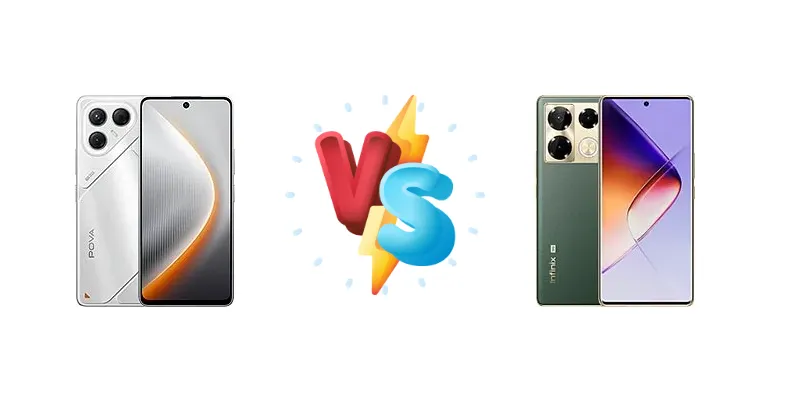
The Tecno Pova 7 and Infinix Note 40 Pro represent compelling options in the increasingly competitive mid-range smartphone market. Both leverage MediaTek's Dimensity series, but diverge in their implementation, particularly around charging technology and core processing power. This comparison dissects these differences to help you determine which device best suits your needs.
🏆 Quick Verdict
For users prioritizing raw performance and faster charging, the Tecno Pova 7 emerges as the winner. Its Dimensity 7300 Ultimate, built on a 4nm process, offers a noticeable edge in CPU and GPU capabilities. However, the Infinix Note 40 Pro’s MagCharge wireless charging and potentially more refined software experience make it a strong contender for those valuing convenience.
| Network |
|---|
| 2G bands | GSM 850 / 900 / 1800 / 1900 | GSM 850 / 900 / 1800 / 1900 |
| 3G bands | HSDPA 850 / 900 / 2100 | HSDPA 850 / 900 / 1700(AWS) / 1900 / 2100 |
| 4G bands | LTE | 1, 2, 3, 4, 5, 7, 8, 12, 17, 20, 28, 38, 40, 41, 42, 66 |
| 5G bands | SA/NSA | 1, 3, 5, 7, 8, 12, 20, 28, 38, 40, 41, 66, 77, 78 SA/NSA |
| Speed | HSPA, LTE, 5G | HSPA, LTE, 5G |
| Technology | GSM / HSPA / LTE / 5G | GSM / HSPA / LTE / 5G |
| Launch |
|---|
| Announced | 2025, July 04 | 2024, March 18 |
| Status | Available. Released 2025, July 10 | Available. Released 2024, March 19 |
| Body |
|---|
| Dimensions | 167.3 x 75.6 x 8.9 mm (6.59 x 2.98 x 0.35 in) | 164.3 x 74.5 x 8.1 mm (6.47 x 2.93 x 0.32 in) |
| SIM | Nano-SIM + Nano-SIM | Nano-SIM + Nano-SIM |
| Weight | 207 g (7.30 oz) | 190 g or 196 g (6.70 oz) |
| Display |
|---|
| Protection | - | Corning Gorilla Glass |
| Resolution | 1080 x 2460 pixels (~396 ppi density) | 1080 x 2436 pixels (~393 ppi density) |
| Size | 6.78 inches, 109.2 cm2 (~86.3% screen-to-body ratio) | 6.78 inches, 109.9 cm2 (~89.8% screen-to-body ratio) |
| Type | IPS LCD, 144Hz | AMOLED, 1B colors, 120Hz, 2160Hz PWM, 1300 nits (peak) |
| Platform |
|---|
| CPU | Octa-core (4x2.5 GHz Cortex-A78 & 4x2.0 GHz Cortex-A55) | Octa-core (2x2.2 GHz Cortex-A78 & 6x2.0 GHz Cortex-A55) |
| Chipset | Mediatek Dimensity 7300 Ultimate (4 nm) | Mediatek Dimensity 7020 (6 nm) |
| GPU | Mali-G615 MC2 | IMG BXM-8-256 |
| OS | Android 15, HIOS 15 | Android 14, XOS 14 |
| Memory |
|---|
| Card slot | microSDXC (uses shared SIM slot) | Unspecified |
| Internal | 128GB 8GB RAM, 256GB 8GB RAM | 256GB 8GB RAM |
| Main Camera |
|---|
| Features | Dual-LED flash | Dual-LED flash, HDR, panorama |
| Single | 50 MP, (wide), PDAF | - |
| Triple | - | 108 MP, f/1.8, (wide), PDAF, OIS
2 MP, f/2.4
2 MP, f/2.4 |
| Video | 4K@30fps, 1080p@30fps | 1440p@30fps, 1080p@30/60fps |
| Selfie camera |
|---|
| Features | - | Dual-LED flash |
| Single | 13 MP, (wide) | 32 MP, f/2.2, (wide), 1/3.1" |
| Video | Yes | 1080p@30fps |
| Sound |
|---|
| 35mm jack | Yes | No |
| Loudspeaker | Yes, with stereo speakers | Yes, with stereo speakers |
| Comms |
|---|
| Bluetooth | Yes | Yes |
| Infrared port | Yes | Yes |
| NFC | Yes | Yes (market/region dependent) |
| Positioning | GPS, GLONASS, GALILEO, BDS | GPS |
| Radio | FM radio, recording | FM radio |
| USB | USB Type-C 2.0, OTG | USB Type-C 2.0, OTG |
| WLAN | Wi-Fi 802.11 a/b/g/n/ac/6, dual-band | Wi-Fi 802.11 a/b/g/n/ac, dual-band |
| Features |
|---|
| Sensors | Accelerometer, gyro, proximity, compass | Fingerprint (under display, optical), accelerometer, gyro, proximity, compass |
| Battery |
|---|
| Charging | 45W wired, 50% in 29 min, 100% in 69 min
30W wireless (magnetic)
10W reverse wired | 45W wired, 50% in 26 min
20W wireless MagCharge
Reverse wired
Reverse wireless |
| Type | Li-Po 6000 mAh | 5000 mAh |
| Misc |
|---|
| Colors | Geek Black, Magic Silver, Oasis Green | Vintage Green, Titan Gold, Racing Edition |
| Models | LJ7 | X6851 |
| Price | ₹ 17,999 | About 280 EUR |
Tecno Pova 7
- More powerful Dimensity 7300 Ultimate chipset
- Faster 30W magnetic wireless charging
- Potentially better sustained gaming performance due to 4nm process
- May prioritize performance over camera features
- Software experience may be less refined than Infinix
Infinix Note 40 Pro
- Convenient MagCharge wireless charging
- Reverse wireless charging capability
- Potentially more polished software experience
- Less powerful Dimensity 7020 chipset
- Slower wireless charging speed (20W)
Display Comparison
While both devices likely feature similar LCD or AMOLED panels (data unavailable), the core difference lies in the underlying processing power driving them. Display quality will be heavily influenced by software calibration, which is brand-specific. Without specific display specs, it's difficult to declare a winner, but the Pova 7's more powerful GPU could potentially handle higher refresh rates or more demanding visual effects in games.
Camera Comparison
Without detailed camera specifications, a direct comparison is challenging. However, the market positioning suggests the Pova 7 may prioritize gaming features over camera prowess, while the Note 40 Pro might lean towards a more balanced approach. Image processing algorithms will play a crucial role, and both phones likely employ software enhancements to improve image quality. The absence of information regarding sensor size and optical image stabilization (OIS) makes it impossible to definitively assess camera performance.
Performance
The Tecno Pova 7’s Mediatek Dimensity 7300 Ultimate (4nm) significantly outpaces the Infinix Note 40 Pro’s Dimensity 7020 (6nm) in terms of architectural efficiency and raw power. The 7300 Ultimate features a more modern CPU configuration – four Cortex-A78 cores clocked at 2.5 GHz versus the Note 40 Pro’s two Cortex-A78 cores at 2.2 GHz. This translates to faster single-core performance and improved responsiveness. The 4nm fabrication process further enhances efficiency, reducing heat and enabling sustained performance during prolonged gaming sessions. The Note 40 Pro’s 6nm process, while still efficient, will likely exhibit more thermal throttling under heavy load.
Battery Life
Both phones offer 45W wired charging, with the Pova 7 reaching 50% in 29 minutes and 100% in 69 minutes, while the Note 40 Pro achieves 50% in 26 minutes. This suggests slightly faster initial charging on the Infinix, but comparable full charge times. The Pova 7 distinguishes itself with 30W wireless charging (magnetic), a significant advantage over the Note 40 Pro’s 20W MagCharge. The Pova 7 also includes 10W reverse wired charging, a feature present on the Note 40 Pro in both wired and wireless forms. The faster wireless charging speed of the Pova 7 is a key differentiator for users who frequently utilize wireless power.
Buying Guide
Buy the Tecno Pova 7 if you need a phone optimized for gaming and demanding tasks, and value the fastest possible wired and wireless charging speeds. Its more powerful chipset will translate to smoother multitasking and higher frame rates. Buy the Infinix Note 40 Pro if you prioritize wireless charging convenience with MagCharge, appreciate a potentially more polished software experience, and are willing to trade a small amount of raw processing power for these features.
Frequently Asked Questions
❓ Will the Dimensity 7020 in the Infinix Note 40 Pro struggle with graphically intensive games like Genshin Impact?
While the Dimensity 7020 is a capable chip, Genshin Impact and similar titles will likely require reduced graphics settings for smooth gameplay. The Dimensity 7300 Ultimate in the Pova 7 offers a more comfortable experience with higher settings and sustained frame rates due to its superior processing power and thermal efficiency.
❓ How does the MagCharge feature on the Infinix Note 40 Pro compare to standard Qi wireless charging?
MagCharge utilizes magnets to align the phone perfectly with the wireless charger, resulting in more efficient power transfer and a more secure connection. Standard Qi wireless charging can be less precise, leading to slower charging speeds and potential misalignment issues. However, the Pova 7's higher wattage wireless charging may still deliver faster overall charging times despite not using MagCharge.
❓ Is the 10W reverse wired charging on the Tecno Pova 7 useful for charging accessories like earbuds?
Yes, the 10W reverse wired charging is convenient for topping up small accessories like wireless earbuds or a smartwatch. While not as fast as dedicated chargers, it provides a useful emergency charging option when a power outlet isn't available.