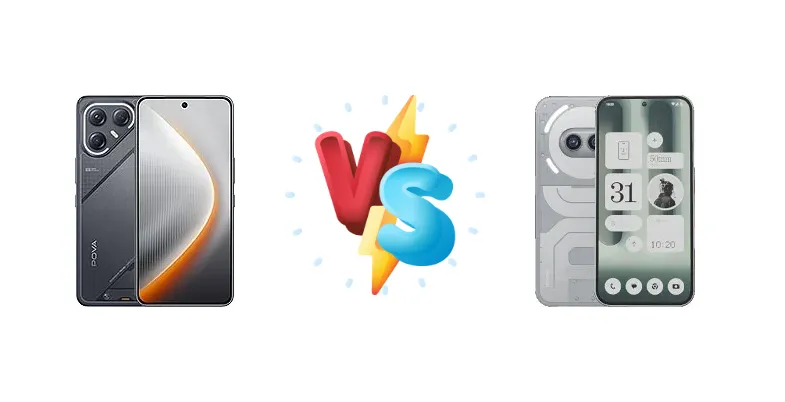
The Tecno Pova 7 Ultra and Nothing Phone (2a) Plus represent distinct approaches to the mid-range smartphone market. The Pova 7 Ultra aggressively targets gamers with a high-end chipset and rapid charging, while the Nothing Phone (2a) Plus aims for a more balanced experience, prioritizing battery life and a clean software experience. This comparison dissects their key differences to help you choose the right device.
🏆 Quick Verdict
For users prioritizing raw performance and lightning-fast charging, the Tecno Pova 7 Ultra is the clear winner. However, the Nothing Phone (2a) Plus delivers exceptional all-day battery life and a brighter display, making it the better choice for everyday users and media consumers.
| Network |
|---|
| 2G bands | GSM 850 / 900 / 1800 / 1900 | GSM 850 / 900 / 1800 / 1900 |
| 3G bands | HSDPA 850 / 900 / 2100 | HSDPA 800 / 850 / 900 / 1700(AWS) / 1900 / 2100 |
| 4G bands | LTE | 1, 3, 4, 5, 7, 8, 18, 19, 20, 26, 28, 38, 39, 40, 41, 42, 66 |
| 5G bands | SA/NSA | 1, 3, 5, 7, 8, 20, 28, 38, 40, 41, 66, 77, 78 SA/NSA |
| Speed | HSPA, LTE, 5G | HSPA, LTE, 5G |
| Technology | GSM / HSPA / LTE / 5G | GSM / HSPA / LTE / 5G |
| Launch |
|---|
| Announced | 2025, June 20 | 2024, July 31 |
| Status | Available. Released 2025, July | Available. Released 2024, August 03 |
| Body |
|---|
| Build | - | Glass front (Gorilla Glass 5), plastic frame, plastic back |
| Dimensions | 160 x 75.2 x 8.9 mm (6.30 x 2.96 x 0.35 in) | 161.7 x 76.3 x 8.5 mm (6.37 x 3.00 x 0.33 in) |
| SIM | Nano-SIM + Nano-SIM | Nano-SIM + Nano-SIM |
| Weight | - | 190 g (6.70 oz) |
| Display |
|---|
| Protection | Corning Gorilla Glass 7i | Corning Gorilla Glass 5 |
| Resolution | 1260 x 2800 pixels, 20:9 ratio (~460 ppi density) | 1080 x 2412 pixels, 20:9 ratio (~395 ppi density) |
| Size | 6.67 inches, 107.4 cm2 (~89.3% screen-to-body ratio) | 6.7 inches, 107.5 cm2 (~87.1% screen-to-body ratio) |
| Type | AMOLED, 1B colors, 144Hz, 2592Hz PWM, 4500 nits (peak) | AMOLED, 1B colors, 120Hz, 2160Hz PWM, HDR10+, 700 nits (typ), 1100 nits (HBM), 1300 nits (peak) |
| Platform |
|---|
| CPU | Octa-core (1x3.35 GHz Cortex-A715 & 3x3.20 GHz Cortex-A715 & 4x2.20 GHz Cortex-A510) | Octa-core (2x3.0 GHz Cortex-A715 & 6x 2.0 GHz Cortex-A510) |
| Chipset | Mediatek Dimensity 8350 Ultimate (4 nm) | Mediatek Dimensity 7350 Pro (4 nm) |
| GPU | Mali G615-MC6 | Mali-G610 MC4 |
| OS | Android 15, HIOS 15 | Android 14, up to 3 major Android upgrades, Nothing OS 3.0 |
| Memory |
|---|
| Card slot | No | No |
| Internal | 256GB 8GB RAM, 256GB 12GB RAM | 256GB 8GB RAM, 256GB 12GB RAM |
| Main Camera |
|---|
| Dual | 108 MP, (wide), 0.7µm, PDAF
8 MP, (ultrawide) | 50 MP, f/1.9, 24mm (wide), 1/1.57", 1.0µm, PDAF, OIS
50 MP, f/2.2, 114˚ (ultrawide), 1/2.76", 0.64µm |
| Features | Dual-LED flash | LED flash, panorama, HDR |
| Video | Yes | 4K@30fps, 1080p@60/120fps, gyro-EIS |
| Selfie camera |
|---|
| Features | - | HDR |
| Single | 13 MP, (wide) | 50 MP, f/2.2, (wide), 1/2.76" |
| Video | Yes | 4K@30fps |
| Sound |
|---|
| 35mm jack | Yes | No |
| Loudspeaker | Yes, with stereo speakers | Yes, with stereo speakers |
| Comms |
|---|
| Bluetooth | Yes | 5.3, A2DP, LE |
| Infrared port | Yes | - |
| NFC | Yes | Yes, 360˚ |
| Positioning | GPS, GLONASS, GALILEO, BDS | GPS, GALILEO, GLONASS, BDS, QZSS |
| Radio | Unspecified | No |
| USB | USB Type-C 2.0, OTG | USB Type-C 2.0, OTG |
| WLAN | Yes | Wi-Fi 802.11 a/b/g/n/ac/6, dual-band, Wi-Fi Direct |
| Features |
|---|
| Sensors | Fingerprint (under display, optical), accelerometer, gyro, proximity, compass | Fingerprint (under display, optical), accelerometer, gyro, proximity, compass |
| Battery |
|---|
| Charging | 70W wired, 50% in 18 min, 100% in 44 min
30W wireless (magnetic)
10W reverse wired | 50W wired, 50% in 21 min, 100% in 56 min |
| Type | 6000 mAh | 5000 mAh |
| Misc |
|---|
| Colors | Geek White, Geek Black | Black, Grey |
| Models | LJ9 | A142P |
| Price | - | € 269.90 / ₹ 22,599 |
Tecno Pova 7 Ultra
- Significantly faster charging (70W wired, 30W wireless)
- More powerful processor (Dimensity 8350 Ultimate)
- Potential for higher gaming performance
- Likely shorter battery life
- Display brightness likely lower than Nothing Phone (2a) Plus
Nothing Phone (2a) Plus
- Exceptional battery life (16:34h active use)
- Brighter display (1097 nits)
- Streamlined software experience
- Slower charging speed (50W wired)
- Less powerful processor (Dimensity 7350 Pro)
Display Comparison
The Nothing Phone (2a) Plus boasts a significantly brighter display, reaching a measured 1097 nits, compared to an unstated peak brightness for the Tecno Pova 7 Ultra. This brightness advantage translates to superior visibility outdoors. While panel technology details are missing for the Pova 7 Ultra, the Nothing Phone (2a) Plus’s brightness is a key differentiator. Both devices likely utilize OLED panels, but the Nothing Phone (2a) Plus’s higher peak brightness provides a tangible benefit for content consumption and usability in bright environments.
Camera Comparison
Without detailed camera specifications for the Tecno Pova 7 Ultra, a direct comparison is limited. However, the market positioning suggests the Nothing Phone (2a) Plus will likely offer a more refined and consistent camera experience. While megapixel counts aren't everything, the Nothing Phone (2a) Plus’s image processing algorithms and potentially larger sensor size (details missing for Pova 7 Ultra) will likely result in better dynamic range and low-light performance. We can assume both phones will feature standard wide and ultrawide lenses, but the Pova 7 Ultra’s focus on gaming may mean less investment in camera optimization.
Performance
The Tecno Pova 7 Ultra’s Mediatek Dimensity 8350 Ultimate chipset is the performance champion here. Its octa-core configuration, featuring a 3.35 GHz Cortex-A715 prime core, significantly outpaces the Nothing Phone (2a) Plus’s Dimensity 7350 Pro (2x3.0 GHz Cortex-A715 & 6x2.0 GHz Cortex-A510). The Dimensity 8350 Ultimate’s more aggressive core clock speeds and potentially higher GPU clock speeds will result in noticeably faster app loading times, smoother multitasking, and higher frame rates in demanding games. The 4nm fabrication process is shared between both chipsets, ensuring reasonable thermal efficiency, but the Pova 7 Ultra will likely require more aggressive cooling to maintain peak performance.
Battery Life
The Nothing Phone (2a) Plus shines in battery life, achieving an active use score of 16:34 hours. While the Tecno Pova 7 Ultra’s battery capacity is unstated, its 70W wired charging is significantly faster than the Nothing Phone (2a) Plus’s 50W charging. The Pova 7 Ultra can reach 50% charge in just 18 minutes and 100% in 44 minutes, while the Nothing Phone (2a) Plus takes 21 minutes for 50% and 56 minutes for a full charge. The Pova 7 Ultra also adds 30W wireless (magnetic) and 10W reverse wired charging, features absent on the Nothing Phone (2a) Plus. This means the Pova 7 Ultra prioritizes quick top-ups, while the Nothing Phone (2a) Plus focuses on maximizing time between charges.
Buying Guide
Buy the Tecno Pova 7 Ultra if you need uncompromising gaming performance, frequently play demanding mobile titles, and value the fastest possible charging speeds. Buy the Nothing Phone (2a) Plus if you prioritize all-day battery life, a brighter and more visible display in sunlight, and a streamlined, minimalist software experience. The Nothing Phone (2a) Plus is also a better fit for users who prefer a more refined aesthetic.
Frequently Asked Questions
❓ Does the Tecno Pova 7 Ultra’s Dimensity 8350 Ultimate chipset get hot during extended gaming sessions?
While the Dimensity 8350 Ultimate is a powerful chip, its thermal performance will depend on Tecno’s cooling solution. Expect some throttling during prolonged, demanding gaming, but the 4nm process should help mitigate excessive heat buildup. Users should monitor temperatures and consider using a game booster app to optimize performance.
❓ How does the Nothing Phone (2a) Plus’s battery life hold up with always-on display enabled?
Enabling the always-on display on the Nothing Phone (2a) Plus will reduce battery life, but the phone’s efficient chipset and large battery should still provide a full day of use for most users. Expect a reduction of approximately 1-2 hours of screen-on time.
❓ Is the 70W charging on the Tecno Pova 7 Ultra compatible with Power Delivery (PD) chargers?
While the Tecno Pova 7 Ultra supports 70W charging, it's likely to utilize its own proprietary charging protocol for the fastest speeds. Using a standard Power Delivery (PD) charger will still charge the device, but at a slower rate, potentially around 18-20W.
❓ Does the Nothing Phone (2a) Plus support expandable storage via microSD card?
No, the Nothing Phone (2a) Plus does not offer microSD card support. Users are limited to the internal storage options available at the time of purchase, so choosing the appropriate storage capacity is crucial.