
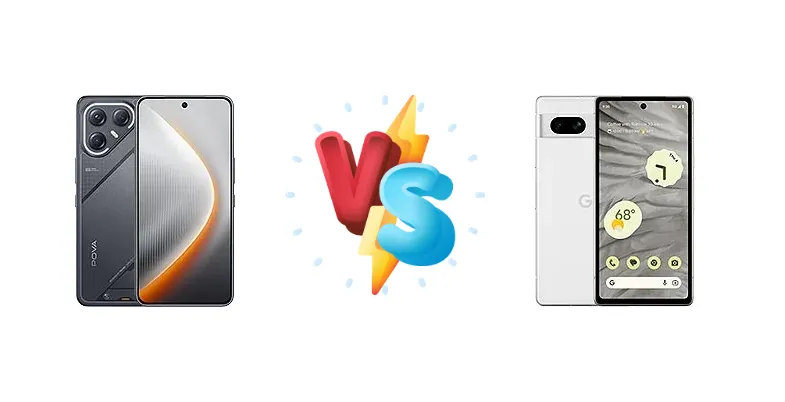
Tecno Pova 7 Ultra vs. Google Pixel 7a: A Deep Dive into Performance, Camera, and Value
| Phones Images | |||||
|---|---|---|---|---|---|
|
🏆 Quick Verdict
For the average user prioritizing camera quality, software experience, and long-term support, the Google Pixel 7a is the clear winner. However, gamers and those demanding the fastest charging speeds will find the Tecno Pova 7 Ultra a compelling alternative, despite its software compromises.
| PHONES | ||
|---|---|---|
| Phone Names | Tecno Pova 7 Ultra | Google Pixel 7a |
| Network | ||
|---|---|---|
| 2G bands | GSM 850 / 900 / 1800 / 1900 | GSM 850 / 900 / 1800 / 1900 |
| 3G bands | HSDPA 850 / 900 / 2100 | HSDPA 800 / 850 / 900 / 1700(AWS) / 1900 / 2100 |
| 4G bands | LTE | 1, 2, 3, 4, 5, 7, 8, 12, 13, 14, 17, 20, 25, 26, 28, 29, 30, 38, 40, 41, 48, 66, 71 - GWKK3, G0DZQ |
| 5G bands | SA/NSA | 1, 2, 3, 5, 7, 8, 12, 14, 20, 25, 28, 30, 38, 41, 48, 66, 71, 77, 78 SA/NSA/Sub6 - GWKK3 |
| Speed | HSPA, LTE, 5G | HSPA, LTE, 5G |
| Technology | GSM / HSPA / LTE / 5G | GSM / HSPA / LTE / 5G |
| - | 1, 2, 3, 5, 7, 8, 12, 20, 25, 28, 38, 40, 41, 66, 75, 76, 77, 78, 79 SA/NSA/Sub6 - GHL1X, G82U8 | |
| Launch | ||
|---|---|---|
| Announced | 2025, June 20 | 2023, May 10 |
| Status | Available. Released 2025, July | Available. Released 2023, May 10 |
| Body | ||
|---|---|---|
| Build | - | Glass front (Gorilla Glass 3), aluminum frame, plastic back |
| Dimensions | 160 x 75.2 x 8.9 mm (6.30 x 2.96 x 0.35 in) | 152 x 72.9 x 9 mm (5.98 x 2.87 x 0.35 in) |
| SIM | Nano-SIM + Nano-SIM | Nano-SIM + eSIM |
| Weight | - | 193.5 g (6.84 oz) |
| - | IP67 dust/water resistant (up to 1m for 30 min) | |
| Display | ||
|---|---|---|
| Protection | Corning Gorilla Glass 7i | Corning Gorilla Glass 3 |
| Resolution | 1260 x 2800 pixels, 20:9 ratio (~460 ppi density) | 1080 x 2400 pixels, 20:9 ratio (~429 ppi density) |
| Size | 6.67 inches, 107.4 cm2 (~89.3% screen-to-body ratio) | 6.1 inches, 90.7 cm2 (~81.8% screen-to-body ratio) |
| Type | AMOLED, 1B colors, 144Hz, 2592Hz PWM, 4500 nits (peak) | OLED, HDR, 90Hz |
| - | Always-on display | |
| Platform | ||
|---|---|---|
| CPU | Octa-core (1x3.35 GHz Cortex-A715 & 3x3.20 GHz Cortex-A715 & 4x2.20 GHz Cortex-A510) | Octa-core (2x2.85 GHz Cortex-X1 & 2x2.35 GHz Cortex-A78 & 4x1.80 GHz Cortex-A55) |
| Chipset | Mediatek Dimensity 8350 Ultimate (4 nm) | Google Tensor G2 (5 nm) |
| GPU | Mali G615-MC6 | Mali-G710 MP7 |
| OS | Android 15, HIOS 15 | Android 13, upgradable to Android 15, up to 5 major Android upgrades |
| Memory | ||
|---|---|---|
| Card slot | No | No |
| Internal | 256GB 8GB RAM, 256GB 12GB RAM | 128GB 8GB RAM |
| - | UFS 3.1 | |
| Main Camera | ||
|---|---|---|
| Dual | 108 MP, (wide), 0.7µm, PDAF 8 MP, (ultrawide) | 64 MP, f/1.9, 26mm (wide), 1/1.73", 0.8µm, dual pixel PDAF, OIS 13 MP, f/2.2, 120˚ (ultrawide), 1.12µm |
| Features | Dual-LED flash | Dual-LED flash, Pixel Shift, Auto-HDR, panorama |
| Video | Yes | 4K@30/60fps, 1080p@30/60/120/240fps, OIS |
| Selfie camera | ||
|---|---|---|
| Features | - | HDR, panorama |
| Single | 13 MP, (wide) | 13 MP, f/2.2, 20mm (ultrawide), 1.12µm |
| Video | Yes | 4K@30fps, 1080p@30fps |
| Sound | ||
|---|---|---|
| 3.5mm jack | - | No |
| 35mm jack | Yes | No |
| Loudspeaker | Yes, with stereo speakers | Yes, with stereo speakers |
| Comms | ||
|---|---|---|
| Bluetooth | Yes | 5.3, A2DP, LE |
| Infrared port | Yes | - |
| NFC | Yes | Yes |
| Positioning | GPS, GLONASS, GALILEO, BDS | GPS, GLONASS, GALILEO, BDS, QZSS, NavIC |
| Radio | Unspecified | No |
| USB | USB Type-C 2.0, OTG | USB Type-C 3.2 |
| WLAN | Yes | Wi-Fi 802.11 a/b/g/n/ac/6e, tri-band |
| Features | ||
|---|---|---|
| Sensors | Fingerprint (under display, optical), accelerometer, gyro, proximity, compass | Fingerprint (under display, optical), accelerometer, gyro, proximity, compass, barometer |
| Battery | ||
|---|---|---|
| Charging | 70W wired, 50% in 18 min, 100% in 44 min 30W wireless (magnetic) 10W reverse wired | 18W wired, PD3.0 7.5W wireless |
| Type | 6000 mAh | Li-Po 4385 mAh |
| Misc | ||
|---|---|---|
| Colors | Geek White, Geek Black | Charcoal, Snow, Sea, Coral |
| Models | LJ9 | GWKK3, GHL1X, G0DZQ, G82U8 |
| Price | - | € 179.90 / $ 150.00 / £ 170.00 / ₹ 25,980 |
Tecno Pova 7 Ultra
- Incredibly fast 70W wired charging
- 30W wireless charging support
- Powerful Mediatek Dimensity 8350 Ultimate chipset
- Likely higher RAM speed (LPDDR5x)
- Software experience likely less refined than Pixel
- Camera performance likely inferior to Pixel 7a
Google Pixel 7a
- Exceptional camera quality and computational photography
- Clean and intuitive software experience
- Guaranteed software updates from Google
- Compact and pocketable design
- Slow 18W wired charging
- Limited 7.5W wireless charging
Display Comparison
The Pixel 7a boasts a measured peak brightness of 1070 nits, ensuring excellent visibility even in direct sunlight. While the Pova 7 Ultra’s display specifications are not provided, its focus on gaming suggests a high refresh rate panel, though likely not LTPO. The Pixel 7a’s smaller 6.1-inch display contributes to a more pocketable form factor, while the Pova 7 Ultra is expected to be larger, catering to immersive gaming. Color accuracy is a known strength of Pixel displays, offering more natural tones, while the Pova 7 Ultra likely prioritizes vibrant colors for gaming.
Camera Comparison
The Google Pixel 7a is renowned for its computational photography capabilities, leveraging the Tensor G2’s image signal processor. While the Pova 7 Ultra’s camera specs are not detailed, it’s unlikely to match the Pixel 7a’s image quality, particularly in challenging lighting conditions. The Pixel 7a’s strengths lie in its dynamic range, accurate colors, and excellent portrait mode. The Pova 7 Ultra may focus on high megapixel counts for marketing, but sensor size and lens quality are more critical for overall image quality. The Pixel 7a’s video capabilities are also superior, offering excellent stabilization and dynamic range.
Performance
The Tecno Pova 7 Ultra’s Mediatek Dimensity 8350 Ultimate (4nm) is a powerhouse, featuring a unique CPU configuration with a 3.35 GHz Cortex-A715 core. This contrasts with the Google Pixel 7a’s Google Tensor G2 (5nm) which utilizes a 2x Cortex-X1 and 2x Cortex-A78 configuration. The 4nm process of the Dimensity 8350 Ultimate should offer better power efficiency than the 5nm Tensor G2, potentially leading to sustained performance during extended gaming sessions. However, the Tensor G2 excels in AI and machine learning tasks, powering features like Magic Eraser and Real Tone. The Pova 7 Ultra likely benefits from faster LPDDR5x RAM, further boosting gaming performance, while the Pixel 7a’s RAM speed is not specified.
Battery Life
The Pixel 7a has an endurance rating of 76 hours, indicating solid battery life. The Tecno Pova 7 Ultra compensates for a potentially smaller battery with its blazing-fast 70W wired charging, achieving 50% charge in just 18 minutes and 100% in 44 minutes. The addition of 30W wireless (magnetic) charging is a significant advantage, while the Pixel 7a is limited to 7.5W wireless charging. The Pova 7 Ultra’s charging speed is a game-changer for users who prioritize minimizing downtime, while the Pixel 7a offers more consistent, all-day battery life.
Buying Guide
Buy the Tecno Pova 7 Ultra if you need uncompromising gaming performance, incredibly fast 70W wired and 30W wireless charging, and don't mind a less polished software experience. Buy the Google Pixel 7a if you prefer a superior camera system, a clean and intuitive software experience with guaranteed updates, and a more compact, refined design.