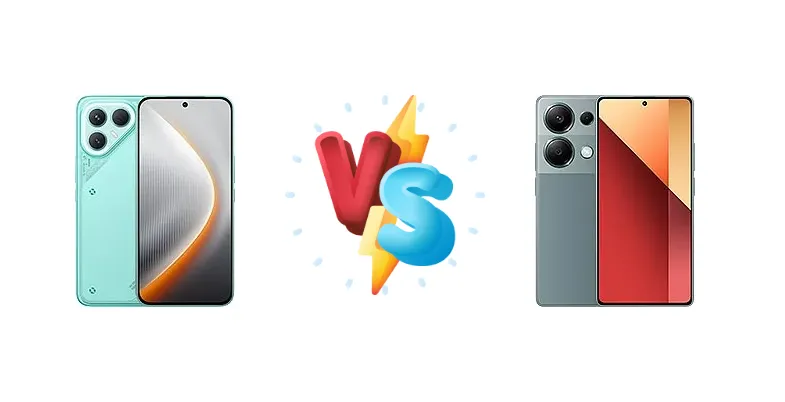
The Tecno Pova 7 Pro and Xiaomi Redmi Note 13 Pro 4G represent compelling options in the increasingly competitive mid-range smartphone market. While both aim to deliver a feature-rich experience without breaking the bank, they take distinctly different approaches – the Pova 7 Pro prioritizing raw processing power and charging speed, while the Redmi Note 13 Pro 4G focuses on a balanced experience with a bright display and solid battery life.
🏆 Quick Verdict
For users prioritizing performance and rapid charging, the Tecno Pova 7 Pro emerges as the winner. Its Dimensity 7300 Ultimate chipset offers a significant performance uplift over the Redmi Note 13 Pro 4G’s Helio G99 Ultra. However, the Redmi Note 13 Pro 4G’s excellent battery life and brighter display make it a strong contender for those valuing longevity and visual clarity.
| Network |
|---|
| 2G bands | GSM 850 / 900 / 1800 / 1900 | GSM 850 / 900 / 1800 / 1900 |
| 3G bands | HSDPA 850 / 900 / 2100 | HSDPA 850 / 900 / 1700(AWS) / 1900 / 2100 |
| 4G bands | LTE | 1, 2, 3, 4, 5, 7, 8, 12, 13, 17, 18, 19, 20, 26, 28, 38, 40, 41, 66 |
| 5G bands | SA/NSA | - |
| Speed | HSPA, LTE, 5G | HSPA, LTE |
| Technology | GSM / HSPA / LTE / 5G | GSM / HSPA / LTE |
| Launch |
|---|
| Announced | 2025, July 04 | 2024, January 15 |
| Status | Available. Released 2025, July 10 | Available. Released 2024, January 15 |
| Body |
|---|
| Build | - | Glass front (Gorilla Glass 5), plastic frame, plastic back |
| Dimensions | 163.5 x 75.9 x 8.2 mm (6.44 x 2.99 x 0.32 in) | 161.1 x 75 x 8 mm (6.34 x 2.95 x 0.31 in) |
| SIM | Nano-SIM + Nano-SIM | Nano-SIM + Nano-SIM |
| Weight | 195 g (6.88 oz) | 188 g (6.63 oz) |
| Display |
|---|
| Protection | Corning Gorilla Glass 7i | Corning Gorilla Glass 5 |
| Resolution | 1224 x 2720 pixels, 20:9 ratio (~440 ppi density) | 1080 x 2400 pixels, 20:9 ratio (~395 ppi density) |
| Size | 6.78 inches, 111.0 cm2 (~89.4% screen-to-body ratio) | 6.67 inches, 107.4 cm2 (~88.9% screen-to-body ratio) |
| Type | AMOLED, 144Hz, 2304Hz PWM, 4500 nits (peak) | AMOLED, 1B colors, 120Hz, 500 nits (typ), 1000 nits (HBM), 1300 nits (peak) |
| Platform |
|---|
| CPU | Octa-core (4x2.5 GHz Cortex-A78 & 4x2.0 GHz Cortex-A55) | Octa-core (2x2.2 GHz Cortex-A76 & 6x2.0 GHz Cortex-A55) |
| Chipset | Mediatek Dimensity 7300 Ultimate (4 nm) | Mediatek Helio G99 Ultra |
| GPU | Mali-G615 MC2 | Mali-G57 MC2 |
| OS | Android 15, HIOS 15 | Android 13, up to 3 major Android upgrades, HyperOS |
| Memory |
|---|
| Card slot | No | microSDXC (uses shared SIM slot) |
| Internal | 128GB 8GB RAM, 256GB 8GB RAM, 256GB 12GB RAM | 128GB 8GB RAM, 256GB 8GB RAM, 256GB 12GB RAM, 512GB 8GB RAM, 512GB 12GB RAM |
| Main Camera |
|---|
| Dual | 64 MP, (wide), 1/1.73", PDAF
8 MP, (ultrawide) | - |
| Features | Dual-LED flash | LED flash, HDR, panorama |
| Triple | - | 200 MP, f/1.7, 23mm (wide), 1/1.4", 0.56µm, multi-directional PDAF, OIS
8 MP, f/2.2, 15mm, 120˚ (ultrawide), 1/4.4", 1.0µm
2 MP (macro) |
| Video | 4K@30fps, 1080p@30fps | 1080p@30/60fps |
| Selfie camera |
|---|
| Single | 13 MP, (wide) | 16 MP, f/2.4, (wide), 1/3.0", 1.0µm |
| Video | Yes | 1080p@30/60fps |
| Sound |
|---|
| 35mm jack | Yes | Yes |
| Loudspeaker | Yes, with stereo speakers | Yes, with dual speakers |
| Comms |
|---|
| Bluetooth | Yes | 5.2, A2DP, LE |
| Infrared port | Yes | Yes |
| NFC | Yes | Yes (market/region dependent) |
| Positioning | GPS, GLONASS, GALILEO, BDS | GPS, GLONASS, GALILEO, BDS |
| Radio | No | FM radio |
| USB | USB Type-C 2.0, OTG | USB Type-C 2.0, OTG |
| WLAN | Wi-Fi 802.11 a/b/g/n/ac/6, dual-band | Wi-Fi 802.11 a/b/g/n/ac, dual-band |
| Features |
|---|
| Sensors | Fingerprint (under display, optical), accelerometer, gyro, proximity, compass | Fingerprint (under display, optical), accelerometer, gyro, compass |
| Battery |
|---|
| Charging | 45W wired, 50% in 26 min, 100% in 61 min
30W wireless (magnetic)
10W reverse wired | 67W wired, 50% in 16 min, 100% in 46 min |
| Type | Li-Po 6000 mAh | 5000 mAh |
| Misc |
|---|
| Colors | Geek Black, Dynamic Grey, Neon Cyan | Midnight Black, Lavender Purple, Forest Green |
| Models | LJ8 | 23117RA68G, 2312FPCA6G |
| Price | About 190 EUR | € 92.00 / $ 269.99 / £ 299.99 |
| SAR | - | 1.09 W/kg (head) 1.09 W/kg (body) |
| SAR EU | - | 0.99 W/kg (head) 0.99 W/kg (body) |
Tecno Pova 7 Pro
- Significantly faster processor (Dimensity 7300 Ultimate)
- Wireless charging support (30W)
- Faster charging speeds (45W wired)
- Potentially better thermal management due to 4nm process
- Battery life data unavailable, potentially lower than Redmi Note 13 Pro 4G
- Display brightness data unavailable, potentially less visible outdoors
Xiaomi Redmi Note 13 Pro 4G
- Excellent battery life (11:36h active use)
- Very bright display (1047 nits)
- Faster wired charging (67W)
- Balanced overall experience
- Less powerful processor (Helio G99 Ultra)
- No wireless charging support
Display Comparison
The Xiaomi Redmi Note 13 Pro 4G boasts a significantly brighter display, reaching a measured 1047 nits. This is crucial for outdoor visibility, a clear advantage over the Tecno Pova 7 Pro (brightness data unavailable). While the Pova 7 Pro’s panel specifics are unknown, the Redmi Note 13 Pro 4G’s brightness level suggests a superior viewing experience in bright conditions. Both likely utilize AMOLED panels, common in this price bracket, but the Redmi’s peak brightness is a key differentiator.
Camera Comparison
Detailed camera analysis is limited by the provided data. However, the absence of sensor size information for either device makes a direct comparison difficult. Both phones likely feature multi-camera setups, but the focus should be on the main sensor’s capabilities. The Redmi Note 13 Pro 4G’s camera is marketed for both photo and video, suggesting a balanced approach, while the Pova 7 Pro’s camera performance remains largely unknown. Ignoring the typical 2MP macro lenses found on both devices, the primary sensor and its associated image processing will be the deciding factors.
Performance
The Tecno Pova 7 Pro’s Mediatek Dimensity 7300 Ultimate, built on a 4nm process, represents a substantial leap in performance over the Redmi Note 13 Pro 4G’s Helio G99 Ultra. The Dimensity 7300 Ultimate’s Cortex-A78 cores, clocked at 2.5 GHz, offer significantly higher single-core performance than the G99 Ultra’s Cortex-A76 cores at 2.2 GHz. This translates to snappier app launches, smoother multitasking, and a more responsive gaming experience. The 4nm node also contributes to improved thermal efficiency, potentially reducing throttling during sustained workloads. The Redmi Note 13 Pro 4G will handle everyday tasks adequately, but the Pova 7 Pro is the clear choice for power users.
Battery Life
The Xiaomi Redmi Note 13 Pro 4G excels in battery life, achieving an active use score of 11 hours and 36 minutes. While the Tecno Pova 7 Pro’s battery capacity is not specified, its charging speed is a major highlight. The Pova 7 Pro supports 45W wired charging (50% in 26 minutes, 100% in 61 minutes) and 30W wireless charging (magnetic), a feature absent on the Redmi Note 13 Pro 4G. The Redmi Note 13 Pro 4G counters with 67W wired charging (50% in 16 minutes, 100% in 46 minutes), offering faster wired charging than the Pova 7 Pro. The Pova 7 Pro’s wireless charging capability provides added convenience, but the Redmi Note 13 Pro 4G’s longer battery life and faster wired charging are compelling advantages.
Buying Guide
Buy the Tecno Pova 7 Pro if you need a phone for demanding tasks like gaming or video editing, and value the fastest possible charging speeds, including wireless. Buy the Xiaomi Redmi Note 13 Pro 4G if you prioritize all-day battery life, a bright and vibrant display for media consumption, and a more refined software experience, even if it means sacrificing some raw processing power.
Frequently Asked Questions
❓ Does the Dimensity 7300 Ultimate in the Tecno Pova 7 Pro get hot during extended gaming sessions?
The Dimensity 7300 Ultimate’s 4nm process is designed for improved thermal efficiency compared to older nodes. While some heat generation is inevitable during gaming, the Pova 7 Pro should manage temperatures better than devices with less efficient chipsets, minimizing throttling and maintaining consistent performance. However, sustained high-intensity gaming will still likely result in some warming.
❓ Is the 67W charging on the Redmi Note 13 Pro 4G compatible with Power Delivery (PD) chargers?
Xiaomi typically uses its own proprietary charging protocols, even with fast charging standards like 67W. While some PD chargers *may* work, it's best to use the charger included in the box or a Xiaomi-certified charger to ensure optimal charging speeds and safety. Using a non-compatible charger could result in slower charging or, in rare cases, damage to the device.
❓ How does the wireless charging on the Tecno Pova 7 Pro compare to wired charging in terms of speed?
The Tecno Pova 7 Pro’s 30W wireless charging is significantly slower than its 45W wired charging. Expect a full wireless charge to take considerably longer – likely over 2 hours – compared to the 61 minutes for a full wired charge. Wireless charging is primarily for convenience, offering a top-up option without needing to plug in a cable.