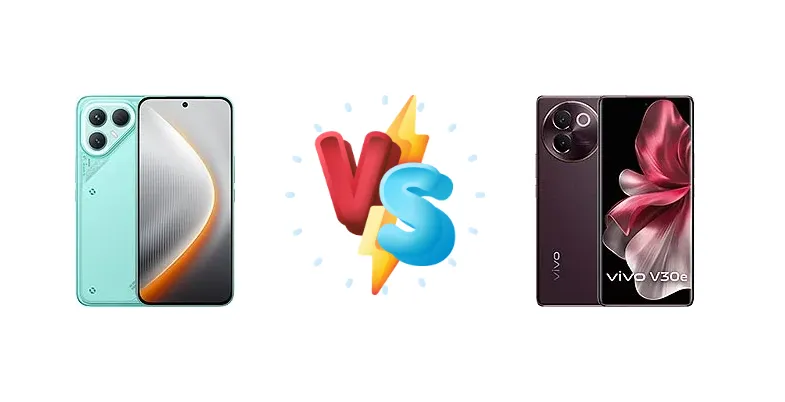
The Tecno Pova 7 Pro and vivo V30e represent compelling options in the increasingly competitive mid-range smartphone market. The Pova 7 Pro aggressively targets gamers with its powerful Mediatek Dimensity 7300 Ultimate chipset, while the vivo V30e prioritizes a balanced experience with the Qualcomm Snapdragon 6 Gen 1, alongside a focus on sleek design and camera capabilities. This comparison dissects their key differences to help you choose the right device.
🏆 Quick Verdict
For users prioritizing raw gaming performance and fast charging, the Tecno Pova 7 Pro is the clear winner. Its Dimensity 7300 Ultimate offers a significant performance uplift. However, the vivo V30e provides a more refined, all-around experience for everyday users who value efficiency and a streamlined software experience.
| Network |
|---|
| 2G bands | GSM 850 / 900 / 1800 / 1900 | GSM 850 / 900 / 1800 / 1900 |
| 3G bands | HSDPA 850 / 900 / 2100 | HSDPA 850 / 900 / 1700(AWS) / 1900 / 2100 - Malaysia |
| 4G bands | LTE | 1, 2, 3, 4, 5, 7, 8, 18, 19, 20, 26, 28, 38, 39, 40, 41 - Malaysia |
| 5G bands | SA/NSA | 1, 3, 5, 7, 8, 20, 28, 38, 40, 41, 77, 78 SA/NSA - Malaysia |
| Speed | HSPA, LTE, 5G | HSPA, LTE, 5G |
| Technology | GSM / HSPA / LTE / 5G | GSM / HSPA / LTE / 5G |
| Launch |
|---|
| Announced | 2025, July 04 | 2024, May 02 |
| Status | Available. Released 2025, July 10 | Available. Released 2024, May 09 |
| Body |
|---|
| Build | - | Glass front, plastic frame, glass back or plastic back |
| Dimensions | 163.5 x 75.9 x 8.2 mm (6.44 x 2.99 x 0.32 in) | 164.4 x 74.8 x 7.7 mm (6.47 x 2.94 x 0.30 in) |
| SIM | Nano-SIM + Nano-SIM | Nano-SIM + Nano-SIM |
| Weight | 195 g (6.88 oz) | 179 g or 188 g (6.31 oz) |
| Display |
|---|
| Protection | Corning Gorilla Glass 7i | Schott Xensation |
| Resolution | 1224 x 2720 pixels, 20:9 ratio (~440 ppi density) | 1080 x 2400 pixels, 20:9 ratio (~388 ppi density) |
| Size | 6.78 inches, 111.0 cm2 (~89.4% screen-to-body ratio) | 6.78 inches, 111.0 cm2 (~90.3% screen-to-body ratio) |
| Type | AMOLED, 144Hz, 2304Hz PWM, 4500 nits (peak) | AMOLED, 1B colors, 120Hz, 1300 nits (peak) |
| Platform |
|---|
| CPU | Octa-core (4x2.5 GHz Cortex-A78 & 4x2.0 GHz Cortex-A55) | Octa-core (4x2.2 GHz Cortex-A78 & 4x1.8 GHz Cortex-A55) |
| Chipset | Mediatek Dimensity 7300 Ultimate (4 nm) | Qualcomm SM6450 Snapdragon 6 Gen 1 (4 nm) |
| GPU | Mali-G615 MC2 | Adreno 710 |
| OS | Android 15, HIOS 15 | Android 14, Funtouch 14 |
| Memory |
|---|
| Card slot | No | microSDXC (uses shared SIM slot) |
| Internal | 128GB 8GB RAM, 256GB 8GB RAM, 256GB 12GB RAM | 128GB 8GB RAM, 256GB 8GB RAM, 256GB 12GB RAM |
| Main Camera |
|---|
| Dual | 64 MP, (wide), 1/1.73", PDAF
8 MP, (ultrawide) | 50 MP, f/1.8, 26mm (wide), 1/1.95", 0.8µm, PDAF, OIS (India only)
8 MP, f/2.2, 120˚ (ultrawide), 1/4.0", 1.12µm |
| Features | Dual-LED flash | Ring-LED flash, panorama, HDR |
| Video | 4K@30fps, 1080p@30fps | 4K@30fps, 1080p@30fps |
| Selfie camera |
|---|
| Single | 13 MP, (wide) | 50 MP, f/2.5, 25mm (wide), AF - India
32 MP, f/2.0, 24mm (wide) - Malaysia |
| Video | Yes | 4K@30fps (India only), 1080p@30fps |
| Sound |
|---|
| 35mm jack | Yes | No |
| Loudspeaker | Yes, with stereo speakers | Yes |
| Comms |
|---|
| Bluetooth | Yes | 5.1, A2DP, LE |
| Infrared port | Yes | - |
| NFC | Yes | Yes (market/region dependent) |
| Positioning | GPS, GLONASS, GALILEO, BDS | GPS, GLONASS, GALILEO, BDS, QZSS, NavIC |
| Radio | No | No |
| USB | USB Type-C 2.0, OTG | USB Type-C 2.0, OTG |
| WLAN | Wi-Fi 802.11 a/b/g/n/ac/6, dual-band | Wi-Fi 802.11 a/b/g/n/ac, dual-band |
| Features |
|---|
| Sensors | Fingerprint (under display, optical), accelerometer, gyro, proximity, compass | Fingerprint (under display, optical), accelerometer, gyro, proximity, compass |
| Battery |
|---|
| Charging | 45W wired, 50% in 26 min, 100% in 61 min
30W wireless (magnetic)
10W reverse wired | 44W wired, PD
Reverse wired |
| Type | Li-Po 6000 mAh | Li-Ion 5500 mAh |
| Misc |
|---|
| Colors | Geek Black, Dynamic Grey, Neon Cyan | Velvet Red (Coco Brown), Silk Blue, Sky Mirror |
| Models | LJ8 | V2339 |
| Price | About 190 EUR | ₹ 23,999 |
Tecno Pova 7 Pro
- Significantly more powerful processor for gaming
- Faster wired and wireless charging speeds
- Reverse wired charging capability
- Potentially larger and heavier design
- Camera performance likely inferior to the V30e
vivo V30e
- More balanced performance for everyday tasks
- Likely superior camera quality and image processing
- Sleeker and more refined design
- Less powerful processor for demanding games
- Slower charging speeds compared to the Pova 7 Pro
- No wireless charging
Display Comparison
Neither device's display specifications were provided, so a direct comparison is limited. However, given the Pova series' history, we anticipate the Pova 7 Pro will prioritize a high refresh rate for gaming, potentially at the expense of color accuracy. The V30e, aligning with vivo's brand, likely focuses on a vibrant and color-accurate AMOLED panel. Bezels are expected to be similar, with both aiming for a modern, immersive viewing experience. Without specific nit brightness data, it's difficult to determine which offers better outdoor visibility.
Camera Comparison
Camera details are absent, but we can infer based on brand positioning. Vivo consistently emphasizes camera capabilities, suggesting the V30e will likely feature a more sophisticated image processing pipeline and potentially a larger main sensor. The Pova series tends to focus less on camera prowess, prioritizing other features. Without sensor size or aperture information, it’s difficult to make a definitive statement, but the V30e is likely to deliver more consistently pleasing photos, especially in challenging lighting conditions. The inclusion of OIS on the V30e is more probable, further enhancing image stability.
Performance
The core difference lies in the chipsets. The Tecno Pova 7 Pro’s Mediatek Dimensity 7300 Ultimate (4nm) boasts a more powerful CPU configuration – 4x2.5 GHz Cortex-A78 cores versus the vivo V30e’s 4x2.2 GHz Cortex-A78 cores. This, combined with the Dimensity’s superior GPU, translates to significantly better gaming performance and faster processing speeds. While both are built on a 4nm process for efficiency, the Dimensity 7300 Ultimate’s architecture provides a clear advantage. The Snapdragon 6 Gen 1 in the V30e will handle everyday tasks smoothly, but will struggle to maintain high frame rates in demanding titles. RAM speed (likely LPDDR4X on both) isn't specified, but the chipset difference will be the dominant factor.
Battery Life
The Tecno Pova 7 Pro’s charging capabilities are a standout feature, offering 45W wired charging (50% in 26 minutes, 100% in 61 minutes) and a unique 30W magnetic wireless charging option. The vivo V30e offers 44W wired charging with PD, which is competitive but slower. While battery capacity isn't specified, the Pova 7 Pro’s faster charging speeds mitigate the impact of a potentially smaller battery. The Pova 7 Pro also includes 10W reverse wired charging, a feature absent on the V30e, allowing it to top up accessories.
Buying Guide
Buy the Tecno Pova 7 Pro if you need uncompromising gaming performance, rapid 45W wired and 30W wireless charging, and don't mind a potentially bulkier design. Buy the vivo V30e if you prefer a more balanced smartphone experience with a focus on camera quality, efficient power consumption, and a sleeker aesthetic, even if it means sacrificing some gaming horsepower.
Frequently Asked Questions
❓ Will the Dimensity 7300 Ultimate in the Pova 7 Pro overheat during prolonged gaming sessions?
The 4nm process and likely effective thermal management solutions employed by Tecno should mitigate overheating. However, sustained high-intensity gaming will inevitably generate heat. The Pova 7 Pro's larger chassis may provide more surface area for heat dissipation compared to the V30e.
❓ Is the 44W charging on the vivo V30e sufficient for quick top-ups throughout the day?
44W charging is reasonably fast and will provide a significant charge in a short amount of time. While not as rapid as the Pova 7 Pro’s 45W charging, it’s still sufficient for most users to quickly replenish the battery during breaks.
❓ Does the Snapdragon 6 Gen 1 in the V30e support any advanced camera features like 4K video recording?
The Snapdragon 6 Gen 1 is capable of 4K video recording, though the V30e's implementation will depend on vivo's software optimizations. Expect good video quality in well-lit conditions, but low-light performance may be limited.
❓ How does the magnetic wireless charging on the Pova 7 Pro compare to standard Qi wireless charging?
Magnetic wireless charging offers a more secure connection and potentially faster charging speeds compared to standard Qi wireless charging. The magnetic alignment ensures optimal coil positioning, maximizing energy transfer efficiency.