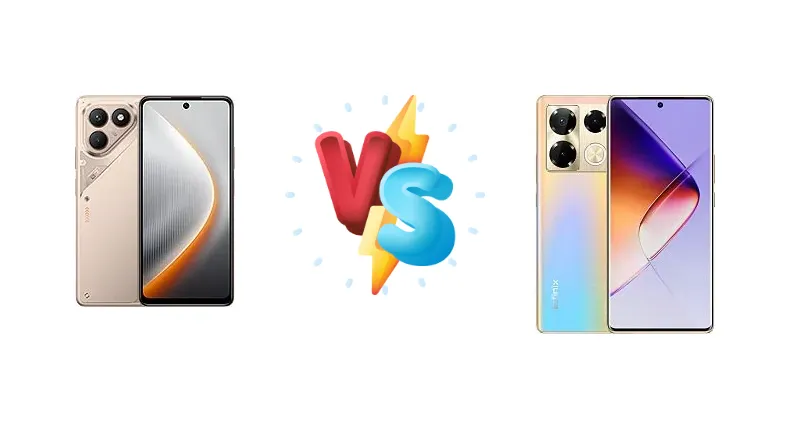
Both the Tecno Pova 7 4G and the Infinix Note 40 Pro 4G target the competitive mid-range smartphone market, but they approach it with different strengths. The Pova 7 emphasizes raw processing power with the Helio G100, while the Note 40 Pro prioritizes charging speed and convenience with its 70W wired and 20W MagCharge wireless capabilities. This comparison will dissect their key differences to determine which device delivers the best value.
🏆 Quick Verdict
For the average user prioritizing convenience and rapid replenishment, the Infinix Note 40 Pro 4G is the clear winner. Its 70W charging and MagCharge wireless capabilities significantly outperform the Tecno Pova 7’s 45W charging. However, gamers and power users might find the Pova 7’s Helio G100 slightly more appealing for sustained performance.
| Network |
|---|
| 2G bands | GSM 850 / 900 / 1800 / 1900 | GSM 850 / 900 / 1800 / 1900 |
| 3G bands | HSDPA 850 / 900 / 2100 | HSDPA 850 / 900 / 1700(AWS) / 1900 / 2100 |
| 4G bands | LTE | 1, 2, 3, 4, 5, 7, 8, 12, 17, 13, 26, 28, 38, 40, 41, 66 |
| Speed | HSPA, LTE | HSPA, LTE |
| Technology | GSM / HSPA / LTE | GSM / HSPA / LTE |
| Launch |
|---|
| Announced | 2025, June 20 | 2024, March 18 |
| Status | Available. Released 2025, June 25 | Available. Released 2024, March 19 |
| Body |
|---|
| Dimensions | 168.6 x 76.6 x 9.3 mm (6.64 x 3.02 x 0.37 in) | 164.4 x 74.6 x 7.8 mm (6.47 x 2.94 x 0.31 in) |
| SIM | Nano-SIM + Nano-SIM | Nano-SIM + Nano-SIM |
| Weight | - | 190 g (6.70 oz) |
| Display |
|---|
| Protection | - | Corning Gorilla Glass |
| Resolution | 1080 x 2460 pixels (~396 ppi density) | 1080 x 2436 pixels (~393 ppi density) |
| Size | 6.78 inches, 109.2 cm2 (~84.5% screen-to-body ratio) | 6.78 inches, 109.9 cm2 (~89.6% screen-to-body ratio) |
| Type | AMOLED, 120Hz | AMOLED, 120Hz, 1300 nits (peak) |
| Platform |
|---|
| CPU | Octa-core (2x2.2 GHz Cortex-A76 & 6x2.0 GHz Cortex-A55) | Octa-core (2x2.2 GHz Cortex-A76 & 6x2.0 GHz Cortex-A55) |
| Chipset | Mediatek Helio G100 Ultimate (6 nm) | Mediatek Helio G99 Ultimate |
| GPU | Mali-G57 MC2 | Mali-G57 MC2 |
| OS | Android 15, HIOS 15 | Android 14, XOS 14 |
| Memory |
|---|
| Card slot | microSDXC (dedicated slot) | Unspecified |
| Internal | 128GB 8GB RAM, 256GB 8GB RAM | 256GB 8GB RAM, 256GB 12GB RAM |
| Main Camera |
|---|
| Dual | 108 MP, (wide), 0.7µm, PDAF
2 MP (macro) | - |
| Features | Dual-LED flash | Quad-LED flash, HDR, panorama |
| Triple | - | 108 MP, f/1.8, (wide), 1/1.67", PDAF, OIS
2 MP, f/2.4
2 MP, f/2.4 |
| Video | Yes | 1440p@30fps, 1080p@30/60fps |
| Selfie camera |
|---|
| Features | - | Dual-LED flash |
| Single | 8 MP, (wide) | 32 MP, f/2.2, (wide), 1/3.1" |
| Video | Yes | 1080p@30fps |
| Sound |
|---|
| 35mm jack | Yes | No |
| Loudspeaker | Yes, with stereo speakers | Yes, with stereo speakers |
| Comms |
|---|
| Bluetooth | Yes | Yes |
| Infrared port | Yes | Yes |
| NFC | Yes | Yes (market/region dependent) |
| Positioning | GPS, GLONASS, GALILEO, BDS | GPS |
| Radio | FM radio | FM radio |
| USB | USB Type-C 2.0, OTG | USB Type-C 2.0, OTG |
| WLAN | Yes | Wi-Fi 802.11 a/b/g/n/ac, dual-band |
| Features |
|---|
| Sensors | Accelerometer, gyro, proximity, compass | Fingerprint (under display, optical), accelerometer, gyro, proximity, compass |
| Battery |
|---|
| Charging | 45W wired, 50% in 29 min, 100% in 70 min
10W reverse wired | 70W wired, 50% in 20 min
20W wireless MagCharge
Reverse wired
Reverse wireless |
| Type | 7000 mAh | 5000 mAh |
| Misc |
|---|
| Colors | Hyper Titanium, Magic Silver, Geek Black | Vintage Green, Titan Gold, Racing Edition |
| Models | LJ6 | X6850 |
| Price | - | About 240 EUR |
Tecno Pova 7 4G
- Potentially better sustained performance due to the 6nm Helio G100.
- May offer slightly better thermal management.
- Competitive price point (likely).
- Slower charging speed (45W vs 70W).
- Lacks wireless charging capabilities.
- Missing camera details hinder a full assessment.
Infinix Note 40 Pro 4G
- Significantly faster 70W wired charging.
- Convenient 20W MagCharge wireless charging.
- Reverse wired and wireless charging for accessories.
- Helio G99 may throttle slightly more under sustained load.
- Potentially higher price compared to the Pova 7.
- Camera performance is unknown.
Display Comparison
While both devices are 4G-only, display details are missing. Assuming both utilize IPS LCD panels common in this price bracket, the key differentiator will be peak brightness and color accuracy. Without specific data, it's difficult to declare a winner, but Infinix historically focuses on vibrant displays, potentially giving it an edge. The Note 40 Pro’s MagCharge compatibility also suggests a potentially more refined overall build quality, which could translate to tighter panel tolerances.
Camera Comparison
Camera specifications are absent, making a direct comparison challenging. However, given the market positioning, both phones likely feature a primary camera around 50MP. The aperture and sensor size will be crucial. Without this data, we can only speculate. Infinix often emphasizes camera features in its marketing, suggesting a potentially more refined image processing pipeline. The absence of details regarding OIS (Optical Image Stabilization) on either device suggests reliance on software stabilization.
Performance
Both the Tecno Pova 7 and Infinix Note 40 Pro utilize an octa-core CPU configuration with the same core arrangement (2x2.2 GHz Cortex-A76 & 6x2.0 GHz Cortex-A55). However, the chipset differs: the Pova 7 features the MediaTek Helio G100 Ultimate (6nm), while the Note 40 Pro uses the Helio G99 Ultimate. The G100, built on a 6nm process, *should* offer slightly better power efficiency and thermal headroom compared to the G99. This could translate to less throttling during extended gaming sessions, benefiting the Pova 7. However, the G99’s optimizations might close the gap. RAM speed (LPDDR4X is likely on both) will be a secondary factor.
Battery Life
The Infinix Note 40 Pro’s 70W wired charging is a significant advantage over the Tecno Pova 7’s 45W charging. The Note 40 Pro claims 50% charge in 20 minutes, while the Pova 7 takes 29 minutes. A full charge on the Pova 7 takes 70 minutes. Furthermore, the Note 40 Pro adds 20W MagCharge wireless charging and reverse charging capabilities, offering unparalleled convenience. While battery capacity isn’t specified, the faster charging speeds of the Note 40 Pro effectively mitigate any potential capacity disadvantage.
Buying Guide
Buy the Tecno Pova 7 4G if you need a phone primarily for gaming and demanding applications, and are willing to sacrifice some charging convenience for potentially sustained performance. Buy the Infinix Note 40 Pro 4G if you prioritize fast charging, wireless charging, and a more versatile charging ecosystem, even if it means a slight trade-off in peak processing power.
Frequently Asked Questions
❓ Does the Helio G99 in the Infinix Note 40 Pro get noticeably hot during prolonged gaming sessions?
While the Helio G99 is a capable chipset, it's built on a slightly larger process node than the G100. This means it *may* generate more heat under sustained load. However, Infinix's thermal management implementation will play a crucial role. Expect some throttling after extended gaming, but it shouldn't be severe enough to render the phone unusable.
❓ How practical is the 20W MagCharge wireless charging on the Infinix Note 40 Pro in real-world use?
The 20W MagCharge is a significant convenience feature. While not as fast as wired charging, it's more than adequate for overnight charging or topping up throughout the day. The magnetic attachment ensures a secure connection, eliminating the need for precise alignment. It's particularly useful for users who frequently use wireless charging pads.
❓ Is the difference in charging speed between 45W and 70W really that noticeable in everyday use?
Yes, the difference is substantial. The Infinix Note 40 Pro’s 70W charging can add a significant amount of battery life in a short period, making it ideal for users who are always on the go. The Pova 7’s 45W charging is still respectable, but it requires a longer charging time to achieve the same level of replenishment.