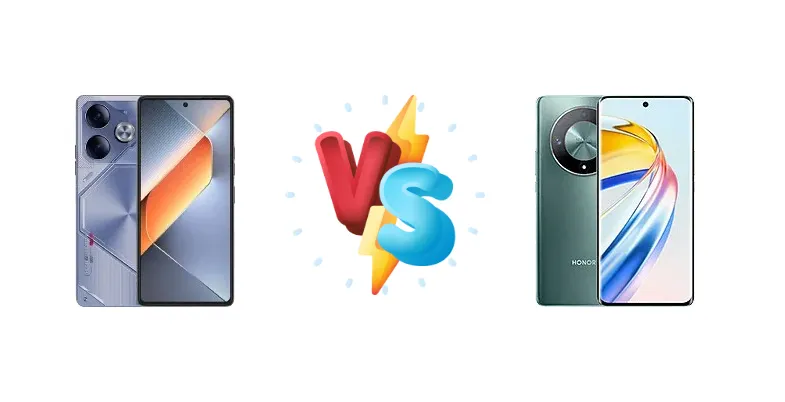
The Tecno Pova 6 and Honor X9b represent compelling options in the increasingly competitive mid-range smartphone market. The Pova 6 aggressively targets gamers with its rapid charging and powerful Helio G99 Ultimate chipset, while the X9b prioritizes efficiency and a balanced experience with the Snapdragon 6 Gen 1. This comparison dissects their key differences to help you choose the right device.
🏆 Quick Verdict
For users prioritizing raw gaming performance and incredibly fast charging, the Tecno Pova 6 is the clear winner. However, the Honor X9b offers a more refined, power-efficient experience thanks to its 4nm Snapdragon 6 Gen 1, making it ideal for everyday users and those valuing battery longevity.
| Network |
|---|
| 2G bands | GSM 850 / 900 / 1800 / 1900 | GSM 850 / 900 / 1800 / 1900 |
| 3G bands | HSDPA 850 / 900 / 2100 | HSDPA 850 / 900 / 1900 / 2100 |
| 4G bands | LTE | 1, 2, 3, 4, 5, 7, 8, 20, 28, 32, 38, 40, 41 |
| 5G bands | - | 1, 3, 7, 8, 20, 28, 38, 40, 41, 77, 78 SA/NSA |
| Speed | HSPA, LTE | HSPA, LTE, 5G |
| Technology | GSM / HSPA / LTE | GSM / HSPA / LTE / 5G |
| Launch |
|---|
| Announced | 2024, April 04 | 2023, October 18 |
| Status | Available. Released 2024, May | Available. Released 2023, October |
| Body |
|---|
| Dimensions | 166.2 x 76.8 x 7.9 mm (6.54 x 3.02 x 0.31 in) | 163.6 x 75.5 x 8 mm (6.44 x 2.97 x 0.31 in) |
| SIM | Nano-SIM + Nano-SIM | Nano-SIM + Nano-SIM |
| Weight | 195 g (6.88 oz) | 185 g (6.53 oz) |
| Display |
|---|
| Resolution | 1080 x 2460 pixels (~396 ppi density) | 1220 x 2652 pixels, 19.5:9 ratio (~431 ppi density) |
| Size | 6.78 inches, 109.2 cm2 (~85.5% screen-to-body ratio) | 6.78 inches, 112.6 cm2 (~91.2% screen-to-body ratio) |
| Type | AMOLED, 1B colors, 120Hz, 1300 nits (peak) | AMOLED, 1B colors, 120Hz, 1200 nits (peak) |
| Platform |
|---|
| CPU | Octa-core (2x2.2 GHz Cortex-A76 & 6x2.0 GHz Cortex-A55) | Octa-core (4x2.2 GHz Cortex-A78 & 4x1.8 GHz Cortex-A55) |
| Chipset | Mediatek Helio G99 Ultimate (6 nm) | Qualcomm SM6450 Snapdragon 6 Gen 1 (4 nm) |
| GPU | Mali-G57 MC2 | Adreno 710 |
| OS | Android 14, HIOS 14 | Android 13, Magic OS 7.2 |
| Memory |
|---|
| Card slot | No | No |
| Internal | 256GB 8GB RAM, 256GB 12GB RAM | 256GB 8GB RAM, 256GB 12GB RAM, 512GB 8GB RAM, 512GB 12GB RAM |
| Main Camera |
|---|
| Features | Quad-LED flash | LED flash, panorama, HDR |
| Single | 108 MP, (wide), 0.7µm, PDAF | - |
| Triple | - | 108 MP, f/1.8, (wide), 1/1.67", PDAF
5 MP, f/2.2, (ultrawide)
2 MP (macro) |
| Video | 1440p@30fps, 1080p@30/60fps | 4K@30fps, 1080p@30fps |
| Selfie camera |
|---|
| Features | Dual-LED dual-tone flash | - |
| Single | 32 MP, (wide) | 16 MP, f/2.5, (wide) |
| Video | 1440p@30fps, 1080p@30/60fps | 1080p@30fps |
| Sound |
|---|
| 35mm jack | Yes | No |
| Loudspeaker | Yes, with stereo speakers | Yes |
| Comms |
|---|
| Bluetooth | Yes | 5.1, A2DP, LE |
| Infrared port | Yes | Yes |
| NFC | Yes | Yes (market/region dependent) |
| Positioning | GPS, GLONASS, GALILEO, BDS | GPS, GLONASS, GALILEO, BDS |
| Radio | FM radio | No |
| USB | USB Type-C 2.0 | USB Type-C 2.0, OTG |
| WLAN | Yes | Wi-Fi 802.11 a/b/g/n/ac, dual-band, Wi-Fi Direct |
| Features |
|---|
| Sensors | Fingerprint (under display, optical), accelerometer, gyro, proximity, compass | Fingerprint (under display, optical), accelerometer, gyro, proximity, compass |
| Battery |
|---|
| Charging | 70W wired, 50% in 20 min, 100% in 50 min
10W reverse wired | 35W wired
Reverse wired |
| Type | 6000 mAh | Li-Po 5800 mAh |
| Misc |
|---|
| Colors | Interstellar Blue, Comet Green, Meteorite Grey | Sunrise Orange, Midnight Black, Emerald Green |
| Models | - | ALI-NX1 |
| Price | About 490 EUR | About 970 EUR |
Tecno Pova 6
- Incredibly fast 70W charging
- Potentially higher peak gaming performance due to Helio G99 Ultimate
- Aggressive pricing likely makes it very affordable
- 6nm process may lead to more thermal throttling
- Potentially less efficient than the Snapdragon 6 Gen 1
Honor X9b
- More efficient 4nm Snapdragon 6 Gen 1
- Likely better sustained performance and thermal management
- Potentially smoother software experience with MagicOS
- Slower 35W charging
- May not match the Pova 6's peak gaming performance
Display Comparison
Neither device boasts a standout display. While specific display specs (resolution, refresh rate) are missing, the focus here is on the underlying chipsets. Display quality will likely be similar, leaning towards adequate for the price point. The absence of LTPO technology on either device suggests standard refresh rate implementations, impacting power consumption during dynamic content.
Camera Comparison
Without detailed camera specifications, a direct comparison is limited. However, the market segment suggests both phones will feature multi-camera setups. The absence of information regarding sensor size and OIS is notable. Image processing will likely be a key differentiator, with Honor historically leaning towards more natural color reproduction, while Tecno often boosts saturation. The presence of a 2MP macro lens on either device is likely a marketing feature with limited real-world utility.
Performance
The core difference lies in the chipsets. The Tecno Pova 6’s MediaTek Helio G99 Ultimate (6nm) utilizes two Cortex-A76 cores for peak performance, while the Honor X9b’s Qualcomm Snapdragon 6 Gen 1 (4nm) employs four Cortex-A78 cores. The Snapdragon 6 Gen 1’s 4nm process offers a significant advantage in thermal efficiency, meaning sustained performance will likely be higher under load, reducing throttling during extended gaming sessions. While the Pova 6’s A76 cores offer strong burst performance, the X9b’s A78 cores are architecturally superior and more efficient. The X9b also benefits from a more modern process node.
Battery Life
The Tecno Pova 6’s 70W wired charging is a standout feature, promising a 50% charge in 20 minutes and a full charge in 50 minutes. This is significantly faster than the Honor X9b’s 35W charging. While battery capacity isn’t specified, the faster charging of the Pova 6 mitigates the impact of a potentially smaller battery. Both devices offer 10W reverse wired charging, useful for topping up accessories, but not a primary selling point.
Buying Guide
Buy the Tecno Pova 6 if you need a phone primarily for gaming, frequently stream videos, and value the ability to quickly top up your battery. Its 70W charging is a game-changer for power users. Buy the Honor X9b if you prefer a more balanced smartphone experience with better power efficiency, a potentially smoother software experience (depending on Honor's MagicOS version), and a device that won't require constant charging.
Frequently Asked Questions
❓ Will the Helio G99 Ultimate in the Tecno Pova 6 overheat during prolonged gaming sessions?
The 6nm process of the Helio G99 Ultimate is prone to more thermal throttling than the 4nm Snapdragon 6 Gen 1. While the Pova 6 will likely deliver higher peak performance, expect performance to drop over extended gaming periods. Active cooling solutions (like a gaming cooler) might be beneficial for sustained high frame rates.
❓ How does the Snapdragon 6 Gen 1's efficiency impact daily usage on the Honor X9b?
The 4nm Snapdragon 6 Gen 1 is significantly more power-efficient than the Helio G99 Ultimate. This translates to longer battery life during typical daily usage, such as browsing, social media, and video streaming. You'll likely find yourself reaching for the charger less frequently with the Honor X9b.
❓ Is the 70W charging on the Tecno Pova 6 compatible with Power Delivery (PD) chargers?
While Tecno doesn't explicitly state PD compatibility, it's unlikely. 70W charging at this price point typically utilizes a proprietary charging protocol. Using a standard PD charger will likely result in significantly slower charging speeds.
❓ Does the Honor X9b support 5G connectivity?
The Snapdragon 6 Gen 1 supports 5G connectivity, so the Honor X9b *should* support 5G. However, regional variations and carrier support will ultimately determine 5G availability.