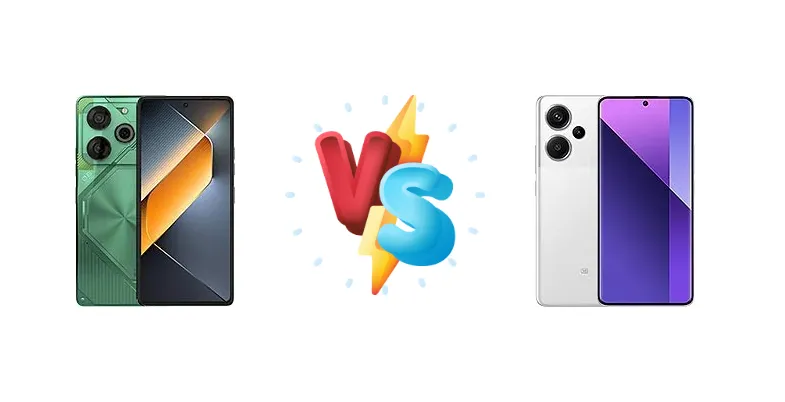
The Tecno Pova 6 Pro and Xiaomi Redmi Note 13 Pro+ represent compelling options in the increasingly competitive mid-range smartphone market. While both aim to deliver a premium experience without the flagship price tag, they prioritize different strengths: the Pova 6 Pro focuses on endurance, while the Redmi Note 13 Pro+ emphasizes charging speed and processing prowess. This comparison dissects their key differences to help you choose the right device.
🏆 Quick Verdict
For users prioritizing all-day (and then some) battery life, the Tecno Pova 6 Pro is the clear winner, offering a remarkable 14:22h of active use. However, the Xiaomi Redmi Note 13 Pro+ counters with significantly faster 120W charging and a more powerful Dimensity 7200 Ultra chipset, making it ideal for power users and gamers.
| Network |
|---|
| 2G bands | GSM 850 / 900 / 1800 / 1900 | GSM 850 / 900 / 1800 / 1900 |
| 3G bands | HSDPA 850 / 900 / 2100 | HSDPA 800 / 850 / 900 / 1700(AWS) / 1900 / 2100 - International |
| 4G bands | LTE | 1, 2, 3, 4, 5, 7, 8, 12, 13, 17, 18, 19, 20, 26, 28, 32, 38, 40, 41, 66 - International |
| 5G bands | SA/NSA | 1, 3, 5, 7, 8, 20, 28, 38, 40, 41, 66, 77, 78 SA/NSA- International |
| Speed | HSPA, LTE, 5G | HSPA, LTE, 5G |
| Technology | GSM / HSPA / LTE / 5G | GSM / CDMA / HSPA / EVDO / LTE / 5G |
| Launch |
|---|
| Announced | 2024, February 26 | 2023, September 21 |
| Status | Available. Released 2024, April 4 | Available. Released 2023, September 21 |
| Body |
|---|
| Build | Glass front, plastic frame, plastic back | Glass front (Gorilla Glass Victus), glass back or silicone polymer back (eco leather) |
| Dimensions | 165.5 x 76.1 x 7.9 mm (6.52 x 3.00 x 0.31 in) | 161.4 x 74.2 x 8.9 mm (6.35 x 2.92 x 0.35 in) |
| SIM | Nano-SIM + Nano-SIM | · Nano-SIM + eSIM· Nano-SIM + Nano-SIM |
| Weight | 198 g (6.98 oz) | 199 g or 204.5 g (7.02 oz) |
| Display |
|---|
| Protection | - | Corning Gorilla Glass Victus |
| Resolution | 1080 x 2436 pixels (~393 ppi density) | 1220 x 2712 pixels, 20:9 ratio (~446 ppi density) |
| Size | 6.78 inches, 109.9 cm2 (~87.2% screen-to-body ratio) | 6.67 inches, 107.4 cm2 (~89.7% screen-to-body ratio) |
| Type | AMOLED, 120Hz, 1300 nits (peak) | AMOLED, 68B colors, 120Hz, 1920Hz PWM, Dolby Vision, HDR10+, 1800 nits (peak) |
| Platform |
|---|
| CPU | Octa-core (2x2.4 GHz Cortex-A76 & 6x2.0 GHz Cortex-A55) | Octa-core (2x2.8 GHz Cortex-A715 & 6x2.0 GHz Cortex-A510) |
| Chipset | Mediatek Dimensity 6080 (6 nm) | Mediatek Dimensity 7200 Ultra (4 nm) |
| GPU | Mali-G57 MC2 | Mali-G610 MC4 |
| OS | Android 14, HIOS 14 | Android 13, up to 3 major Android upgrades, HyperOS |
| Memory |
|---|
| Card slot | microSDXC (dedicated slot) | No |
| Internal | 256GB 8GB RAM, 256GB 12GB RAM | 256GB 8GB RAM, 256GB 12GB RAM, 512GB 8GB RAM, 512GB 12GB RAM, 512GB 16GB RAM |
| Main Camera |
|---|
| Dual | 108 MP, f/1.9, 24mm (wide), 1/1.52", 0.7µm, PDAF
Auxiliary lenses | - |
| Features | Dual-LED flash | Dual-LED dual-tone flash, HDR, panorama |
| Triple | - | 200 MP, f/1.7, 23mm (wide), 1/1.4", 0.56µm, multi-directional PDAF, OIS
8 MP, f/2.2, 16mm, 120˚ (ultrawide), 1/4.0", 1.12µm
2 MP (macro) |
| Video | 1440p@30fps, 1080p@30/60fps | 4K@24/30fps, 1080p@30/60/120fps, gyro-EIS |
| Selfie camera |
|---|
| Features | Dual-LED dual-tone flash | HDR, panorama |
| Single | 32 MP, f/2.2, 22mm (wide), 1/3.1", 0.7µm | 16 MP, f/2.4, (wide) |
| Video | 1440p@30fps, 1080p@30/60fps | 1080p@30/60fps |
| Sound |
|---|
| 35mm jack | Yes | No |
| Loudspeaker | Yes, with stereo speakers | Yes, with stereo speakers |
| Comms |
|---|
| Bluetooth | 5.3, A2DP, LE | 5.3, A2DP, LE |
| Infrared port | Yes | Yes |
| NFC | Yes | Yes (market/region dependent) |
| Positioning | GPS, GLONASS, GALILEO, BDS | GPS, GLONASS, BDS, GALILEO, QZSS |
| Radio | FM radio | No |
| USB | USB Type-C 2.0 | USB Type-C 2.0, OTG |
| WLAN | Wi-Fi 802.11 a/b/g/n/ac, dual-band | Wi-Fi 802.11 a/b/g/n/ac/6, dual-band, Wi-Fi Direct |
| Features |
|---|
| Sensors | Fingerprint (under display, optical), accelerometer, gyro, proximity, compass | Fingerprint (under display, optical), accelerometer, gyro, proximity, compass |
| Battery |
|---|
| Charging | 70W wired, 50% in 20 min, 100% in 50 min
10W reverse wired | 120W wired, PD3.0, 100% in 19 min |
| Type | 6000 mAh | Li-Po 5000 mAh |
| Misc |
|---|
| Colors | Comet Green, Meteorite Grey | Midnight Black (Fushion Black), Moonlight White (Fushion White), Aurora Purple, Fushion Purple, Camo Green |
| Models | LI9 | 23090RA98C, 23090RA98G, 23090RA98I |
| Price | About 410 EUR | $ 299.98 / £ 299.00 / € 208.98 / ₹ 24,999 |
| SAR | - | 1.09 W/kg (head) 0.85 W/kg (body) |
| SAR EU | - | 0.98 W/kg (head) 1.00 W/kg (body) |
Tecno Pova 6 Pro
- Exceptional battery life (14:22h active use)
- Respectable 70W fast charging
- More affordable price point (likely)
- Less powerful processor (Dimensity 6080)
- Lower peak display brightness
Xiaomi Redmi Note 13 Pro+
- Faster processor (Dimensity 7200 Ultra)
- Ultra-fast 120W charging (19 min to full)
- Higher peak display brightness
- Significantly shorter battery life (10:38h active use)
- Potentially higher price
Display Comparison
Both devices feature capable displays, but differ in brightness and underlying technology. The Redmi Note 13 Pro+ boasts a peak brightness of 1283 nits, while the Tecno Pova 6 Pro reaches 1070 nits. While the Redmi is brighter, the difference isn’t massive. Neither device specifies LTPO technology, suggesting standard refresh rate management. The Redmi Note 13 Pro+’s slightly higher brightness will be more noticeable outdoors in direct sunlight, but the Pova 6 Pro’s display remains perfectly usable. Color accuracy data is unavailable, so we must assume typical mid-range performance for both.
Camera Comparison
Camera details are limited, but we can infer some differences. Both phones likely feature multi-camera systems, but the focus should be on the main sensors. Without specific sensor size information, it’s difficult to make a definitive judgment. However, the Redmi Note 13 Pro+’s chipset offers a more powerful ISP (Image Signal Processor), potentially leading to better image processing and low-light performance. The presence of OIS (Optical Image Stabilization) on the Redmi would further enhance image quality, particularly in videos. We can safely ignore the likely inclusion of 2MP macro cameras on both devices, as their utility is minimal.
Performance
The Xiaomi Redmi Note 13 Pro+ takes a clear lead in processing power with its Mediatek Dimensity 7200 Ultra (4nm) chipset, featuring a 2x2.8 GHz Cortex-A715 CPU configuration. This contrasts with the Tecno Pova 6 Pro’s Dimensity 6080 (6nm) and its 2x2.4 GHz Cortex-A76 cores. The 4nm process node of the Dimensity 7200 Ultra offers superior power efficiency and thermal performance compared to the 6nm Dimensity 6080, translating to less throttling during sustained workloads. While both utilize 6x2.0 GHz Cortex-A55 cores for efficiency, the Redmi’s higher-clocked A715 cores will deliver a noticeably snappier experience in demanding applications and games. RAM specifications are not provided, but assuming similar configurations, the chipset difference will be the primary performance differentiator.
Battery Life
Battery life is where the Tecno Pova 6 Pro truly shines, achieving an impressive 14:22h of active use. This significantly surpasses the Xiaomi Redmi Note 13 Pro+'s 10:38h. While the Redmi Note 13 Pro+ compensates with blazing-fast 120W wired charging (0-100% in 19 minutes), the Pova 6 Pro’s 70W charging (50% in 20 min, 100% in 50 min) is still respectable. The Pova 6 Pro’s larger battery capacity, combined with the less power-hungry Dimensity 6080, results in a substantial endurance advantage. The Redmi’s 120W charging is a convenience, but the Pova 6 Pro minimizes the need to charge frequently.
Buying Guide
Buy the Tecno Pova 6 Pro if you need a phone that can reliably last through a full day of heavy use, and potentially two days of moderate use, without constantly searching for a charger. It’s perfect for travelers, commuters, or anyone who dislikes battery anxiety. Buy the Xiaomi Redmi Note 13 Pro+ if you prioritize fast charging, smoother multitasking, and a more responsive gaming experience, and are willing to compromise on ultimate battery longevity.
Frequently Asked Questions
❓ Does the Dimensity 7200 Ultra in the Redmi Note 13 Pro+ get noticeably hot during extended gaming sessions?
While the Dimensity 7200 Ultra is a powerful chip, its 4nm process node and likely optimized thermal design should mitigate overheating. However, prolonged gaming at maximum settings will inevitably generate heat. Expect some thermal throttling, but it should be less pronounced than on devices with less efficient chipsets.
❓ Is the 70W charging on the Tecno Pova 6 Pro fast enough for daily use, or will I miss the 120W on the Redmi?
70W charging is still quite fast, topping up the Pova 6 Pro to 100% in 50 minutes. While not as rapid as the Redmi’s 120W, it’s sufficient for overnight charging or a quick top-up during a short break. The Pova 6 Pro’s superior battery life also reduces the frequency with which you’ll need to charge.
❓ How does the Dimensity 6080 perform with graphically demanding games like Genshin Impact or Call of Duty Mobile?
The Dimensity 6080 is capable of running these games, but you’ll likely need to lower the graphics settings to achieve a smooth frame rate. It’s not a dedicated gaming chipset, so don’t expect flagship-level performance. The Redmi Note 13 Pro+ with its Dimensity 7200 Ultra will provide a significantly better gaming experience.