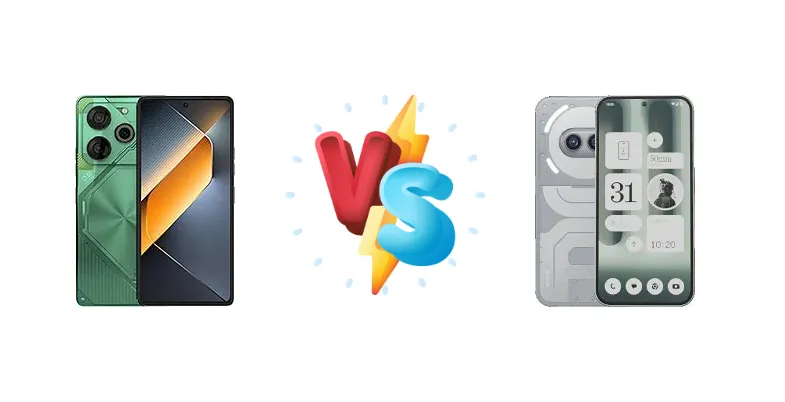
The Tecno Pova 6 Pro and Nothing Phone (2a) Plus represent compelling options in the increasingly competitive mid-range smartphone market. The Pova 6 Pro aggressively targets users prioritizing maximum battery life and fast charging, while the Nothing Phone (2a) Plus aims for a more balanced experience with a more modern chipset and a focus on design and software.
🏆 Quick Verdict
For the average user, the Nothing Phone (2a) Plus emerges as the slightly stronger choice. Its Mediatek Dimensity 7350 Pro, built on a 4nm process, delivers superior performance and efficiency compared to the Pova 6 Pro’s Dimensity 6080. However, the Pova 6 Pro’s exceptional 14:22-hour active use battery life makes it ideal for power users.
| Network |
|---|
| 2G bands | GSM 850 / 900 / 1800 / 1900 | GSM 850 / 900 / 1800 / 1900 |
| 3G bands | HSDPA 850 / 900 / 2100 | HSDPA 800 / 850 / 900 / 1700(AWS) / 1900 / 2100 |
| 4G bands | LTE | 1, 3, 4, 5, 7, 8, 18, 19, 20, 26, 28, 38, 39, 40, 41, 42, 66 |
| 5G bands | SA/NSA | 1, 3, 5, 7, 8, 20, 28, 38, 40, 41, 66, 77, 78 SA/NSA |
| Speed | HSPA, LTE, 5G | HSPA, LTE, 5G |
| Technology | GSM / HSPA / LTE / 5G | GSM / HSPA / LTE / 5G |
| Launch |
|---|
| Announced | 2024, February 26 | 2024, July 31 |
| Status | Available. Released 2024, April 4 | Available. Released 2024, August 03 |
| Body |
|---|
| Build | Glass front, plastic frame, plastic back | Glass front (Gorilla Glass 5), plastic frame, plastic back |
| Dimensions | 165.5 x 76.1 x 7.9 mm (6.52 x 3.00 x 0.31 in) | 161.7 x 76.3 x 8.5 mm (6.37 x 3.00 x 0.33 in) |
| SIM | Nano-SIM + Nano-SIM | Nano-SIM + Nano-SIM |
| Weight | 198 g (6.98 oz) | 190 g (6.70 oz) |
| Display |
|---|
| Protection | - | Corning Gorilla Glass 5 |
| Resolution | 1080 x 2436 pixels (~393 ppi density) | 1080 x 2412 pixels, 20:9 ratio (~395 ppi density) |
| Size | 6.78 inches, 109.9 cm2 (~87.2% screen-to-body ratio) | 6.7 inches, 107.5 cm2 (~87.1% screen-to-body ratio) |
| Type | AMOLED, 120Hz, 1300 nits (peak) | AMOLED, 1B colors, 120Hz, 2160Hz PWM, HDR10+, 700 nits (typ), 1100 nits (HBM), 1300 nits (peak) |
| Platform |
|---|
| CPU | Octa-core (2x2.4 GHz Cortex-A76 & 6x2.0 GHz Cortex-A55) | Octa-core (2x3.0 GHz Cortex-A715 & 6x 2.0 GHz Cortex-A510) |
| Chipset | Mediatek Dimensity 6080 (6 nm) | Mediatek Dimensity 7350 Pro (4 nm) |
| GPU | Mali-G57 MC2 | Mali-G610 MC4 |
| OS | Android 14, HIOS 14 | Android 14, up to 3 major Android upgrades, Nothing OS 3.0 |
| Memory |
|---|
| Card slot | microSDXC (dedicated slot) | No |
| Internal | 256GB 8GB RAM, 256GB 12GB RAM | 256GB 8GB RAM, 256GB 12GB RAM |
| Main Camera |
|---|
| Dual | 108 MP, f/1.9, 24mm (wide), 1/1.52", 0.7µm, PDAF
Auxiliary lenses | 50 MP, f/1.9, 24mm (wide), 1/1.57", 1.0µm, PDAF, OIS
50 MP, f/2.2, 114˚ (ultrawide), 1/2.76", 0.64µm |
| Features | Dual-LED flash | LED flash, panorama, HDR |
| Video | 1440p@30fps, 1080p@30/60fps | 4K@30fps, 1080p@60/120fps, gyro-EIS |
| Selfie camera |
|---|
| Features | Dual-LED dual-tone flash | HDR |
| Single | 32 MP, f/2.2, 22mm (wide), 1/3.1", 0.7µm | 50 MP, f/2.2, (wide), 1/2.76" |
| Video | 1440p@30fps, 1080p@30/60fps | 4K@30fps |
| Sound |
|---|
| 35mm jack | Yes | No |
| Loudspeaker | Yes, with stereo speakers | Yes, with stereo speakers |
| Comms |
|---|
| Bluetooth | 5.3, A2DP, LE | 5.3, A2DP, LE |
| Infrared port | Yes | - |
| NFC | Yes | Yes, 360˚ |
| Positioning | GPS, GLONASS, GALILEO, BDS | GPS, GALILEO, GLONASS, BDS, QZSS |
| Radio | FM radio | No |
| USB | USB Type-C 2.0 | USB Type-C 2.0, OTG |
| WLAN | Wi-Fi 802.11 a/b/g/n/ac, dual-band | Wi-Fi 802.11 a/b/g/n/ac/6, dual-band, Wi-Fi Direct |
| Features |
|---|
| Sensors | Fingerprint (under display, optical), accelerometer, gyro, proximity, compass | Fingerprint (under display, optical), accelerometer, gyro, proximity, compass |
| Battery |
|---|
| Charging | 70W wired, 50% in 20 min, 100% in 50 min
10W reverse wired | 50W wired, 50% in 21 min, 100% in 56 min |
| Type | 6000 mAh | 5000 mAh |
| Misc |
|---|
| Colors | Comet Green, Meteorite Grey | Black, Grey |
| Models | LI9 | A142P |
| Price | About 410 EUR | € 269.90 / ₹ 22,599 |
Tecno Pova 6 Pro
- Exceptional battery life (14:22h active use)
- Ultra-fast 70W wired charging
- 10W reverse wired charging
- Less powerful chipset (Dimensity 6080)
- Older CPU architecture
Nothing Phone (2a) Plus
- More efficient chipset (Dimensity 7350 Pro, 4nm)
- Slightly brighter display (1097 nits)
- Newer CPU architecture
- Shorter battery life (16:34h active use)
- Slower 50W charging
Display Comparison
Both devices feature displays capable of reaching over 1000 nits of peak brightness, with the Nothing Phone (2a) Plus marginally edging out the Tecno Pova 6 Pro at 1097 nits versus 1070 nits. While both are bright enough for outdoor visibility, the difference is subtle. Neither specification details refresh rates or panel technology (OLED vs LCD), which would be crucial for a full assessment. The lack of LTPO on either device suggests less dynamic refresh rate control, potentially impacting battery life during variable content viewing.
Camera Comparison
Without detailed camera specifications beyond the main sensors, a direct comparison is limited. However, the chipset difference suggests the Nothing Phone (2a) Plus will benefit from a more powerful ISP (Image Signal Processor) within the Dimensity 7350 Pro, potentially leading to better image processing, noise reduction, and dynamic range. The absence of OIS information for either device means image stabilization will rely heavily on software algorithms. The market segment suggests both will likely feature competent, but not class-leading, camera systems.
Performance
The core difference lies in the chipsets. The Nothing Phone (2a) Plus utilizes the Mediatek Dimensity 7350 Pro, fabricated on a more efficient 4nm process, featuring a CPU with 2x3.0 GHz Cortex-A715 cores. This contrasts with the Tecno Pova 6 Pro’s Dimensity 6080 (6nm) and its 2x2.4 GHz Cortex-A76 cores. The 4nm node of the Dimensity 7350 Pro translates to better thermal efficiency, meaning sustained performance will be higher under load, and less throttling during extended gaming sessions. While both use 6x2.0 GHz Cortex-A55/A510 efficiency cores, the (2a) Plus’s CPU architecture is a generation newer, offering incremental improvements in power efficiency.
Battery Life
The Tecno Pova 6 Pro shines in battery endurance, achieving an impressive 14:22 hours of active use. This is notably longer than the Nothing Phone (2a) Plus’s 16:34 hours. However, the Nothing Phone (2a) Plus compensates with a more efficient chipset. The Pova 6 Pro boasts significantly faster 70W wired charging (50% in 20 minutes, 100% in 50 minutes) compared to the (2a) Plus’s 50W charging (50% in 21 minutes, 100% in 56 minutes). The Pova 6 Pro also includes 10W reverse wired charging, a feature absent on the (2a) Plus.
Buying Guide
Buy the Tecno Pova 6 Pro if you absolutely need the longest possible battery life and prioritize fast 70W charging above all else. It’s the phone for those who frequently find themselves away from a power outlet. Buy the Nothing Phone (2a) Plus if you value a more responsive user experience, a slightly brighter display, and a more efficient chipset, even if it means sacrificing some battery endurance.
Frequently Asked Questions
❓ Does the Dimensity 7350 Pro in the Nothing Phone (2a) Plus get noticeably warmer during extended gaming sessions compared to the Dimensity 6080 in the Pova 6 Pro?
While both chipsets will generate heat under load, the Dimensity 7350 Pro’s 4nm process is inherently more thermally efficient. This means it’s likely to maintain higher sustained performance for longer periods before throttling, and will generally run cooler overall, even if peak temperatures are similar.
❓ How much of a real-world difference will the faster charging of the Tecno Pova 6 Pro make in daily use?
The Pova 6 Pro’s 70W charging is a significant advantage. Being able to top up 50% of the battery in just 20 minutes is incredibly convenient, especially for users who frequently forget to charge overnight or need a quick boost before heading out. The (2a) Plus’s 50W charging is still respectable, but noticeably slower.
❓ Given the lack of detailed camera specs, can we expect a significant difference in photo quality between these two phones?
While megapixel counts aren't everything, the Dimensity 7350 Pro's more powerful ISP in the Nothing Phone (2a) Plus will likely result in better image processing, particularly in challenging lighting conditions. Expect improved noise reduction, dynamic range, and overall image clarity compared to the Pova 6 Pro.