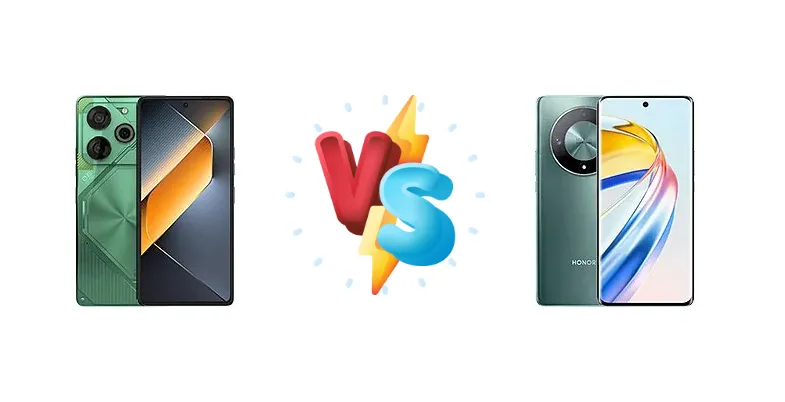
The Tecno Pova 6 Pro and Honor X9b represent compelling options in the competitive mid-range smartphone market. The Pova 6 Pro aggressively targets gamers and power users with its rapid charging and extended battery life, while the Honor X9b focuses on a more balanced experience with a newer, more efficient chipset. This comparison dissects their key differences to determine which device delivers the best value.
🏆 Quick Verdict
For users prioritizing all-day battery life and rapid replenishment, the Tecno Pova 6 Pro is the clear winner. Its 14:22-hour active use score and 70W charging significantly outperform the Honor X9b. However, the X9b’s Snapdragon 6 Gen 1 offers a more modern architecture and potentially better sustained performance.
| Network |
|---|
| 2G bands | GSM 850 / 900 / 1800 / 1900 | GSM 850 / 900 / 1800 / 1900 |
| 3G bands | HSDPA 850 / 900 / 2100 | HSDPA 850 / 900 / 1900 / 2100 |
| 4G bands | LTE | 1, 2, 3, 4, 5, 7, 8, 20, 28, 32, 38, 40, 41 |
| 5G bands | SA/NSA | 1, 3, 7, 8, 20, 28, 38, 40, 41, 77, 78 SA/NSA |
| Speed | HSPA, LTE, 5G | HSPA, LTE, 5G |
| Technology | GSM / HSPA / LTE / 5G | GSM / HSPA / LTE / 5G |
| Launch |
|---|
| Announced | 2024, February 26 | 2023, October 18 |
| Status | Available. Released 2024, April 4 | Available. Released 2023, October |
| Body |
|---|
| Build | Glass front, plastic frame, plastic back | - |
| Dimensions | 165.5 x 76.1 x 7.9 mm (6.52 x 3.00 x 0.31 in) | 163.6 x 75.5 x 8 mm (6.44 x 2.97 x 0.31 in) |
| SIM | Nano-SIM + Nano-SIM | Nano-SIM + Nano-SIM |
| Weight | 198 g (6.98 oz) | 185 g (6.53 oz) |
| Display |
|---|
| Resolution | 1080 x 2436 pixels (~393 ppi density) | 1220 x 2652 pixels, 19.5:9 ratio (~431 ppi density) |
| Size | 6.78 inches, 109.9 cm2 (~87.2% screen-to-body ratio) | 6.78 inches, 112.6 cm2 (~91.2% screen-to-body ratio) |
| Type | AMOLED, 120Hz, 1300 nits (peak) | AMOLED, 1B colors, 120Hz, 1200 nits (peak) |
| Platform |
|---|
| CPU | Octa-core (2x2.4 GHz Cortex-A76 & 6x2.0 GHz Cortex-A55) | Octa-core (4x2.2 GHz Cortex-A78 & 4x1.8 GHz Cortex-A55) |
| Chipset | Mediatek Dimensity 6080 (6 nm) | Qualcomm SM6450 Snapdragon 6 Gen 1 (4 nm) |
| GPU | Mali-G57 MC2 | Adreno 710 |
| OS | Android 14, HIOS 14 | Android 13, Magic OS 7.2 |
| Memory |
|---|
| Card slot | microSDXC (dedicated slot) | No |
| Internal | 256GB 8GB RAM, 256GB 12GB RAM | 256GB 8GB RAM, 256GB 12GB RAM, 512GB 8GB RAM, 512GB 12GB RAM |
| Main Camera |
|---|
| Dual | 108 MP, f/1.9, 24mm (wide), 1/1.52", 0.7µm, PDAF
Auxiliary lenses | - |
| Features | Dual-LED flash | LED flash, panorama, HDR |
| Triple | - | 108 MP, f/1.8, (wide), 1/1.67", PDAF
5 MP, f/2.2, (ultrawide)
2 MP (macro) |
| Video | 1440p@30fps, 1080p@30/60fps | 4K@30fps, 1080p@30fps |
| Selfie camera |
|---|
| Features | Dual-LED dual-tone flash | - |
| Single | 32 MP, f/2.2, 22mm (wide), 1/3.1", 0.7µm | 16 MP, f/2.5, (wide) |
| Video | 1440p@30fps, 1080p@30/60fps | 1080p@30fps |
| Sound |
|---|
| 35mm jack | Yes | No |
| Loudspeaker | Yes, with stereo speakers | Yes |
| Comms |
|---|
| Bluetooth | 5.3, A2DP, LE | 5.1, A2DP, LE |
| Infrared port | Yes | Yes |
| NFC | Yes | Yes (market/region dependent) |
| Positioning | GPS, GLONASS, GALILEO, BDS | GPS, GLONASS, GALILEO, BDS |
| Radio | FM radio | No |
| USB | USB Type-C 2.0 | USB Type-C 2.0, OTG |
| WLAN | Wi-Fi 802.11 a/b/g/n/ac, dual-band | Wi-Fi 802.11 a/b/g/n/ac, dual-band, Wi-Fi Direct |
| Features |
|---|
| Sensors | Fingerprint (under display, optical), accelerometer, gyro, proximity, compass | Fingerprint (under display, optical), accelerometer, gyro, proximity, compass |
| Battery |
|---|
| Charging | 70W wired, 50% in 20 min, 100% in 50 min
10W reverse wired | 35W wired
Reverse wired |
| Type | 6000 mAh | Li-Po 5800 mAh |
| Misc |
|---|
| Colors | Comet Green, Meteorite Grey | Sunrise Orange, Midnight Black, Emerald Green |
| Models | LI9 | ALI-NX1 |
| Price | About 410 EUR | About 970 EUR |
Tecno Pova 6 Pro
- Exceptional battery life (14:22h active use)
- Ultra-fast 70W charging
- Higher CPU clock speeds for burst performance
- Older 6nm chipset process
- Potentially less efficient power consumption
Honor X9b
- More efficient 4nm Snapdragon 6 Gen 1 chipset
- Potentially better sustained performance
- Likely improved image processing
- Slower 35W charging
- Lower CPU clock speeds compared to Pova 6 Pro
Display Comparison
The Tecno Pova 6 Pro boasts a peak brightness of 1070 nits, ensuring excellent visibility even in direct sunlight. While the Honor X9b’s display specifications aren’t provided, Honor typically focuses on color accuracy and viewing angles in this segment. The Pova 6 Pro’s higher brightness is a tangible advantage for outdoor users. Without knowing the panel technology of the X9b (e.g., AMOLED vs. LCD), it’s difficult to assess color reproduction and contrast ratios, but the Pova 6 Pro’s brightness is a clear win.
Camera Comparison
Without detailed camera specifications for either device, a direct comparison is challenging. However, focusing on the chipsets, the Snapdragon 6 Gen 1 typically offers better image signal processing (ISP) capabilities than the Dimensity 6080, potentially resulting in improved image quality, especially in low-light conditions. The absence of information regarding sensor sizes and optical image stabilization (OIS) makes a definitive judgment impossible, but the X9b likely has an advantage in image processing.
Performance
The core difference lies in the chipsets: the Tecno Pova 6 Pro utilizes the Mediatek Dimensity 6080 (6nm), while the Honor X9b features the Qualcomm Snapdragon 6 Gen 1 (4nm). The Snapdragon 6 Gen 1’s 4nm process offers superior power efficiency compared to the Dimensity 6080’s 6nm node, potentially leading to less heat generation and more sustained performance during demanding tasks. However, the Dimensity 6080’s Cortex-A76 cores (2x2.4 GHz) are clocked higher than the X9b’s Cortex-A78 cores (4x2.2 GHz), suggesting a potential edge in burst performance. The X9b’s architecture is newer, but the Pova 6 Pro’s clock speeds are higher.
Battery Life
The Tecno Pova 6 Pro shines in battery performance, achieving an impressive 14:22 hours of active use. This is coupled with a blazing-fast 70W wired charging solution, capable of reaching 50% charge in just 20 minutes and a full charge in 50 minutes. The Honor X9b, with its 35W charging, is significantly slower. While the X9b’s battery capacity isn’t specified, the Pova 6 Pro’s combination of endurance and charging speed is a major selling point, particularly for users who frequently find themselves away from a power outlet.
Buying Guide
Buy the Tecno Pova 6 Pro if you need exceptional battery endurance for gaming, streaming, or heavy daily use, and value the convenience of incredibly fast charging. Buy the Honor X9b if you prioritize a more efficient processor for everyday tasks and appreciate a potentially smoother experience with modern apps, even if it means sacrificing some battery life and charging speed.
Frequently Asked Questions
❓ Will the Dimensity 6080 in the Tecno Pova 6 Pro struggle with graphically demanding games like Genshin Impact?
While the Dimensity 6080 is capable, Genshin Impact and similar titles will likely require reduced graphics settings for a consistently smooth experience. The chipset’s strength lies in its ability to handle sustained performance, but it may not match the raw graphical power of higher-end chips. The Pova 6 Pro’s large battery will help mitigate any performance throttling due to heat.
❓ How much slower is the 35W charging on the Honor X9b compared to the 70W charging on the Tecno Pova 6 Pro in real-world use?
The difference is substantial. The Tecno Pova 6 Pro can gain a 50% charge in just 20 minutes, while the Honor X9b will take considerably longer – likely over an hour. For users who frequently need a quick top-up, the Pova 6 Pro’s charging speed is a significant advantage.
❓ Does the Snapdragon 6 Gen 1 in the Honor X9b offer noticeable improvements in app loading times compared to the Dimensity 6080?
You'll likely see slightly faster app loading times on the Honor X9b due to the Snapdragon 6 Gen 1's more modern architecture and optimized processing. However, the difference won't be dramatic for most everyday apps. The benefit will be more apparent in multitasking and demanding applications.