
Tecno Pova 6 Pro vs Google Pixel 7a: A Deep Dive into Performance, Battery, and Camera
| Phones Images | |||||
|---|---|---|---|---|---|
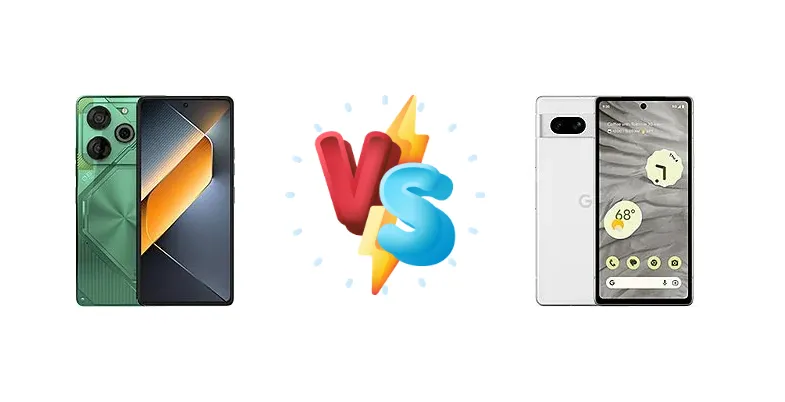
|
🏆 Quick Verdict
For the average user prioritizing camera quality and a smooth software experience, the Google Pixel 7a is the superior choice. However, if extended battery life and rapid charging are paramount, particularly for gaming, the Tecno Pova 6 Pro offers compelling value.
| PHONES | ||
|---|---|---|
| Phone Names | Tecno Pova 6 Pro | Google Pixel 7a |
| Network | ||
|---|---|---|
| 2G bands | GSM 850 / 900 / 1800 / 1900 | GSM 850 / 900 / 1800 / 1900 |
| 3G bands | HSDPA 850 / 900 / 2100 | HSDPA 800 / 850 / 900 / 1700(AWS) / 1900 / 2100 |
| 4G bands | LTE | 1, 2, 3, 4, 5, 7, 8, 12, 13, 14, 17, 20, 25, 26, 28, 29, 30, 38, 40, 41, 48, 66, 71 - GWKK3, G0DZQ |
| 5G bands | SA/NSA | 1, 2, 3, 5, 7, 8, 12, 14, 20, 25, 28, 30, 38, 41, 48, 66, 71, 77, 78 SA/NSA/Sub6 - GWKK3 |
| Speed | HSPA, LTE, 5G | HSPA, LTE, 5G |
| Technology | GSM / HSPA / LTE / 5G | GSM / HSPA / LTE / 5G |
| - | 1, 2, 3, 5, 7, 8, 12, 20, 25, 28, 38, 40, 41, 66, 75, 76, 77, 78, 79 SA/NSA/Sub6 - GHL1X, G82U8 | |
| Launch | ||
|---|---|---|
| Announced | 2024, February 26 | 2023, May 10 |
| Status | Available. Released 2024, April 4 | Available. Released 2023, May 10 |
| Body | ||
|---|---|---|
| Build | Glass front, plastic frame, plastic back | Glass front (Gorilla Glass 3), aluminum frame, plastic back |
| Dimensions | 165.5 x 76.1 x 7.9 mm (6.52 x 3.00 x 0.31 in) | 152 x 72.9 x 9 mm (5.98 x 2.87 x 0.35 in) |
| SIM | Nano-SIM + Nano-SIM | Nano-SIM + eSIM |
| Weight | 198 g (6.98 oz) | 193.5 g (6.84 oz) |
| - | IP67 dust/water resistant (up to 1m for 30 min) | |
| Display | ||
|---|---|---|
| Protection | - | Corning Gorilla Glass 3 |
| Resolution | 1080 x 2436 pixels (~393 ppi density) | 1080 x 2400 pixels, 20:9 ratio (~429 ppi density) |
| Size | 6.78 inches, 109.9 cm2 (~87.2% screen-to-body ratio) | 6.1 inches, 90.7 cm2 (~81.8% screen-to-body ratio) |
| Type | AMOLED, 120Hz, 1300 nits (peak) | OLED, HDR, 90Hz |
| - | Always-on display | |
| Platform | ||
|---|---|---|
| CPU | Octa-core (2x2.4 GHz Cortex-A76 & 6x2.0 GHz Cortex-A55) | Octa-core (2x2.85 GHz Cortex-X1 & 2x2.35 GHz Cortex-A78 & 4x1.80 GHz Cortex-A55) |
| Chipset | Mediatek Dimensity 6080 (6 nm) | Google Tensor G2 (5 nm) |
| GPU | Mali-G57 MC2 | Mali-G710 MP7 |
| OS | Android 14, HIOS 14 | Android 13, upgradable to Android 15, up to 5 major Android upgrades |
| Memory | ||
|---|---|---|
| Card slot | microSDXC (dedicated slot) | No |
| Internal | 256GB 8GB RAM, 256GB 12GB RAM | 128GB 8GB RAM |
| - | UFS 3.1 | |
| Main Camera | ||
|---|---|---|
| Dual | 108 MP, f/1.9, 24mm (wide), 1/1.52", 0.7µm, PDAF Auxiliary lenses | 64 MP, f/1.9, 26mm (wide), 1/1.73", 0.8µm, dual pixel PDAF, OIS 13 MP, f/2.2, 120˚ (ultrawide), 1.12µm |
| Features | Dual-LED flash | Dual-LED flash, Pixel Shift, Auto-HDR, panorama |
| Video | 1440p@30fps, 1080p@30/60fps | 4K@30/60fps, 1080p@30/60/120/240fps, OIS |
| Selfie camera | ||
|---|---|---|
| Features | Dual-LED dual-tone flash | HDR, panorama |
| Single | 32 MP, f/2.2, 22mm (wide), 1/3.1", 0.7µm | 13 MP, f/2.2, 20mm (ultrawide), 1.12µm |
| Video | 1440p@30fps, 1080p@30/60fps | 4K@30fps, 1080p@30fps |
| Sound | ||
|---|---|---|
| 3.5mm jack | - | No |
| 35mm jack | Yes | No |
| Loudspeaker | Yes, with stereo speakers | Yes, with stereo speakers |
| Comms | ||
|---|---|---|
| Bluetooth | 5.3, A2DP, LE | 5.3, A2DP, LE |
| Infrared port | Yes | - |
| NFC | Yes | Yes |
| Positioning | GPS, GLONASS, GALILEO, BDS | GPS, GLONASS, GALILEO, BDS, QZSS, NavIC |
| Radio | FM radio | No |
| USB | USB Type-C 2.0 | USB Type-C 3.2 |
| WLAN | Wi-Fi 802.11 a/b/g/n/ac, dual-band | Wi-Fi 802.11 a/b/g/n/ac/6e, tri-band |
| Features | ||
|---|---|---|
| Sensors | Fingerprint (under display, optical), accelerometer, gyro, proximity, compass | Fingerprint (under display, optical), accelerometer, gyro, proximity, compass, barometer |
| Battery | ||
|---|---|---|
| Charging | 70W wired, 50% in 20 min, 100% in 50 min 10W reverse wired | 18W wired, PD3.0 7.5W wireless |
| Type | 6000 mAh | Li-Po 4385 mAh |
| Misc | ||
|---|---|---|
| Colors | Comet Green, Meteorite Grey | Charcoal, Snow, Sea, Coral |
| Models | LI9 | GWKK3, GHL1X, G0DZQ, G82U8 |
| Price | About 410 EUR | € 179.90 / $ 150.00 / £ 170.00 / ₹ 25,980 |
Tecno Pova 6 Pro
- Exceptional battery life (14:22h active use)
- Ultra-fast 70W charging
- Competitive price point
- Less powerful processor than the Pixel 7a
- Camera performance likely inferior to the Pixel 7a
Google Pixel 7a
- Superior processor (Google Tensor G2)
- Excellent camera quality and image processing
- Smooth and refined software experience
- Slower 18W charging
- Lower battery endurance compared to the Pova 6 Pro
Display Comparison
Both the Tecno Pova 6 Pro and Google Pixel 7a feature displays capable of reaching 1070 nits of peak brightness, ensuring excellent visibility even in direct sunlight. However, the context data lacks information regarding panel technology (OLED vs LCD) or refresh rates. Given the Pixel 7a’s price point, it likely utilizes a higher-quality OLED panel with potentially better color accuracy and contrast. The Pova 6 Pro, aiming for value, may employ an LCD. Bezels are not specified, but the Pixel 7a generally benefits from Google’s design aesthetic, likely resulting in slimmer bezels.
Camera Comparison
The Pixel 7a’s camera system is a clear strength. While specific sensor details are missing for both devices, Google’s computational photography prowess, powered by the Tensor G2’s image signal processor (ISP), elevates image quality significantly. The Pixel 7a excels in dynamic range, low-light performance, and overall image processing. The Pova 6 Pro likely relies more on hardware specifications, and without detailed information, it’s difficult to assess its camera capabilities beyond basic functionality. The absence of details regarding OIS on the Pova 6 Pro suggests the Pixel 7a will offer superior video stabilization.
Performance
The performance disparity is significant. The Google Pixel 7a’s Tensor G2, fabricated on a 5nm process, boasts a more advanced architecture – featuring Cortex-X1 and Cortex-A78 cores – compared to the Tecno Pova 6 Pro’s Dimensity 6080 (6nm). The Tensor G2’s CPU configuration (2x2.85 GHz Cortex-X1 & 2x2.35 GHz Cortex-A78 & 4x1.80 GHz Cortex-A55) provides a substantial performance advantage over the Pova 6 Pro’s (2x2.4 GHz Cortex-A76 & 6x2.0 GHz Cortex-A55) in demanding tasks like video editing and complex gaming. While the Pova 6 Pro is capable, the Tensor G2 offers a smoother, more responsive experience. The Pixel 7a’s RAM configuration (likely LPDDR5X) is also expected to be faster than the Pova 6 Pro’s, further enhancing multitasking.
Battery Life
The Tecno Pova 6 Pro shines in battery endurance, achieving an impressive 14:22 hours of active use. This contrasts with the Pixel 7a’s older endurance rating of 76 hours, which is a less direct comparison. The Pova 6 Pro’s 70W wired charging is a game-changer, delivering a 50% charge in just 20 minutes and a full charge in 50 minutes. The Pixel 7a’s 18W charging feels comparatively slow. While the Pixel 7a may have a slightly larger battery capacity (not specified), the Pova 6 Pro’s charging speed and real-world endurance give it a significant advantage for users who prioritize minimizing downtime.
Buying Guide
Buy the Tecno Pova 6 Pro if you need all-day battery life with intensive use, prioritize fast 70W charging, and frequently engage in mobile gaming. Buy the Google Pixel 7a if you prefer a more polished software experience, exceptional camera performance, and benefit from Google’s AI-powered features, even if it means sacrificing some battery endurance.