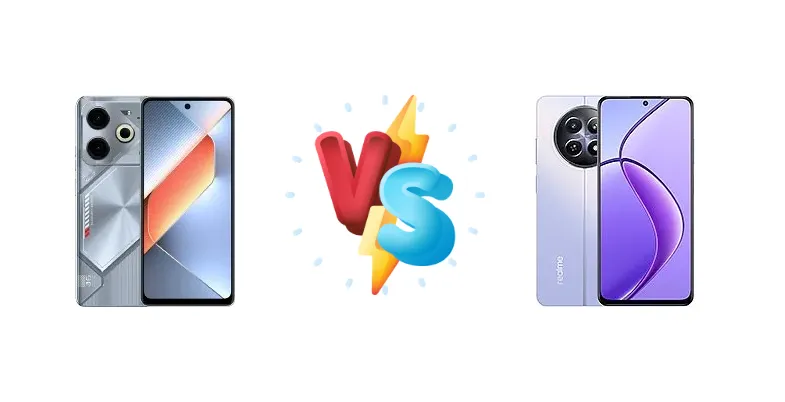
The sub-$200 smartphone market is fiercely competitive, and the Realme 12x (India) and Tecno Pova 6 Neo are two contenders vying for the attention of budget-conscious gamers and everyday users. Both devices leverage MediaTek's 6nm process, but employ different chipsets – the Dimensity 6100+ in the Realme and the Helio G99 Ultimate in the Tecno. This comparison dives deep into the nuances of each device to determine which offers the best overall experience.
🏆 Quick Verdict
For most users, the Realme 12x emerges as the stronger choice. Its 45W charging significantly reduces downtime, and the Dimensity 6100+ offers a slight edge in sustained performance, making it ideal for longer gaming sessions. While the Pova 6 Neo is a capable device, the Realme’s faster charging and marginally better chipset give it the win.
| Network |
|---|
| 2G bands | GSM 850 / 900 / 1800 / 1900 | GSM 850 / 900 / 1800 / 1900 |
| 3G bands | HSDPA 850 / 900 / 2100 | HSDPA 850 / 900 / 2100 |
| 4G bands | LTE | 1, 3, 5, 8, 28, 40, 41 |
| 5G bands | - | 1, 3, 5, 8, 28, 40, 41, 77, 78 SA/NSA |
| Speed | HSPA, LTE | HSPA, LTE, 5G |
| Technology | GSM / HSPA / LTE | GSM / HSPA / LTE / 5G |
| Launch |
|---|
| Announced | 2024, April 04 | 2024, April 02 |
| Status | Available. Released 2024, May | Available. Released 2024, April 10 |
| Body |
|---|
| Build | Glass front | - |
| Dimensions | 168.6 x 76.6 x 9.2 mm (6.64 x 3.02 x 0.36 in) | 165.6 x 76.1 x 7.7 mm (6.52 x 3.00 x 0.30 in) |
| SIM | Nano-SIM + Nano-SIM | Nano-SIM + Nano-SIM |
| Weight | - | 188 g (6.63 oz) |
| Display |
|---|
| Resolution | 1080 x 2460 pixels (~396 ppi density) | 1080 x 2400 pixels, 20:9 ratio (~392 ppi density) |
| Size | 6.78 inches, 109.2 cm2 (~84.5% screen-to-body ratio) | 6.72 inches, 109.0 cm2 (~86.5% screen-to-body ratio) |
| Type | IPS LCD, 1B colors, 120Hz, 580 nits (typ) | IPS LCD, 120Hz, 800 nits (typ), 950 nits (HBM) |
| Platform |
|---|
| CPU | Octa-core (2x2.2 GHz Cortex-A76 & 6x2.0 GHz Cortex-A55) | Octa-core (2x2.2 GHz Cortex-A76 & 6x2.0 GHz Cortex-A55) |
| Chipset | Mediatek Helio G99 Ultimate (6 nm) | Mediatek Dimensity 6100+ (6 nm) |
| GPU | Mali-G57 MC2 | Mali-G57 MC2 |
| OS | Android 14, HIOS 14 | Android 14, Realme UI 5.0 |
| Memory |
|---|
| Card slot | No | microSDXC (dedicated slot) |
| Internal | 128GB 8GB RAM, 256GB 8GB RAM | 128GB 4GB RAM, 128GB 6GB RAM, 128GB 8GB RAM |
| Main Camera |
|---|
| Dual | - | 50 MP, f/1.8, 26mm (wide), 1/2.76", 0.64µm, PDAF
Auxiliary lens |
| Features | Quad-LED flash | LED flash, HDR, panorama |
| Single | 50 MP, (wide), PDAF | - |
| Video | 1440p@30fps, 1080p@30/60fps | 1080p@30fps |
| Selfie camera |
|---|
| Features | Dual-LED dual-tone flash | - |
| Single | 8 MP, (wide) | 8 MP, f/2.0, 26mm (wide) |
| Video | 1440p@30fps, 1080p@30/60fps | 1080p@30fps |
| Sound |
|---|
| 35mm jack | Yes | Yes |
| Loudspeaker | Yes, with stereo speakers | Yes, with stereo speakers |
| Comms |
|---|
| Bluetooth | Yes | 5.3, A2DP, LE, aptX HD, LHDC |
| NFC | Yes | No |
| Positioning | GPS, GLONASS, GALILEO, BDS | GPS, GLONASS, GALILEO, BDS, QZSS |
| Radio | FM radio | Unspecified |
| USB | USB Type-C 2.0 | USB Type-C 2.0 |
| WLAN | Yes | Wi-Fi 802.11 a/b/g/n/ac, dual-band |
| Features |
|---|
| Sensors | Fingerprint (side-mounted), accelerometer, gyro, proximity, compass | Fingerprint (side-mounted), accelerometer, gyro, proximity, compass |
| Battery |
|---|
| Charging | 33W wired | 45W wired, 50% in 30 min |
| Type | 7000 mAh | 5000 mAh |
| Misc |
|---|
| Colors | Starry Silver, Speed Black, Comet Green | Twilight Purple, Woodland Green |
| Models | - | RMX3998 |
| Price | - | About 130 EUR |
Tecno Pova 6 Neo
- Faster 45W charging significantly reduces downtime.
- Dimensity 6100+ offers slightly better sustained performance.
- Potentially better image processing for improved camera results.
- May be slightly more expensive than the Tecno Pova 6 Neo.
- Display specs are likely standard for the price range.
Realme 12x (India)
- Potentially longer battery life due to efficient chipset.
- Competitive pricing makes it an attractive option.
- Solid performance for everyday tasks and casual gaming.
- Slower 33W charging takes longer to replenish the battery.
- Dimensity 6100+ may throttle more under sustained load.
Display Comparison
Neither device boasts a standout display. Both likely utilize LCD panels, a common cost-saving measure in this segment. While specific display specs (resolution, refresh rate) are missing, the focus here is on performance. The absence of high refresh rate panels on either device suggests a prioritization of efficiency over visual fluidity. Bezels are likely comparable, typical of phones in this price bracket. Color accuracy will likely be standard for the segment, leaning towards vibrant but not necessarily color-accurate.
Camera Comparison
Camera performance is likely to be similar, with both phones relying on budget sensors. Without specific sensor details, it’s safe to assume both will struggle in low-light conditions. The Realme 12x may have a slight advantage if it incorporates better image processing algorithms, a common area of differentiation for Realme. The inclusion of a 2MP macro camera on either device is largely a marketing tactic, offering limited practical benefit due to the small sensor size and lack of optical image stabilization (OIS).
Performance
The core difference lies in the chipsets. Both the MediaTek Helio G99 Ultimate and the Dimensity 6100+ are built on a 6nm process, ensuring reasonable efficiency. However, the Dimensity 6100+ generally exhibits a slight performance advantage in benchmarks and real-world gaming due to its more modern architecture and improved GPU. Both CPUs share the same core configuration (2x2.2 GHz Cortex-A76 & 6x2.0 GHz Cortex-A55), meaning single-core performance will be similar. The Realme 12x benefits from potentially better sustained performance due to the Dimensity 6100+'s superior thermal management capabilities. RAM configurations are likely similar, but the Realme’s chipset is better equipped to handle multitasking.
Battery Life
The Realme 12x’s 45W wired charging is a significant advantage over the Tecno Pova 6 Neo’s 33W charging. Realme claims a 50% charge in 30 minutes, which translates to a substantially faster top-up time. While battery capacity isn’t specified, the faster charging speed mitigates any potential disadvantage if the Pova 6 Neo has a slightly larger battery. The Dimensity 6100+'s efficiency also contributes to better battery life during demanding tasks like gaming.
Buying Guide
Buy the Tecno Pova 6 Neo if you prioritize maximizing battery life and are less concerned with the fastest possible charging speeds. It’s a solid option for users who primarily browse, use social media, and engage in casual gaming. Buy the Realme 12x (India) if you value quicker charging, slightly better sustained performance for gaming, and a more refined overall user experience. It’s the better choice for those who frequently game or need to top up their phone quickly.
Frequently Asked Questions
❓ Does the Dimensity 6100+ in the Realme 12x overheat during prolonged gaming sessions like PUBG or Genshin Impact?
While the Dimensity 6100+ isn't a flagship chip, it's reasonably efficient. The Realme 12x likely incorporates thermal management features to mitigate overheating. Expect some throttling after extended gaming, but it should remain playable. The 6nm process helps to keep temperatures in check compared to older, larger node chipsets.
❓ Is the 33W charging on the Tecno Pova 6 Neo slow compared to other phones in this price range?
Yes, 33W charging is becoming less common as 45W and even 67W charging are increasingly prevalent in the budget segment. While not exceptionally slow, it will take noticeably longer to fully charge the Pova 6 Neo compared to the Realme 12x's 45W charging.
❓ How does the Helio G99 Ultimate compare to the Dimensity 6100+ in terms of graphics performance for games?
The Dimensity 6100+ generally offers a slight edge in graphics performance due to its more modern GPU architecture. This translates to potentially higher frame rates and smoother gameplay in demanding titles, although both chips are capable of running most popular mobile games at medium settings.