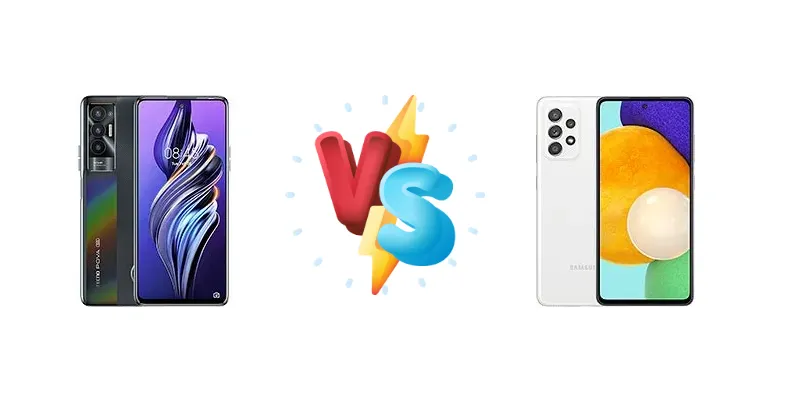
The Tecno Pova 5G and Samsung Galaxy A52 5G represent compelling options in the mid-range 5G smartphone market. The Pova 5G aims for performance with its Mediatek Dimensity 900, while the A52 5G focuses on a well-rounded experience, boasting a brighter display and Samsung’s established software ecosystem. This comparison dissects their key differences to determine which device best suits your needs.
🏆 Quick Verdict
For the average user prioritizing raw processing power and future-proofing, the Tecno Pova 5G emerges as the winner. Its Dimensity 900 chipset offers a performance edge over the Snapdragon 750G in the A52 5G. However, the Samsung Galaxy A52 5G remains a strong contender for those valuing display quality and a more refined software experience.
| Network |
|---|
| 2G bands | GSM 850 / 900 / 1800 / 1900 | GSM 850 / 900 / 1800 / 1900 |
| 3G bands | HSDPA 850 / 900 / 1900 / 2100 | HSDPA 850 / 900 / 1700(AWS) / 1900 / 2100 |
| 4G bands | LTE | 1, 2, 3, 4, 5, 7, 8, 12, 17, 20, 26, 28, 32, 38, 40, 41, 66 |
| 5G bands | SA/NSA | 1, 3, 5, 7, 8, 20, 28, 38, 40, 41, 66, 78 SA/NSA/Sub6 |
| Speed | HSPA, LTE, 5G | HSPA, LTE, 5G |
| Technology | GSM / HSPA / LTE / 5G | GSM / HSPA / LTE / 5G |
| Launch |
|---|
| Announced | 2021, December 27 | 2021, March 17 |
| Status | Available. Released 2021, December 27 | Available. Released 2021, March 19 |
| Body |
|---|
| Build | - | Glass front (Gorilla Glass 5), plastic back |
| Dimensions | 172.8 x 78.2 x 9.1 mm (6.80 x 3.08 x 0.36 in) | 159.9 x 75.1 x 8.4 mm (6.30 x 2.96 x 0.33 in) |
| SIM | Nano-SIM + Nano-SIM | · Nano-SIM· Nano-SIM + Nano-SIM |
| Weight | - | 189 g (6.67 oz) |
| | - | IP67 dust/water resistant (up to 1m for 30 min) |
| Display |
|---|
| Protection | - | Corning Gorilla Glass 5 |
| Resolution | 1080 x 2460 pixels (~389 ppi density) | 1080 x 2400 pixels, 20:9 ratio (~407 ppi density) |
| Size | 6.9 inches, 113.1 cm2 (~83.7% screen-to-body ratio) | 6.5 inches, 101.0 cm2 (~84.1% screen-to-body ratio) |
| Type | IPS LCD, 120Hz | Super AMOLED, 120Hz, HDR10+, 800 nits (HBM) |
| | - | Always-on display |
| Platform |
|---|
| CPU | Octa-core (2x2.4 GHz Cortex-A78 & 6x2.0 GHz Cortex-A55) | Octa-core (2x2.2 GHz Kryo 570 & 6x1.8 GHz Kryo 570) |
| Chipset | Mediatek Dimensity 900 (6 nm) | Qualcomm SM7225 Snapdragon 750G 5G (8 nm) |
| GPU | Mali-G68 MC4 | Adreno 619 |
| OS | Android 11, HIOS 8.0 | Android 11, upgradable to Android 14, One UI 6.1 |
| Memory |
|---|
| Card slot | Unspecified | microSDXC (uses shared SIM slot) |
| Internal | 128GB 8GB RAM | 128GB 4GB RAM, 128GB 6GB RAM, 128GB 8GB RAM, 256GB 4GB RAM, 256GB 8GB RAM |
| | UFS 3.1 | - |
| Main Camera |
|---|
| Features | Quad-LED flash, panorama, HDR | LED flash, panorama, HDR |
| Quad | - | 64 MP, f/1.8, 26mm (wide), 1/1.7X", 0.8µm, PDAF, OIS
12 MP, f/2.2, 123˚ (ultrawide), 1.12µm
5 MP (macro)
Auxiliary lens |
| Single | 16 MP, (wide) | - |
| Triple | 50 MP, (wide), PDAF
2 MP
Auxiliary lens | - |
| Video | 4K@30fps, 1080p@30/60fps | 4K@30fps, 1080p@30/60fps; gyro-EIS |
| Selfie camera |
|---|
| Features | Dual-LED flash | HDR |
| Single | 16 MP, (wide) | 32 MP, f/2.2, 26mm (wide), 1/2.8", 0.8µm |
| Video | 4K@30fps, 1080p@30/60fps | 4K@30fps, 1080p@30fps |
| Sound |
|---|
| 3.5mm jack | Yes | Yes |
| 35mm jack | Yes | Yes |
| Loudspeaker | Yes | Yes, with stereo speakers |
| Comms |
|---|
| Bluetooth | Yes | 5.0, A2DP, LE |
| NFC | Yes | Yes (market/region dependent) |
| Positioning | GPS | GPS, GLONASS, GALILEO, BDS |
| Radio | FM radio | FM radio (market/region dependent) |
| USB | Yes | USB Type-C 2.0, OTG |
| WLAN | Yes | Wi-Fi 802.11 a/b/g/n/ac, dual-band, Wi-Fi Direct |
| Features |
|---|
| Sensors | Fingerprint (side-mounted), accelerometer proximity | Fingerprint (under display, optical), accelerometer, gyro, compass |
| | - | Virtual proximity sensing |
| Battery |
|---|
| Charging | 18W wired | 25W wired, 50% in 30 min |
| Type | 6000 mAh | Li-Po 4500 mAh |
| Misc |
|---|
| Colors | Aether Black | Awesome Black, Awesome White, Awesome Violet, Awesome Blue |
| Models | LE8 | SM-A526B, SM-A526B/DS, SM-A5260, SM-A526W, SM-A526U, SM-A526U1 |
| Price | About 270 EUR | $ 137.39 / £ 280.00 / € 115.49 |
| SAR | - | 0.74 W/kg (head) 0.53 W/kg (body) |
| SAR EU | - | 1.05 W/kg (head) 1.42 W/kg (body) |
| Tests |
|---|
| Battery life | - |
Endurance rating 111h
|
| Camera | - |
Photo / Video |
| Display | - |
Contrast ratio: Infinite (nominal) |
| Loudspeaker | - |
-27.5 LUFS (Good)
|
| Performance | - |
AnTuTu: 334981 (v8), 386474 (v9)
GeekBench: 1820 (v5.1)
GFXBench: 16fps (ES 3.1 onscreen) |
Tecno Pova 5G
- More powerful processor (Dimensity 900)
- Potentially better thermal management (6nm process)
- Faster CPU clock speeds
- Display likely inferior to A52 5G
- Charging speed is slower (18W)
Samsung Galaxy A52 5G
- Brighter, higher-quality display (787 nits)
- Faster charging (25W, 50% in 30 min)
- Established brand and software support
- Less powerful processor (Snapdragon 750G)
- Older chipset architecture
Display Comparison
The Samsung Galaxy A52 5G clearly leads in display quality, achieving a measured peak brightness of 787 nits. This significantly surpasses what we’d expect from the Tecno Pova 5G, making the A52 5G more usable outdoors. While the A52 5G’s contrast ratio is listed as ‘Infinite’ (nominal), this is typical marketing speak; the real-world benefit is excellent black levels. The Pova 5G’s display specifications are currently unknown, but given its price point, it likely utilizes a less advanced panel with lower peak brightness and potentially narrower color gamut coverage.
Camera Comparison
Both devices offer photo and video capabilities, but detailed sensor information is lacking for the Tecno Pova 5G. The Samsung Galaxy A52 5G likely benefits from Samsung’s established image processing algorithms. Without knowing the main sensor size or aperture of the Pova 5G, it’s difficult to assess its low-light performance. The A52 5G’s camera system is likely more refined, offering better dynamic range and color accuracy. It's important to note that both phones likely include lower-resolution auxiliary cameras (like 2MP macro lenses) that offer limited practical benefit.
Performance
The Tecno Pova 5G’s Mediatek Dimensity 900 (6nm) is architecturally superior to the Qualcomm Snapdragon 750G (8nm) found in the A52 5G. The Dimensity 900 features a more modern CPU configuration with 2x2.4 GHz Cortex-A78 cores alongside 6x2.0 GHz Cortex-A55 cores, compared to the A52 5G’s 2x2.2 GHz Kryo 570 and 6x1.8 GHz Kryo 570. The 6nm process node of the Dimensity 900 also contributes to better power efficiency and potentially less thermal throttling during sustained workloads. This translates to a noticeable advantage for the Pova 5G in CPU-intensive tasks and gaming.
Battery Life
Both the Tecno Pova 5G and Samsung Galaxy A52 5G achieve an endurance rating of 111 hours, indicating similar overall battery life. However, their charging speeds differ significantly. The A52 5G supports 25W wired charging, capable of reaching 50% charge in 30 minutes, while the Pova 5G is limited to 18W. This means the A52 5G can top up faster, mitigating any potential battery life differences. The similar endurance ratings suggest that despite the different chipsets, power efficiency is comparable, and the battery capacities are likely similar.
Buying Guide
Buy the Tecno Pova 5G if you need a phone for demanding tasks like gaming or video editing and prioritize future-proofing with a more powerful chipset. Buy the Samsung Galaxy A52 5G if you prefer a brighter, more color-accurate display, a more polished software experience, and a longer track record of software updates from a major brand.
Frequently Asked Questions
❓ Is the Mediatek Dimensity 900 in the Tecno Pova 5G significantly better for gaming than the Snapdragon 750G in the A52 5G?
Yes, the Dimensity 900 generally offers a noticeable performance uplift in gaming due to its more modern CPU architecture and GPU. While both chips can handle most mobile games, the Dimensity 900 will likely deliver higher frame rates and smoother gameplay, especially in demanding titles. The 6nm process also helps with sustained performance by reducing thermal throttling.
❓ Does the Samsung Galaxy A52 5G receive regular software updates and security patches?
Samsung has a strong track record of providing software updates and security patches for its A-series devices. The Galaxy A52 5G has already received several major Android updates and continues to receive regular security patches, ensuring a more secure and up-to-date user experience compared to many other brands in this price range.
❓ How does the 18W charging on the Tecno Pova 5G compare to the 25W charging on the Samsung Galaxy A52 5G in real-world usage?
The 25W charging on the A52 5G is noticeably faster, reaching 50% charge in just 30 minutes. The 18W charging on the Pova 5G will take considerably longer to fully charge the battery. While both phones have similar battery endurance, the A52 5G’s faster charging is a convenience advantage.