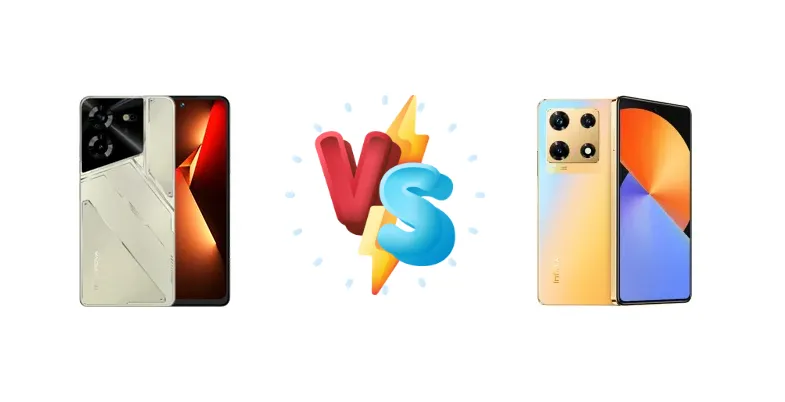
Both the Tecno Pova 5 and the Infinix Note 30 Pro target the competitive mid-range smartphone market, relying on the Mediatek Helio G99 chipset for performance. However, they diverge significantly in charging technology and added features, creating a clear choice for users prioritizing speed versus versatility.
🏆 Quick Verdict
For the average user, the Infinix Note 30 Pro emerges as the stronger contender. Its 68W wired charging, coupled with 15W wireless and reverse wireless capabilities, offers a significantly faster and more convenient charging experience than the Tecno Pova 5’s 45W solution, justifying a potential price premium.
| Network |
|---|
| 2G bands | GSM 850 / 900 / 1800 / 1900 | GSM 850 / 900 / 1800 / 1900 |
| 3G bands | HSDPA 850 / 900 / 2100 | HSDPA 850 / 900 / 1700(AWS) / 1900 / 2100 |
| 4G bands | LTE | 1, 2, 3, 4, 5, 7, 8, 12, 17, 20, 28, 38, 40, 41, 66 |
| Speed | HSPA, LTE | HSPA, LTE |
| Technology | GSM / HSPA / LTE | GSM / HSPA / LTE |
| Launch |
|---|
| Announced | 2023, June 29 | 2023, May 22 |
| Status | Available. Released 2023, July | Available. Released 2023, May 22 |
| Body |
|---|
| Build | Glass front, plastic frame, plastic back | Glass front, plastic frame, glass back |
| Dimensions | 168.6 x 76.6 x 9 mm (6.64 x 3.02 x 0.35 in) | 162.7 x 76 x 8.2 mm (6.41 x 2.99 x 0.32 in) |
| SIM | Nano-SIM + Nano-SIM | Nano-SIM + Nano-SIM |
| Weight | 219.4 g (7.76 oz) | 203 g (7.16 oz) |
| | - | IP53 |
| Display |
|---|
| Resolution | 1080 x 2460 pixels (~396 ppi density) | 1080 x 2400 pixels, 20:9 ratio (~395 ppi density) |
| Size | 6.78 inches, 109.2 cm2 (~84.5% screen-to-body ratio) | 6.67 inches, 107.4 cm2 (~86.9% screen-to-body ratio) |
| Type | IPS LCD, 120Hz, 580 nits (typ) | AMOLED, 1B colors, 120Hz, 900 nits (peak) |
| | - | * the display diagonal size and resolution is unconfirmed |
| Platform |
|---|
| CPU | Octa-core (2x2.2 GHz Cortex-A76 & 6x2.0 GHz Cortex-A55) | Octa-core (2x2.2 GHz Cortex-A76 & 6x2.0 GHz Cortex-A55) |
| Chipset | Mediatek Helio G99 (6 nm) | Mediatek Helio G99 (6 nm) |
| GPU | Mali-G57 MC2 | Mali-G57 MC2 |
| OS | Android 13, HIOS 13 | Android 13, XOS 13 |
| Memory |
|---|
| Card slot | microSDXC | microSDXC (dedicated slot) |
| Internal | 128GB 8GB RAM, 256GB 8GB RAM | 256GB 8GB RAM |
| Main Camera |
|---|
| Features | Dual LED flash | Quad-LED flash, HDR, panorama |
| Single | 50 MP, f/1.6, (wide), 1/2.76", PDAF
Auxiliary lens | - |
| Triple | - | 108 MP, (wide), 1/1.67", PDAF
2 MP (macro)
Auxiliary lens |
| Video | 1440p@30fps, 1080p@30fps | 1440p@30fps, 1080p@30fps |
| Selfie camera |
|---|
| Features | LED flash | LED flash, HDR |
| Single | 8 MP | 32 MP, f/2.0, (wide), 1/2.8" |
| Video | 1080p@30fps | 1080p@30fps |
| Sound |
|---|
| 3.5mm jack | - | Yes |
| 35mm jack | Yes | Yes |
| Loudspeaker | Yes, with stereo speakers | Yes, with dual speakers |
| | - | Sound by JBL
24-bit/192kHz audio |
| Comms |
|---|
| Bluetooth | Yes | Yes |
| NFC | Yes | Yes (market/region dependent) |
| Positioning | GPS, GLONASS, GALILEO, BDS | GPS |
| Radio | FM radio | FM radio |
| USB | USB Type-C 2.0, OTG | USB Type-C 2.0, OTG |
| WLAN | Wi-Fi 802.11 a/b/g/n/ac, dual-band | Wi-Fi 802.11 a/b/g/n/ac, dual-band, Wi-Fi Direct |
| Features |
|---|
| Sensors | Fingerprint (side-mounted), accelerometer, gyro, proximity, compass | Fingerprint (side-mounted), accelerometer, gyro, proximity, compass |
| Battery |
|---|
| Charging | 45W wired, 50% in 21 min, 100% in 60 min
10W reverse wired | 68W wired, PD3.0, 80% in 30 min
15W wireless
Reverse wireless |
| Type | 6000 mAh | 5000 mAh |
| Misc |
|---|
| Colors | Mecha Black, Amber Gold, Hurricane Blue, Free Fire Edition | Magic Black, Variable Gold |
| Models | LH7n | X678B |
| Price | About 130 EUR | - |
Tecno Pova 5
- Potentially lower price point
- Reliable Mediatek Helio G99 performance
- 45W fast charging is still respectable
- Slower charging compared to the Note 30 Pro
- Lacks wireless charging capabilities
- No reverse charging
Infinix Note 30 Pro
- Significantly faster 68W wired charging with PD3.0
- Convenient 15W wireless charging
- Versatile reverse wireless charging
- Likely a higher price tag
- Helio G99 may throttle under heavy load
- Camera performance dependent on software optimization
Display Comparison
Both devices are expected to feature similar LCD panels, given their price points. However, detailed display specs (resolution, refresh rate, peak brightness) are missing. The absence of LTPO technology suggests neither phone will offer adaptive refresh rates for power saving. Bezels are likely comparable, and color accuracy will be a key differentiator, requiring hands-on testing to determine which provides a more vibrant and accurate viewing experience.
Camera Comparison
Camera details beyond the main sensor are sparse. Both phones likely feature multi-camera setups, but the quality of secondary sensors (ultrawide, macro) is often limited in this price bracket. The absence of Optical Image Stabilization (OIS) on either device suggests image stabilization will rely on software algorithms. Image processing style will be a key differentiator – Tecno often favors vibrant, saturated colors, while Infinix tends towards a more natural look. The aperture of the main lens will impact low-light performance.
Performance
Both the Tecno Pova 5 and Infinix Note 30 Pro utilize the Mediatek Helio G99 (6 nm) chipset, featuring an octa-core CPU configuration with 2x2.2 GHz Cortex-A76 and 6x2.0 GHz Cortex-A55 cores. This means raw processing power will be nearly identical. Performance will largely depend on RAM configuration and software optimization. While RAM speed (LPDDR4X vs LPDDR5X) isn’t specified, thermal management will be crucial; the G99 is known to throttle under sustained load, and the effectiveness of each phone’s cooling solution will dictate long-term gaming performance.
Battery Life
The charging capabilities are the most significant differentiator. The Infinix Note 30 Pro’s 68W wired charging, supporting PD3.0, promises an 80% charge in just 30 minutes, a substantial advantage over the Tecno Pova 5’s 45W charging (50% in 21 min, 100% in 60 min). The addition of 15W wireless charging and reverse wireless charging on the Infinix Note 30 Pro adds considerable convenience. While battery capacity isn’t specified, the faster charging speeds of the Note 30 Pro effectively mitigate any potential disadvantage from a slightly smaller battery.
Buying Guide
Buy the Tecno Pova 5 if you need a reliable, capable device for everyday tasks and light gaming, and prioritize maximizing battery life over rapid charging. It’s the ideal choice for users who don’t mind a longer charge time in exchange for potentially better value. Buy the Infinix Note 30 Pro if you value fast charging, wireless convenience, and the flexibility of reverse wireless charging. This phone is geared towards users who are constantly on the go and need to quickly top up their device.
Frequently Asked Questions
❓ Will the Infinix Note 30 Pro’s 68W charging work with any USB-C charger, or do I need a specific adapter?
The Infinix Note 30 Pro supports USB Power Delivery (PD3.0), meaning it will work with any USB-C charger that supports the PD standard. However, to achieve the full 68W charging speed, you’ll need a PD-compatible charger rated for at least 65W. Using a lower wattage charger will still charge the phone, but at a slower rate.
❓ Does the Tecno Pova 5 support fast charging protocols other than its standard 45W?
While the Tecno Pova 5 supports 45W charging, it's unclear if it supports other fast charging protocols like Power Delivery (PD) or Quick Charge. Using a charger that doesn't support the Pova 5's native protocol will likely result in slower charging speeds.
❓ Can I use the Infinix Note 30 Pro to charge my wireless earbuds or smartwatch?
Yes, the Infinix Note 30 Pro features reverse wireless charging. This allows you to use the phone as a wireless charging pad for compatible devices like wireless earbuds or smartwatches. The charging speed will be slower than dedicated wireless chargers, but it’s a convenient feature for topping up smaller devices on the go.