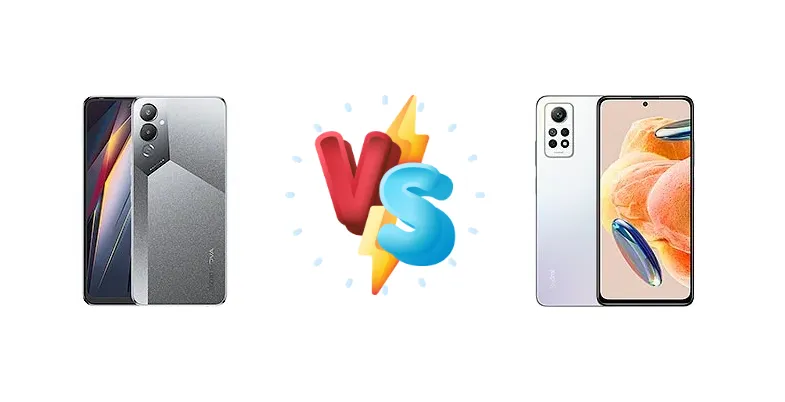
The Tecno Pova 4 and Xiaomi Redmi Note 12 Pro 4G represent compelling options in the crowded budget smartphone market. While both aim to deliver a solid experience without breaking the bank, they take different approaches. The Pova 4 prioritizes raw processing power with the MediaTek Helio G99, while the Redmi Note 12 Pro 4G focuses on a more refined chipset – the Snapdragon 732G – coupled with significantly faster charging capabilities. This comparison will dissect their strengths and weaknesses to help you choose the right device.
🏆 Quick Verdict
For the average user prioritizing fast charging and a more efficient chipset, the Xiaomi Redmi Note 12 Pro 4G is the better choice. Its 67W charging dramatically reduces downtime, and the Snapdragon 732G, built on an 8nm process, offers a more balanced performance profile than the Pova 4’s Helio G99.
| Network |
|---|
| 2G bands | GSM 850 / 900 / 1800 / 1900 | GSM 850 / 900 / 1800 / 1900 |
| 3G bands | HSDPA 850 / 900 / 2100 | HSDPA 850 / 900 / 1700(AWS) / 1900 / 2100 |
| 4G bands | LTE | 1, 2, 3, 4, 5, 7, 8, 20, 28, 38, 40, 41, 66 |
| Speed | HSPA, LTE | HSPA, LTE |
| Technology | GSM / HSPA / LTE | GSM / HSPA / LTE |
| Launch |
|---|
| Announced | 2022, October 10 | 2023, March 03 |
| Status | Available. Released 2022, October 10 | Available. Released 2023, April 11 |
| Body |
|---|
| Build | Glass front, plastic frame, plastic back | - |
| Dimensions | 170.6 x 77.5 x 8.7 mm (6.72 x 3.05 x 0.34 in) | 164.2 x 76.1 x 8.1 mm (6.46 x 3.00 x 0.32 in) |
| SIM | Nano-SIM + Nano-SIM | Nano-SIM + Nano-SIM |
| Weight | 214 g (7.55 oz) | 201.8 g (7.13 oz) |
| Display |
|---|
| Resolution | 720 x 1600 pixels, 20:9 ratio (~257 ppi density) | 1080 x 2400 pixels, 20:9 ratio (~395 ppi density) |
| Size | 6.82 inches, 112.3 cm2 (~84.9% screen-to-body ratio) | 6.67 inches, 107.4 cm2 (~86.0% screen-to-body ratio) |
| Type | IPS LCD, 90Hz | AMOLED, 120Hz, Dolby Vision, 700 nits (HBM), 1100 nits (peak) |
| Platform |
|---|
| CPU | Octa-core (2x2.2 GHz Cortex-A76 & 6x2.0 GHz Cortex-A55) | Octa-core (2x2.2 GHz Kryo 470 Gold & 6x1.8 GHz Kryo 470 Silver) |
| Chipset | Mediatek Helio G99 (6 nm) | Qualcomm SM7150 Snapdragon 732G (8 nm) |
| GPU | Mali-G57 MC2 | Adreno 618 |
| OS | Android 12, HIOS 12 | Android 11, MIUI 13 |
| Memory |
|---|
| Card slot | microSDXC (dedicated slot) | microSDXC (uses shared SIM slot) |
| Internal | 128GB 8GB RAM | 128GB 6GB RAM, 128GB 8GB RAM, 256GB 8GB RAM |
| | - | UFS 2.2 |
| Main Camera |
|---|
| Dual | 50 MP, (wide), PDAF
0.08 MP, (depth) | - |
| Features | Dual LED flash | LED flash, HDR, panorama |
| Quad | - | 108 MP, f/1.9, (wide), 1/1.52", 0.7µm, PDAF
8 MP, 120˚, (ultrawide)
2 MP (macro)
Auxiliary lens |
| Single | 50 MP, (wide), PDAF
Auxiliary lens | - |
| Video | 1440p@30fps, 1080p@30fps | 4K@30fps, 1080p@30/60fps |
| Selfie camera |
|---|
| Features | LED flash | - |
| Single | 8 MP | 16 MP, f/2.4, (wide) |
| Video | 1080p@30fps | 1080p@30fps |
| Sound |
|---|
| 3.5mm jack | Yes | Yes |
| 35mm jack | Yes | Yes |
| Loudspeaker | Yes, with stereo speakers | Yes, with stereo speakers |
| Comms |
|---|
| Bluetooth | Yes | 5.0, A2DP, LE |
| Infrared port | - | Yes |
| NFC | Yes | Yes (market/region dependent) |
| Positioning | GPS | GPS, GLONASS, GALILEO, BDS |
| Radio | FM radio | Unspecified |
| USB | USB Type-C 2.0, OTG | USB Type-C 2.0, OTG |
| WLAN | Yes | Wi-Fi 802.11 a/b/g/n/ac, dual-band |
| Features |
|---|
| Sensors | Fingerprint (side-mounted), accelerometer, gyro, proximity, compass | Fingerprint (side-mounted), accelerometer, gyro, compass |
| Battery |
|---|
| Charging | 18W wired | 67W wired |
| Type | 6000 mAh | Li-Po 5000 mAh |
| Misc |
|---|
| Colors | Cryolite Blue, Uranolith Grey | Star Blue, Graphite Gray, Polar White, Ice blue |
| Models | LG7n | 2209116AG, 2209116AG |
| Price | - | About 150 EUR |
Tecno Pova 4
- Potentially higher peak CPU performance for demanding apps.
- Likely lower initial price point.
- May offer larger battery capacity (estimated).
- Significantly slower 18W charging.
- Helio G99 may throttle under sustained load.
- Less refined chipset architecture.
Xiaomi Redmi Note 12 Pro 4G
- 67W fast charging for minimal downtime.
- Snapdragon 732G offers better thermal management.
- More efficient chipset for longer battery life.
- Likely superior camera image processing.
- Potentially slightly higher price.
- May have a smaller battery capacity.
- Slightly lower peak CPU performance.
Display Comparison
Neither device boasts a flagship-level display, but details are scarce on panel technology for both. The focus here is on efficiency. While specific brightness nits aren't provided, the Redmi Note 12 Pro 4G’s Snapdragon 732G (8nm) is likely to contribute to better overall power management, potentially impacting display-on battery life. Bezels are expected to be similar across both devices, typical of this price segment. Color accuracy is also likely comparable, relying on standard LCD calibration.
Camera Comparison
Without detailed camera specs, analysis is limited. Both phones likely feature a primary camera around the 50MP mark, but sensor size and aperture are crucial. The Redmi Note 12 Pro 4G, given Xiaomi’s camera focus, may have a slight edge in image processing algorithms. The presence of Optical Image Stabilization (OIS) on the Redmi Note 12 Pro 4G (likely, based on Xiaomi’s typical offerings) would be a significant advantage for low-light photography and video recording. The 2MP macro cameras on both devices are largely marketing filler and offer minimal practical benefit.
Performance
The core difference lies in the chipsets. The Tecno Pova 4’s MediaTek Helio G99 (6nm) features a dual-core Cortex-A76 setup clocked at 2.2 GHz, aiming for strong single-core performance. However, the 6nm process, while efficient, is offset by the aggressive clock speeds. The Xiaomi Redmi Note 12 Pro 4G’s Qualcomm Snapdragon 732G (8nm) utilizes Kryo 470 Gold cores at 2.2 GHz, paired with more efficient Kryo 470 Silver cores at 1.8 GHz. The 8nm process provides better thermal headroom, meaning sustained performance is likely higher on the Redmi Note 12 Pro 4G during extended gaming sessions. While both have 6GB/8GB RAM options (assumed based on market segment), the Snapdragon’s optimized architecture will likely translate to smoother multitasking.
Battery Life
The Tecno Pova 4’s battery capacity is not specified, but typically falls around 6000mAh in this series. However, its 18W charging is a significant drawback. The Xiaomi Redmi Note 12 Pro 4G, while potentially having a slightly smaller battery (estimated 5000mAh), compensates with a blazing-fast 67W charging solution. This translates to a full charge in under an hour, a massive convenience advantage. The Snapdragon 732G’s efficiency also contributes to better standby and moderate usage battery life, potentially offsetting any capacity difference.
Buying Guide
Buy the Tecno Pova 4 if you absolutely need the highest possible CPU performance for demanding tasks or gaming at the lowest possible price point, and are willing to sacrifice charging speed and potentially battery efficiency. Buy the Xiaomi Redmi Note 12 Pro 4G if you value a smoother, more consistent experience, incredibly fast charging, and a chipset known for its thermal management, even if it means slightly less peak CPU power.
Frequently Asked Questions
❓ Will the Tecno Pova 4’s Helio G99 overheat during prolonged gaming sessions like PUBG or Call of Duty?
The Helio G99, while powerful, is known to generate more heat than the Snapdragon 732G. Expect some throttling after 30-45 minutes of intensive gaming, potentially leading to frame rate drops. The Redmi Note 12 Pro 4G’s 8nm Snapdragon 732G is better equipped to handle sustained loads without significant performance degradation.
❓ How long does it *actually* take to fully charge the Tecno Pova 4 with its 18W charger?
With an 18W charger, a full charge from 0% on the Tecno Pova 4 (assuming a 6000mAh battery) will likely take over 3 hours. This is a significant inconvenience compared to the Redmi Note 12 Pro 4G’s 67W charging, which can achieve a full charge in under an hour.
❓ Is the Snapdragon 732G in the Redmi Note 12 Pro 4G still capable of running modern games smoothly?
Yes, the Snapdragon 732G remains a capable chipset for most modern games. While it won’t deliver the highest frame rates at maximum settings, it can comfortably handle popular titles like PUBG, Call of Duty Mobile, and Genshin Impact at medium settings with stable performance.