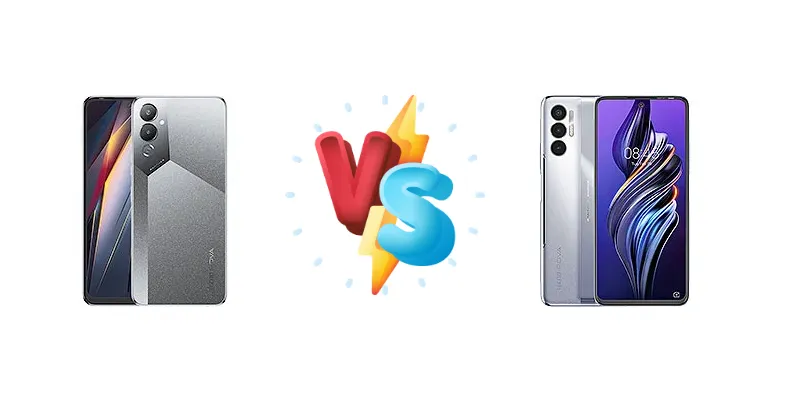
The Tecno Pova series is known for offering impressive features at budget-friendly prices. The Pova 4 and Pova 3 are the latest iterations, but which one reigns supreme? This comprehensive comparison will delve into their specs, performance, and overall value to help you make an informed decision.
🏆 Quick Verdict
The Tecno Pova 4 boasts a significantly faster chipset and a more efficient 6nm process, resulting in better performance. However, the Pova 3’s faster charging (33W vs 18W) and reverse charging capability give it an edge for those prioritizing quick power-ups and the ability to charge accessories. Overall, the Pova 4 is the better performer, but the Pova 3 offers faster charging.
| Network |
|---|
| 2G bands | GSM 850 / 900 / 1800 / 1900 | GSM 850 / 900 / 1800 / 1900 |
| 3G bands | HSDPA 850 / 900 / 2100 | HSDPA 850 / 900 / 2100 |
| 4G bands | LTE | LTE |
| Speed | HSPA, LTE | HSPA, LTE |
| Technology | GSM / HSPA / LTE | GSM / HSPA / LTE |
| Launch |
|---|
| Announced | 2022, October 10 | 2022, May 25 |
| Status | Available. Released 2022, October 10 | Available. Released 2022, May 25 |
| Body |
|---|
| Build | Glass front, plastic frame, plastic back | Glass front, plastic frame, plastic back |
| Dimensions | 170.6 x 77.5 x 8.7 mm (6.72 x 3.05 x 0.34 in) | 173.1 x 78.5 x 9.4 mm (6.81 x 3.09 x 0.37 in) |
| SIM | Nano-SIM + Nano-SIM | Nano-SIM + Nano-SIM |
| Weight | 214 g (7.55 oz) | 230 g (8.11 oz) |
| | - | RGB notification light stripe on the back (Electric Blue model only) |
| Display |
|---|
| Resolution | 720 x 1600 pixels, 20:9 ratio (~257 ppi density) | 1080 x 2460 pixels (~389 ppi density) |
| Size | 6.82 inches, 112.3 cm2 (~84.9% screen-to-body ratio) | 6.9 inches, 113.1 cm2 (~83.2% screen-to-body ratio) |
| Type | IPS LCD, 90Hz | IPS LCD, 90Hz |
| Platform |
|---|
| CPU | Octa-core (2x2.2 GHz Cortex-A76 & 6x2.0 GHz Cortex-A55) | Octa-core (2x2.0 GHz Cortex-A75 & 6x1.8 GHz Cortex-A55) |
| Chipset | Mediatek Helio G99 (6 nm) | Mediatek MT6769H Helio G88 (12 nm) |
| GPU | Mali-G57 MC2 | Mali-G52 MC2 |
| OS | Android 12, HIOS 12 | Android 11, HIOS |
| Memory |
|---|
| Card slot | microSDXC (dedicated slot) | microSDXC (dedicated slot) |
| Internal | 128GB 8GB RAM | 64GB 4GB RAM, 128GB 6GB RAM |
| Main Camera |
|---|
| Dual | 50 MP, (wide), PDAF
0.08 MP, (depth) | - |
| Features | Dual LED flash | Quad-LED flash, HDR |
| Single | 50 MP, (wide), PDAF
Auxiliary lens | 50 MP, (wide), PDAF
Auxiliary lenses |
| Triple | - | 50 MP, (wide), PDAF
0.08 MP, (depth)
0.08 MP |
| Video | 1440p@30fps, 1080p@30fps | 1440p@30fps, 1080p@30fps |
| Selfie camera |
|---|
| Features | LED flash | Dual-LED flash |
| Single | 8 MP | 8 MP, f/2.0 |
| Video | 1080p@30fps | 1080p@30fps |
| Sound |
|---|
| 3.5mm jack | Yes | Yes |
| 35mm jack | Yes | Yes |
| Loudspeaker | Yes, with stereo speakers | Yes, with stereo speakers |
| Comms |
|---|
| Bluetooth | Yes | Yes |
| NFC | Yes | Yes |
| Positioning | GPS | GPS, GALILEO, BDS |
| Radio | FM radio | FM radio |
| USB | USB Type-C 2.0, OTG | USB Type-C 2.0, OTG |
| WLAN | Yes | Yes |
| Features |
|---|
| Sensors | Fingerprint (side-mounted), accelerometer, gyro, proximity, compass | Fingerprint (side-mounted), accelerometer, proximity, compass |
| Battery |
|---|
| Charging | 18W wired | 33W wired
10W reverse wired |
| Type | 6000 mAh | 7000 mAh |
| Misc |
|---|
| Colors | Cryolite Blue, Uranolith Grey | Electric Blue, Tech Silver, Eco Black |
| Models | LG7n | LF7n |
| Price | - | About 150 EUR |
Tecno Pova 4
- Faster Processor (Helio G99)
- More Efficient 6nm Process
- Potentially Improved Camera Processing
- Slightly Better Display (potentially)
- Slower Charging (18W)
- No Reverse Charging
Tecno Pova 3
- Faster Charging (33W)
- Reverse Charging Capability
- Large 6000mAh Battery
- Slower Processor (Helio G88)
- Less Efficient 12nm Process
- Potentially Inferior Camera Performance
Display Comparison
Both phones typically feature a large 6.9-inch display, likely with a 90Hz or 120Hz refresh rate for smoother visuals. While both offer a similar screen size, the Pova 4 might have slightly improved color accuracy or brightness due to advancements in display technology. Expect a resolution around 1080 x 2460 pixels on both.
Camera Comparison
Both phones likely feature a 50MP main camera, but the Pova 4 may have improved image processing algorithms for better low-light performance and dynamic range. The Pova 3's camera is decent, but the Pova 4 is expected to deliver slightly better image quality. Front-facing cameras are likely in the 32MP range for both.
Performance
This is where the Pova 4 shines. The Mediatek Helio G99 (6nm) is a substantial upgrade over the Pova 3's Helio G88 (12nm). The G99 offers a more powerful CPU and GPU, leading to noticeably faster app loading times, smoother gaming, and improved overall responsiveness. The 6nm process also contributes to better power efficiency.
Battery Life
Both phones pack a large 6000mAh battery, promising all-day battery life. However, the Pova 3's 33W fast charging is significantly faster than the Pova 4's 18W charging. The Pova 3 also includes reverse charging, allowing you to charge other devices like earbuds or smartwatches.
Buying Guide
The Tecno Pova 4 is ideal for users who prioritize gaming and smooth multitasking. If you're a heavy gamer or frequently use demanding apps, the Pova 4's improved chipset will be a noticeable upgrade. The Tecno Pova 3 is a great choice for those who value faster charging speeds and the convenience of reverse charging, even if it means sacrificing some processing power.
Frequently Asked Questions
❓ Is the Tecno Pova 4 worth the upgrade from the Pova 3?
If you prioritize performance and gaming, then yes. The Pova 4's chipset is a significant upgrade. If fast charging and reverse charging are more important, the Pova 3 remains a viable option.
❓ What is the battery life like on both phones?
Both phones offer excellent battery life, easily lasting a full day with moderate usage. The large 6000mAh battery is a key selling point for both devices.