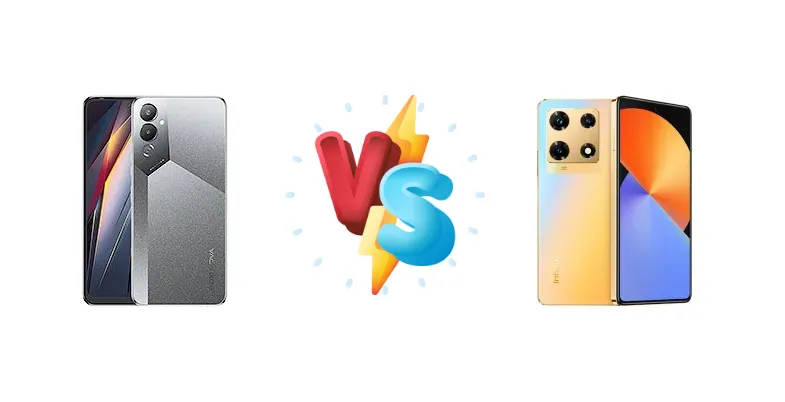
The Tecno Pova 4 and Infinix Note 30 Pro are both contenders in the competitive budget smartphone arena. Both offer a compelling package with a focus on gaming and large displays, but significant differences exist. Let's dive into a detailed comparison to help you decide which one is right for you.
🏆 Quick Verdict
The Infinix Note 30 Pro takes the crown thanks to its significantly faster 68W charging, wireless charging capabilities, and likely a superior display. While the Pova 4 offers a larger battery, the Note 30 Pro's overall feature set and charging speed make it the better value.
| Network |
|---|
| 2G bands | GSM 850 / 900 / 1800 / 1900 | GSM 850 / 900 / 1800 / 1900 |
| 3G bands | HSDPA 850 / 900 / 2100 | HSDPA 850 / 900 / 1700(AWS) / 1900 / 2100 |
| 4G bands | LTE | 1, 2, 3, 4, 5, 7, 8, 12, 17, 20, 28, 38, 40, 41, 66 |
| Speed | HSPA, LTE | HSPA, LTE |
| Technology | GSM / HSPA / LTE | GSM / HSPA / LTE |
| Launch |
|---|
| Announced | 2022, October 10 | 2023, May 22 |
| Status | Available. Released 2022, October 10 | Available. Released 2023, May 22 |
| Body |
|---|
| Build | Glass front, plastic frame, plastic back | Glass front, plastic frame, glass back |
| Dimensions | 170.6 x 77.5 x 8.7 mm (6.72 x 3.05 x 0.34 in) | 162.7 x 76 x 8.2 mm (6.41 x 2.99 x 0.32 in) |
| SIM | Nano-SIM + Nano-SIM | Nano-SIM + Nano-SIM |
| Weight | 214 g (7.55 oz) | 203 g (7.16 oz) |
| | - | IP53 |
| Display |
|---|
| Resolution | 720 x 1600 pixels, 20:9 ratio (~257 ppi density) | 1080 x 2400 pixels, 20:9 ratio (~395 ppi density) |
| Size | 6.82 inches, 112.3 cm2 (~84.9% screen-to-body ratio) | 6.67 inches, 107.4 cm2 (~86.9% screen-to-body ratio) |
| Type | IPS LCD, 90Hz | AMOLED, 1B colors, 120Hz, 900 nits (peak) |
| | - | * the display diagonal size and resolution is unconfirmed |
| Platform |
|---|
| CPU | Octa-core (2x2.2 GHz Cortex-A76 & 6x2.0 GHz Cortex-A55) | Octa-core (2x2.2 GHz Cortex-A76 & 6x2.0 GHz Cortex-A55) |
| Chipset | Mediatek Helio G99 (6 nm) | Mediatek Helio G99 (6 nm) |
| GPU | Mali-G57 MC2 | Mali-G57 MC2 |
| OS | Android 12, HIOS 12 | Android 13, XOS 13 |
| Memory |
|---|
| Card slot | microSDXC (dedicated slot) | microSDXC (dedicated slot) |
| Internal | 128GB 8GB RAM | 256GB 8GB RAM |
| Main Camera |
|---|
| Dual | 50 MP, (wide), PDAF
0.08 MP, (depth) | - |
| Features | Dual LED flash | Quad-LED flash, HDR, panorama |
| Single | 50 MP, (wide), PDAF
Auxiliary lens | - |
| Triple | - | 108 MP, (wide), 1/1.67", PDAF
2 MP (macro)
Auxiliary lens |
| Video | 1440p@30fps, 1080p@30fps | 1440p@30fps, 1080p@30fps |
| Selfie camera |
|---|
| Features | LED flash | LED flash, HDR |
| Single | 8 MP | 32 MP, f/2.0, (wide), 1/2.8" |
| Video | 1080p@30fps | 1080p@30fps |
| Sound |
|---|
| 3.5mm jack | Yes | Yes |
| 35mm jack | Yes | Yes |
| Loudspeaker | Yes, with stereo speakers | Yes, with dual speakers |
| | - | Sound by JBL
24-bit/192kHz audio |
| Comms |
|---|
| Bluetooth | Yes | Yes |
| NFC | Yes | Yes (market/region dependent) |
| Positioning | GPS | GPS |
| Radio | FM radio | FM radio |
| USB | USB Type-C 2.0, OTG | USB Type-C 2.0, OTG |
| WLAN | Yes | Wi-Fi 802.11 a/b/g/n/ac, dual-band, Wi-Fi Direct |
| Features |
|---|
| Sensors | Fingerprint (side-mounted), accelerometer, gyro, proximity, compass | Fingerprint (side-mounted), accelerometer, gyro, proximity, compass |
| Battery |
|---|
| Charging | 18W wired | 68W wired, PD3.0, 80% in 30 min
15W wireless
Reverse wireless |
| Type | 6000 mAh | 5000 mAh |
| Misc |
|---|
| Colors | Cryolite Blue, Uranolith Grey | Magic Black, Variable Gold |
| Models | LG7n | X678B |
Tecno Pova 4
- Larger 6000mAh battery
- Potentially lower price
- Large display for media consumption
- Slower 18W charging
- Likely LCD display
- Less premium design
Infinix Note 30 Pro
- 68W fast charging
- Wireless charging (15W)
- Reverse wireless charging
- Likely AMOLED display with 120Hz refresh rate
- Potentially better camera processing
- Smaller battery capacity
- Potentially higher price
Display Comparison
Both phones feature large displays, likely around 6.7 inches, but the Infinix Note 30 Pro is expected to have a higher refresh rate (120Hz vs potentially 90Hz on the Pova 4) and potentially better color accuracy and brightness. The Note 30 Pro may also feature an AMOLED panel versus the Pova 4's LCD, offering richer colors and deeper blacks.
Camera Comparison
The Tecno Pova 4 likely features a 50MP main camera, while the Infinix Note 30 Pro is expected to have a similar or slightly improved main sensor, potentially with better image processing. Both phones will likely offer ultrawide and macro lenses. Image quality will depend heavily on software and processing algorithms.
Performance
Both devices share the same Mediatek Helio G99 chipset and CPU configuration. Real-world performance should be similar for everyday tasks and gaming, though software optimization could play a role. Expect smooth performance for most games at medium settings.
Battery Life
The Tecno Pova 4 boasts a larger 6000mAh battery compared to the Infinix Note 30 Pro's likely 5000mAh battery. However, the Note 30 Pro's 68W charging drastically reduces charging times, potentially negating the Pova 4's battery advantage in practical use.
Buying Guide
The Tecno Pova 4 is ideal for users prioritizing maximum battery life and a larger screen for media consumption, especially those on a tighter budget. The Infinix Note 30 Pro is perfect for those who value fast charging, wireless charging convenience, and potentially a better display experience, even at a slightly higher price point.
Frequently Asked Questions
❓ Is the Helio G99 chipset good for gaming?
Yes, the Helio G99 is a capable chipset for mid-range gaming. You can expect smooth gameplay in most titles at medium settings.
❓ Which phone has better battery life?
The Tecno Pova 4 has a larger battery capacity, but the Infinix Note 30 Pro's faster charging may make it more convenient overall.
❓ Does the Infinix Note 30 Pro support 5G?
While not explicitly stated, it's likely the Infinix Note 30 Pro supports 5G connectivity, given its positioning in the market. Confirm with the official specifications.