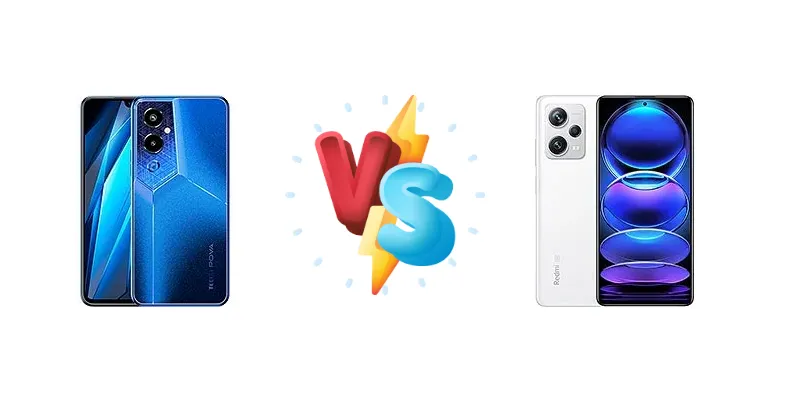
The Tecno Pova 4 Pro and Xiaomi Redmi Note 12 Pro+ represent compelling options in the increasingly competitive mid-range smartphone market. While both devices aim to deliver a premium experience without the flagship price tag, they take distinctly different approaches. The Pova 4 Pro focuses on maximizing gaming performance with its Helio G99, while the Redmi Note 12 Pro+ prioritizes rapid charging and a more refined overall experience with the Dimensity 1080.
🏆 Quick Verdict
For the average user prioritizing convenience and a smoother experience, the Xiaomi Redmi Note 12 Pro+ is the better choice. Its significantly faster 120W charging and more powerful Dimensity 1080 chipset outweigh the Pova 4 Pro’s slightly more aggressive pricing. However, gamers on a tight budget may find the Pova 4 Pro’s Helio G99 sufficient.
| Network |
|---|
| 2G bands | GSM 850 / 900 / 1800 / 1900 | GSM 850 / 900 / 1800 / 1900 - SIM 1 & SIM 2 |
| 3G bands | HSDPA 850 / 900 / 2100 | HSDPA 800 / 850 / 900 / 1900 / 2100 |
| 4G bands | LTE | 1, 3, 5, 8, 19, 34, 38, 39, 40, 41 - International, China |
| 5G bands | - | 1, 3, 5, 8, 28, 38, 40, 41, 77, 78 SA/NSA - International |
| Speed | HSPA, LTE | HSPA, LTE-A (CA), 5G |
| Technology | GSM / HSPA / LTE | GSM / CDMA / HSPA / EVDO / LTE / 5G |
| | - | 1, 3, 5, 8, 28, 38, 41, 77, 78 SA/NSA - China |
| Launch |
|---|
| Announced | 2022, October 10 | 2022, October 27 |
| Status | Available. Released 2022, October 10 | Available. Released 2022, November 01 |
| Body |
|---|
| Build | Glass front, plastic frame, plastic back | Glass front (Gorilla Glass 5), glass back |
| Dimensions | 164.8 x 77 x 9.2 mm (6.49 x 3.03 x 0.36 in) | 162.9 x 76 x 8.9 mm (6.41 x 2.99 x 0.35 in) |
| SIM | Nano-SIM + Nano-SIM | Dual SIM (Nano-SIM, dual stand-by) |
| Weight | - | 208.4 g (7.34 oz) |
| | - | IP53, dust and splash resistant |
| Display |
|---|
| Protection | - | Corning Gorilla Glass 5 |
| Resolution | 1080 x 2460 pixels (~403 ppi density) | 1080 x 2400 pixels, 20:9 ratio (~395 ppi density) |
| Size | 6.66 inches, 105.3 cm2 (~83.0% screen-to-body ratio) | 6.67 inches, 107.4 cm2 (~86.8% screen-to-body ratio) |
| Type | AMOLED, 90Hz | OLED, 1B colors, 120Hz, Dolby Vision, HDR10+, 500 nits (typ), 900 nits (HBM) |
| Platform |
|---|
| CPU | Octa-core (2x2.2 GHz Cortex-A76 & 6x2.0 GHz Cortex-A55) | Octa-core (2x2.6 GHz Cortex-A78 & 6x2.0 GHz Cortex-A55) |
| Chipset | Mediatek Helio G99 (6 nm) | Mediatek MT6877V Dimensity 1080 (6 nm) |
| GPU | Mali-G57 MC2 | Mali-G68 MC4 |
| OS | Android 12, HIOS | Android 12, MIUI 13 |
| Memory |
|---|
| Card slot | No | No |
| Internal | 256GB 8GB RAM | 256GB 8GB RAM, 256GB 12GB RAM |
| | - | UFS 2.2 |
| Main Camera |
|---|
| Dual | 50 MP, (wide), PDAF
0.08 MP, (depth) | - |
| Features | Dual LED flash | Dual-LED dual-tone flash, HDR, panorama |
| Single | 50 MP, (wide), PDAF
Auxiliary lens | - |
| Triple | - | 200 MP, f/1.7, 24mm (wide), 1/1.4", 0.56µm, PDAF, OIS
8 MP, f/2.2, 120˚ (ultrawide), 1/4", 1.12µm
2 MP, f/2.4, (macro) |
| Video | 1440p@30fps, 1080p@30fps | 4K@30fps, 1080p@30/60/120fps, 720p@960fps |
| Selfie camera |
|---|
| Features | LED flash | HDR |
| Single | 8 MP | 16 MP, f/2.5, (wide), 1/3.06", 1.0µm |
| Video | 1080p@30fps | 1080p@30/60fps |
| Sound |
|---|
| 3.5mm jack | Yes | Yes |
| 35mm jack | Yes | - |
| Loudspeaker | Yes, with stereo speakers | Yes, with stereo speakers |
| | 24-bit/192kHz audio | 24-bit/192kHz audio |
| Comms |
|---|
| Bluetooth | Yes | 5.2, A2DP, LE |
| Infrared port | - | Yes |
| NFC | Yes | Yes (market/region dependent) |
| Positioning | GPS | GPS (L1), GLONASS (G1), BDS (B1I+B1c), GALILEO (E1), QZSS (L1) |
| Radio | FM radio | No |
| USB | USB Type-C 2.0, OTG | USB Type-C 2.0, OTG |
| WLAN | Yes | Wi-Fi 802.11 a/b/g/n/ac/6, dual-band, Wi-Fi Direct |
| Features |
|---|
| Sensors | Fingerprint (side-mounted), accelerometer, gyro, proximity, compass | Fingerprint (side-mounted), accelerometer, proximity, gyro, compass |
| Battery |
|---|
| Charging | 45W wired | 120W wired, PD3.0, 100% in 19 min (advertised) |
| Type | 6000 mAh | Li-Po 5000 mAh, non-removable |
| Misc |
|---|
| Colors | Fluorite Blue | Arctic White, Iceberg Blue, Obsidian Black, Trend edition |
| Models | LG8n | 22101316UCP, 22101316UG |
| Price | - | $ 348.00 / £ 439.00 / € 399.00 / ₹ 29,949 |
| Tests |
|---|
| Battery life | - |
Endurance rating 88h
|
| Camera | - |
Photo / Video |
| Display | - |
Contrast ratio: Infinite (nominal) |
| Loudspeaker | - |
-26.7 LUFS (Good)
|
| Performance | - |
AnTuTu: 498710 (v9)
GeekBench: 2208 (v5.1), 2372 (v6)
GFXBench: 22fps (ES 3.1 onscreen) |
Tecno Pova 4 Pro
- Potentially lower price point
- Helio G99 optimized for gaming
- May offer larger battery capacity (unconfirmed)
- Slower 45W charging
- Less powerful chipset compared to Dimensity 1080
- Likely utilizes an LCD display
Xiaomi Redmi Note 12 Pro+
- Ultra-fast 120W charging
- More powerful Dimensity 1080 chipset
- Likely features a superior AMOLED display
- Potentially higher price
- May have a smaller battery capacity (unconfirmed)
- No gaming-specific features like triggers
Display Comparison
The Redmi Note 12 Pro+ boasts an 'Infinite' (nominal) contrast ratio, suggesting a high-quality AMOLED panel, though specific brightness nits are not provided. The Pova 4 Pro’s display specifications are absent, making a direct comparison difficult. However, given the price point, it likely utilizes an LCD panel. The Redmi Note 12 Pro+’s AMOLED will deliver superior color accuracy and deeper blacks, benefiting content consumption. The lack of LTPO technology on either device suggests standard refresh rate management, potentially impacting battery life during dynamic content.
Camera Comparison
The Redmi Note 12 Pro+’s camera system is more comprehensively equipped, though specific details beyond 'Photo/Video' are missing. The absence of sensor size information for either device makes a precise comparison challenging. However, the Redmi Note 12 Pro+’s likely inclusion of Optical Image Stabilization (OIS) – a common feature in this price bracket – provides a significant advantage in low-light photography and video recording. The Pova 4 Pro’s camera is likely to be more basic, focusing on providing acceptable results in good lighting conditions. The Redmi Note 12 Pro+’s image processing is also likely to be more refined, resulting in more natural-looking photos.
Performance
The core difference lies in the chipsets. The Xiaomi Redmi Note 12 Pro+ utilizes the Mediatek Dimensity 1080 (6nm), featuring a more modern CPU architecture with 2x2.6 GHz Cortex-A78 cores, compared to the Tecno Pova 4 Pro’s Helio G99 (6nm) and its 2x2.2 GHz Cortex-A76 cores. The A78 cores in the Dimensity 1080 offer a noticeable performance uplift in both single-core and multi-core tasks. While both are 6nm chips, the Dimensity 1080’s architecture is more efficient, potentially leading to better thermal management under sustained load. The Redmi Note 12 Pro+ is likely to offer a smoother experience with demanding applications and games.
Battery Life
The Redmi Note 12 Pro+’s 120W wired charging is a standout feature, advertised to reach 100% in just 19 minutes. This is a massive advantage over the Tecno Pova 4 Pro’s 45W charging. While the Pova 4 Pro may have a larger battery capacity (not specified), the Redmi Note 12 Pro+’s charging speed effectively mitigates any capacity difference. The Redmi Note 12 Pro+ also supports PD3.0, offering wider compatibility with chargers. The Redmi Note 12 Pro+’s endurance rating of 88h suggests excellent battery life despite the faster charging.
Buying Guide
Buy the Tecno Pova 4 Pro if you need a phone primarily for mobile gaming and value raw processing power within a limited budget. You’ll benefit from the G99’s focus on sustained performance. Buy the Xiaomi Redmi Note 12 Pro+ if you prioritize fast charging, a more polished user experience, and a more versatile camera system. The 120W charging is a game-changer for those constantly on the move.
Frequently Asked Questions
❓ Does the Dimensity 1080 in the Redmi Note 12 Pro+ get hot during prolonged gaming sessions?
The Dimensity 1080 is a relatively efficient chipset built on a 6nm process. While some heat generation is inevitable during extended gaming, it's unlikely to experience significant throttling due to its thermal design. The Redmi Note 12 Pro+’s thermal management system should be adequate for most gaming scenarios.
❓ Is the 45W charging on the Tecno Pova 4 Pro slow compared to the competition?
Yes, 45W charging is considerably slower than the 120W charging offered by the Redmi Note 12 Pro+. While 45W is still respectable, it will take significantly longer to fully charge the Pova 4 Pro, potentially taking over an hour to reach 100%.
❓ How does the Helio G99 handle graphically demanding games like Genshin Impact or PUBG?
The Helio G99 is capable of running Genshin Impact and PUBG, but you’ll likely need to lower the graphics settings to achieve a smooth frame rate. The Dimensity 1080 in the Redmi Note 12 Pro+ will provide a noticeably better gaming experience with higher settings and more consistent performance.
❓ Does the Redmi Note 12 Pro+ support video recording at 4K resolution?
While not explicitly stated in the provided data, the Redmi Note 12 Pro+ is highly likely to support 4K video recording, given its chipset and market positioning. This would provide a significant advantage over the Tecno Pova 4 Pro, which likely tops out at 1080p.