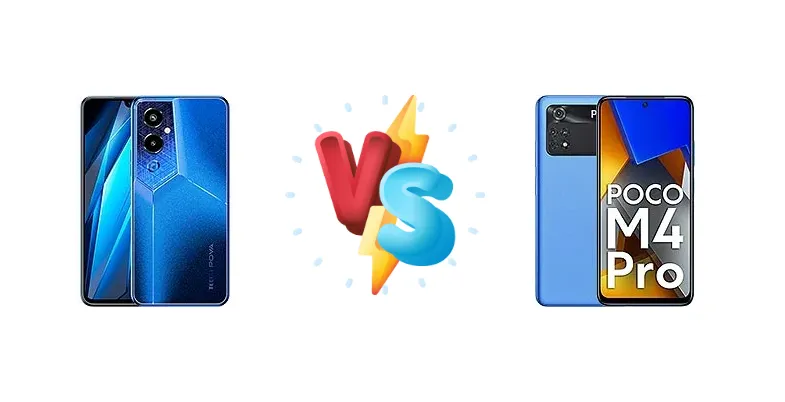
The budget smartphone market is fiercely competitive, and the Tecno Pova 4 Pro and Xiaomi Poco M4 Pro are two strong contenders. Both offer impressive features for their price point, but which one truly comes out on top? This comprehensive comparison will delve into every aspect, from display and performance to camera and battery life.
🏆 Quick Verdict
The Tecno Pova 4 Pro edges out the Poco M4 Pro thanks to its more powerful Helio G99 chipset and faster 45W charging. While the Poco M4 Pro boasts excellent battery life and a brighter display, the Pova 4 Pro's performance advantage makes it the slightly better overall choice for most users.
| Network |
|---|
| 2G bands | GSM 850 / 900 / 1800 / 1900 | GSM 850 / 900 / 1800 / 1900 |
| 3G bands | HSDPA 850 / 900 / 2100 | HSDPA 850 / 900 / 1700(AWS) / 1900 / 2100 - International |
| 4G bands | LTE | 1, 2, 3, 4, 5, 7, 8, 20, 28, 38, 40, 41 - International |
| Speed | HSPA, LTE | HSPA, LTE |
| Technology | GSM / HSPA / LTE | GSM / HSPA / LTE |
| | - | 1, 3, 5, 8, 40, 41 - India |
| Launch |
|---|
| Announced | 2022, October 10 | 2022, February 28 |
| Status | Available. Released 2022, October 10 | Available. Released 2022, March 16 |
| Body |
|---|
| Build | Glass front, plastic frame, plastic back | Glass front (Gorilla Glass 3), plastic frame, plastic back |
| Dimensions | 164.8 x 77 x 9.2 mm (6.49 x 3.03 x 0.36 in) | 159.9 x 73.9 x 8.1 mm (6.30 x 2.91 x 0.32 in) |
| SIM | Nano-SIM + Nano-SIM | Nano-SIM + Nano-SIM |
| Weight | - | 179.5 g (6.31 oz) |
| | - | IP53, dust and splash resistant |
| Display |
|---|
| Protection | - | Corning Gorilla Glass 3 |
| Resolution | 1080 x 2460 pixels (~403 ppi density) | 1080 x 2400 pixels, 20:9 ratio (~409 ppi density) |
| Size | 6.66 inches, 105.3 cm2 (~83.0% screen-to-body ratio) | 6.43 inches, 99.8 cm2 (~84.5% screen-to-body ratio) |
| Type | AMOLED, 90Hz | AMOLED, 90Hz, 700 nits, 1000 nits (peak) |
| Platform |
|---|
| CPU | Octa-core (2x2.2 GHz Cortex-A76 & 6x2.0 GHz Cortex-A55) | Octa-core (2x2.05 GHz Cortex-A76 & 6x2.0 GHz Cortex-A55) |
| Chipset | Mediatek Helio G99 (6 nm) | Mediatek MT6781 Helio G96 (12 nm) |
| GPU | Mali-G57 MC2 | Mali-G57 MC2 |
| OS | Android 12, HIOS | Android 11, MIUI 13 for POCO |
| Memory |
|---|
| Card slot | No | microSDXC (dedicated slot) |
| Internal | 256GB 8GB RAM | 64GB 6GB RAM, 128GB 6GB RAM, 128GB 8GB RAM, 256GB 8GB RAM |
| | - | UFS 2.2 |
| Main Camera |
|---|
| Dual | 50 MP, (wide), PDAF
0.08 MP, (depth) | - |
| Features | Dual LED flash | LED flash, HDR, panorama |
| Single | 50 MP, (wide), PDAF
Auxiliary lens | 16 MP, f/2.5, (wide), 1/3.06" 1.0µm |
| Triple | - | 64 MP, f/1.8, 26mm (wide), 0.7µm, PDAF
8 MP, f/2.2, 118˚ (ultrawide), 1/4.0", 1.12µm
2 MP (macro) |
| Video | 1440p@30fps, 1080p@30fps | 1080p@30fps |
| Selfie camera |
|---|
| Features | LED flash | HDR |
| Single | 8 MP | 16 MP, f/2.5, (wide), 1/3.06" 1.0µm |
| Video | 1080p@30fps | 1080p@30fps |
| Sound |
|---|
| 3.5mm jack | Yes | Yes |
| 35mm jack | Yes | Yes |
| Loudspeaker | Yes, with stereo speakers | Yes, with stereo speakers |
| | 24-bit/192kHz audio | 24-bit/192kHz audio |
| Comms |
|---|
| Bluetooth | Yes | 5.0, A2DP, LE |
| Infrared port | - | Yes |
| NFC | Yes | Yes |
| Positioning | GPS | GPS, GLONASS, BDS, GALILEO |
| Radio | FM radio | FM radio, recording |
| USB | USB Type-C 2.0, OTG | USB Type-C 2.0, OTG |
| WLAN | Yes | Wi-Fi 802.11 a/b/g/n/ac, dual-band, Wi-Fi Direct |
| Features |
|---|
| Sensors | Fingerprint (side-mounted), accelerometer, gyro, proximity, compass | Fingerprint (side-mounted), accelerometer, gyro, compass |
| | - | Virtual proximity sensing |
| Battery |
|---|
| Charging | 45W wired | 33W wired, PD3.0, QC3, 100% in 58 min |
| Type | 6000 mAh | Li-Po 5000 mAh |
| Misc |
|---|
| Colors | Fluorite Blue | Power Black, Cool Blue, Poco Yellow |
| Models | LG8n | MZB0B5VIN, 2201117PI, 2201117PG |
| Price | - | € 100.18 |
| SAR | - | 0.85 W/kg (head) 0.85 W/kg (body) |
| SAR EU | - | 0.59 W/kg (head) 0.84 W/kg (body) |
| Tests |
|---|
| Battery life | - |
Endurance rating 126h
|
| Camera | - |
Photo / Video |
| Display | - |
Contrast ratio: Infinite (nominal) |
| Loudspeaker | - |
-25.2 LUFS (Very good)
|
| Performance | - |
AnTuTu: 318444 (v9)
GeekBench: 1836 (v5.1)
GFXBench: 12fps (ES 3.1 onscreen) |
Tecno Pova 4 Pro
- More powerful chipset (Helio G99)
- Faster 45W charging
- Modern 6nm process
- Generally better performance
- Display not as bright as Poco M4 Pro
- Camera details are limited
- Design may not appeal to everyone
Xiaomi Poco M4 Pro
- Exceptional battery life (126h endurance)
- Brighter display (737 nits)
- PD3.0, QC3 charging support
- Good value for money
- Less powerful chipset (Helio G96)
- Slower charging (33W)
- Older 12nm process
- Camera details are limited
Display Comparison
The Poco M4 Pro takes the display crown with a measured peak brightness of 737 nits, offering a noticeably brighter viewing experience, especially outdoors. While the Pova 4 Pro's display is decent, it lacks the same level of brightness. The Poco M4 Pro's 'infinite' contrast ratio is a nominal claim, but generally indicates good contrast.
Camera Comparison
Camera performance is generally comparable between the two, with both offering decent image quality in good lighting conditions. However, detailed camera specs are missing, so a direct comparison is difficult. Both likely feature a main sensor and ultrawide lens. Low-light performance is likely a weak point for both.
Performance
Here, the Tecno Pova 4 Pro shines. Its Mediatek Helio G99 chipset, built on a more efficient 6nm process, provides a significant performance boost over the Poco M4 Pro's Helio G96 (12nm). Expect smoother gaming and faster app loading times on the Pova 4 Pro.
Battery Life
The Poco M4 Pro excels in battery life, boasting an impressive endurance rating of 126 hours. While the Pova 4 Pro has a large battery, the Poco M4 Pro's optimization likely contributes to its superior longevity.
Buying Guide
The Tecno Pova 4 Pro is ideal for gamers and users who prioritize performance and fast charging. The Xiaomi Poco M4 Pro is a great pick for those who value long battery life, a vibrant display, and a more balanced overall experience.
Frequently Asked Questions
❓ Which phone is better for gaming?
The Tecno Pova 4 Pro is the better choice for gaming due to its more powerful Helio G99 chipset.
❓ Which phone has better battery life?
The Xiaomi Poco M4 Pro offers significantly better battery life, with an endurance rating of 126 hours.
❓ Does the Poco M4 Pro support fast charging?
Yes, the Poco M4 Pro supports 33W wired charging with PD3.0 and QC3 protocols, charging 100% in 58 minutes.
❓ Which phone is more likely to receive software updates?
Xiaomi generally has a better track record for software updates, so the Poco M4 Pro might receive updates for a longer period.