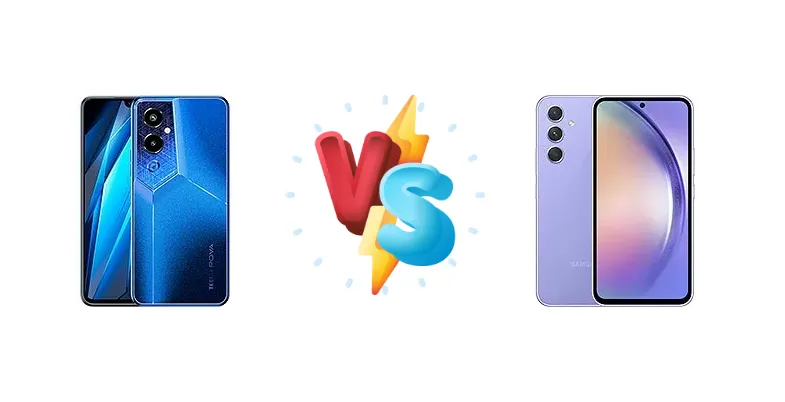
The Tecno Pova 4 Pro and Samsung Galaxy A54 represent distinct approaches to the mid-range smartphone market. The Pova 4 Pro aggressively targets gamers with its focus on raw processing power and fast charging, while the Galaxy A54 prioritizes a well-rounded experience with a strong emphasis on display quality, camera versatility, and Samsung’s established software ecosystem. This comparison dissects their key differences to help you choose the right device.
🏆 Quick Verdict
For the average user prioritizing a balanced experience, the Samsung Galaxy A54 emerges as the stronger contender. Its superior display, refined camera system, and long-term software support outweigh the Pova 4 Pro’s gaming-focused strengths. However, gamers on a tight budget will find the Pova 4 Pro’s Helio G99 a compelling option.
| Network |
|---|
| 2G bands | GSM 850 / 900 / 1800 / 1900 | GSM 850 / 900 / 1800 / 1900 |
| 3G bands | HSDPA 850 / 900 / 2100 | HSDPA 850 / 900 / 1700(AWS) / 1900 / 2100 |
| 4G bands | LTE | 1, 2, 3, 4, 5, 7, 8, 12, 17, 20, 26, 28, 32, 38, 40, 41, 66 - International |
| 5G bands | - | 1, 3, 7, 8, 20, 28, 38, 40, 41, 77, 78 SA/NSA/Sub6 - International |
| Speed | HSPA, LTE | HSPA, LTE, 5G |
| Technology | GSM / HSPA / LTE | GSM / HSPA / LTE / 5G |
| | - | 25, 41, 66, 71 SA/NSA/Sub6/mmWave - USA |
| Launch |
|---|
| Announced | 2022, October 10 | 2023, March 15 |
| Status | Available. Released 2022, October 10 | Available. Released 2023, March 24 |
| Body |
|---|
| Build | Glass front, plastic frame, plastic back | Glass front (Gorilla Glass 5), glass back (Gorilla Glass 5), plastic frame |
| Dimensions | 164.8 x 77 x 9.2 mm (6.49 x 3.03 x 0.36 in) | 158.2 x 76.7 x 8.2 mm (6.23 x 3.02 x 0.32 in) |
| SIM | Nano-SIM + Nano-SIM | · Nano-SIM + eSIM· Nano-SIM + Nano-SIM |
| Weight | - | 202 g (7.13 oz) |
| | - | IP67 dust/water resistant (up to 1m for 30 min) |
| Display |
|---|
| Protection | - | Corning Gorilla Glass 5 |
| Resolution | 1080 x 2460 pixels (~403 ppi density) | 1080 x 2340 pixels, 19.5:9 ratio (~403 ppi density) |
| Size | 6.66 inches, 105.3 cm2 (~83.0% screen-to-body ratio) | 6.4 inches, 100.5 cm2 (~82.9% screen-to-body ratio) |
| Type | AMOLED, 90Hz | Super AMOLED, 120Hz, HDR10+, 1000 nits (HBM) |
| Platform |
|---|
| CPU | Octa-core (2x2.2 GHz Cortex-A76 & 6x2.0 GHz Cortex-A55) | Octa-core (4x2.4 GHz Cortex-A78 & 4x2.0 GHz Cortex-A55) |
| Chipset | Mediatek Helio G99 (6 nm) | Exynos 1380 (5 nm) |
| GPU | Mali-G57 MC2 | Mali-G68 MP5 |
| OS | Android 12, HIOS | Android 13, up to 4 major Android upgrades, One UI 7 |
| Memory |
|---|
| Card slot | No | microSDXC (uses shared SIM slot) |
| Internal | 256GB 8GB RAM | 128GB 4GB RAM, 128GB 6GB RAM, 128GB 8GB RAM, 256GB 6GB RAM, 256GB 8GB RAM |
| Main Camera |
|---|
| Dual | 50 MP, (wide), PDAF
0.08 MP, (depth) | - |
| Features | Dual LED flash | LED flash, panorama, HDR |
| Single | 50 MP, (wide), PDAF
Auxiliary lens | 32 MP, f/2.2, 26mm (wide), 1/2.8", 0.8µm |
| Triple | - | 50 MP, f/1.8, 23mm (wide), 1/1.56", 1.0µm, PDAF, OIS
12 MP, f/2.2, 13mm, 123˚ (ultrawide), 1/3.X", 1.12µm
5 MP (macro) |
| Video | 1440p@30fps, 1080p@30fps | 4K@30fps, 1080p@30/60fps, 720p@480fps, gyro-EIS |
| Selfie camera |
|---|
| Features | LED flash | - |
| Single | 8 MP | 32 MP, f/2.2, 26mm (wide), 1/2.8", 0.8µm |
| Video | 1080p@30fps | 4K@30fps, 1080p@30/60fps |
| Sound |
|---|
| 3.5mm jack | Yes | No |
| 35mm jack | Yes | No |
| Loudspeaker | Yes, with stereo speakers | Yes, with stereo speakers |
| | 24-bit/192kHz audio | - |
| Comms |
|---|
| Bluetooth | Yes | 5.3, A2DP, LE |
| NFC | Yes | Yes (market/region dependent) |
| Positioning | GPS | GPS, GLONASS, GALILEO, BDS |
| Radio | FM radio | No |
| USB | USB Type-C 2.0, OTG | USB Type-C 2.0, OTG |
| WLAN | Yes | Wi-Fi 802.11 a/b/g/n/ac/6, dual-band, Wi-Fi Direct |
| Features |
|---|
| Sensors | Fingerprint (side-mounted), accelerometer, gyro, proximity, compass | Fingerprint (under display, optical), accelerometer, gyro, compass, barometer (USA only) |
| | - | Virtual proximity sensing |
| Battery |
|---|
| Charging | 45W wired | 25W wired |
| Type | 6000 mAh | 5000 mAh |
| Misc |
|---|
| Colors | Fluorite Blue | Lime, Graphite, Violet, White |
| Models | LG8n | SM-A546V, SM-A546U, SM-A546U1, SM-A546B, SM-A546B/DS, SM-A546E, SM-A546E/DS, SM-A5460, SM-A546M, SM-A546M/DS, SM-A546W |
| Price | - | € 210.00 / $ 119.11 / £ 169.95 / ₹ 28,999 |
| SAR | - | 0.81 W/kg (head) 0.67 W/kg (body) |
| SAR EU | - | 0.69 W/kg (head) 1.34 W/kg (body) |
| Tests |
|---|
| Battery life | - |
Endurance rating 119h
|
| Camera | - |
Photo / Video |
| Display | - |
Contrast ratio: Infinite (nominal) |
| Loudspeaker | - |
-26.6 LUFS (Good)
|
| Performance | - |
AnTuTu: 506678 (v9)
GeekBench: 2703 (v5.1), 2797 (v6)
GFXBench: 25fps (ES 3.1 onscreen) |
Tecno Pova 4 Pro
- Significantly faster 45W charging
- Potentially better value for money
- Gaming-focused chipset
- Display likely inferior to Galaxy A54
- Camera performance likely less refined
- Software support may be limited
Samsung Galaxy A54
- Brighter and more vibrant display
- Superior camera system with refined image processing
- Long-term software support from Samsung
- Slower 25W charging
- Higher price point
- Less raw gaming power compared to Pova 4 Pro
Display Comparison
The Samsung Galaxy A54 boasts a significantly brighter display, reaching a measured 980 nits, compared to an unstated value for the Pova 4 Pro. This brightness advantage translates to better visibility outdoors. While the Pova 4 Pro’s display specs are unknown, Samsung’s ‘Infinite’ contrast ratio suggests a superior viewing experience with deeper blacks. The A54’s panel likely benefits from Samsung’s color science, offering more accurate and vibrant colors. The lack of information on the Pova 4 Pro’s panel technology makes a direct comparison difficult, but Samsung’s reputation in display technology gives it a clear edge.
Camera Comparison
Both devices offer photo and video capabilities, but the Galaxy A54 is expected to deliver a more refined and consistent camera experience. While specific sensor details are missing for the Pova 4 Pro, Samsung’s image processing algorithms and potentially larger main sensor (based on market segment) will likely result in better dynamic range and low-light performance. The A54’s camera system benefits from Samsung’s software optimizations, offering features like Single Take and improved portrait mode. The Pova 4 Pro may rely on software enhancements to compensate for potentially less capable hardware.
Performance
The Samsung Galaxy A54’s Exynos 1380 (5nm) chipset offers a performance advantage over the Tecno Pova 4 Pro’s Mediatek Helio G99 (6nm). The Exynos 1380 utilizes more powerful Cortex-A78 cores (4x2.4 GHz) compared to the Pova 4 Pro’s Cortex-A76 cores (2x2.2 GHz). The 5nm fabrication process of the Exynos 1380 also contributes to better power efficiency and potentially less thermal throttling during sustained workloads. While the Pova 4 Pro’s Helio G99 is capable, the Exynos 1380 provides a smoother experience for demanding tasks and multitasking. The A54’s likely use of faster LPDDR5 RAM further enhances performance.
Battery Life
Both phones achieve an impressive endurance rating of 119 hours, indicating similar overall battery life. However, the Tecno Pova 4 Pro distinguishes itself with its 45W wired charging, significantly faster than the Galaxy A54’s 25W charging. This means the Pova 4 Pro can replenish its battery much quicker, minimizing downtime. While the A54’s battery life is excellent, the Pova 4 Pro’s charging speed is a key advantage for users who prioritize convenience.
Buying Guide
Buy the Tecno Pova 4 Pro if you need a phone primarily for mobile gaming and demand the fastest possible charging speeds. Its Mediatek Helio G99 chipset offers respectable performance for the price, and the 45W charging is a significant advantage. Buy the Samsung Galaxy A54 if you prefer a phone with a vibrant display, a versatile camera system, and a polished software experience, even if it means sacrificing some raw gaming horsepower and charging speed.
Frequently Asked Questions
❓ Does the Exynos 1380 in the Galaxy A54 tend to overheat during prolonged gaming sessions?
The Exynos 1380 is generally well-managed in terms of thermal performance. While it can get warm during extended gaming, Samsung’s thermal management system typically prevents significant throttling, ensuring a relatively stable frame rate. The 5nm process node contributes to better efficiency compared to older chipsets.
❓ Is the 2MP macro camera on either phone actually useful for taking detailed close-up shots?
Generally, 2MP macro cameras on phones in this price range offer limited detail and image quality. They are often included for marketing purposes but rarely deliver truly impressive macro photography. The Galaxy A54’s overall camera system is more likely to produce usable close-up shots even without relying heavily on the macro lens.
❓ Can the Tecno Pova 4 Pro reliably maintain 60fps in demanding games like PUBG Mobile at high graphics settings?
The Pova 4 Pro’s Helio G99 chipset can likely achieve 60fps in PUBG Mobile at medium to high graphics settings. However, maintaining a consistently stable 60fps at the highest settings may require some optimization of in-game settings to balance visual fidelity and performance. Expect some frame drops during intense action sequences.
❓ How long does it realistically take to fully charge the Samsung Galaxy A54 with the 25W charger?
With the included 25W charger, the Samsung Galaxy A54 typically takes around 1 hour and 45 minutes to 2 hours to fully charge from 0% to 100%. While slower than the Pova 4 Pro’s charging speed, it’s still reasonably quick and convenient for overnight charging.