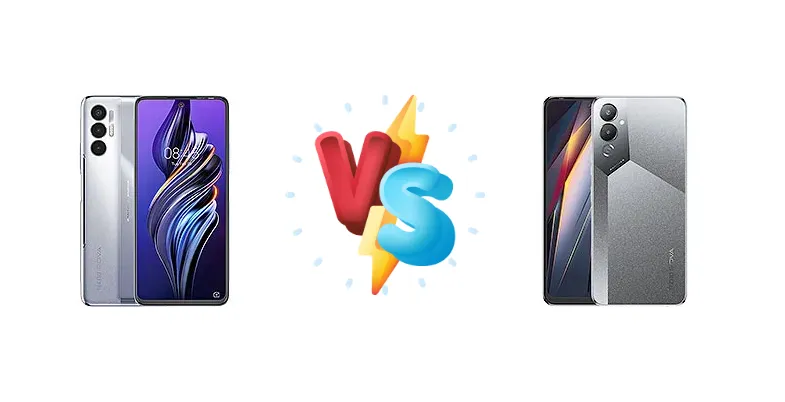
The Tecno Pova series is known for offering impressive features at budget-friendly prices. The Pova 3 and Pova 4 continue this trend, but with key differences. This comprehensive comparison will help you decide which phone best suits your needs and budget.
🏆 Quick Verdict
The Tecno Pova 4 emerges as the clear winner thanks to its more efficient 6nm chipset, improved performance, and faster charging. While the Pova 3 offers reverse charging, the Pova 4's overall package provides a better user experience for the price.
| Network |
|---|
| 2G bands | GSM 850 / 900 / 1800 / 1900 | GSM 850 / 900 / 1800 / 1900 |
| 3G bands | HSDPA 850 / 900 / 2100 | HSDPA 850 / 900 / 2100 |
| 4G bands | LTE | LTE |
| Speed | HSPA, LTE | HSPA, LTE |
| Technology | GSM / HSPA / LTE | GSM / HSPA / LTE |
| Launch |
|---|
| Announced | 2022, May 25 | 2022, October 10 |
| Status | Available. Released 2022, May 25 | Available. Released 2022, October 10 |
| Body |
|---|
| Build | Glass front, plastic frame, plastic back | Glass front, plastic frame, plastic back |
| Dimensions | 173.1 x 78.5 x 9.4 mm (6.81 x 3.09 x 0.37 in) | 170.6 x 77.5 x 8.7 mm (6.72 x 3.05 x 0.34 in) |
| SIM | Nano-SIM + Nano-SIM | Nano-SIM + Nano-SIM |
| Weight | 230 g (8.11 oz) | 214 g (7.55 oz) |
| | RGB notification light stripe on the back (Electric Blue model only) | - |
| Display |
|---|
| Resolution | 1080 x 2460 pixels (~389 ppi density) | 720 x 1600 pixels, 20:9 ratio (~257 ppi density) |
| Size | 6.9 inches, 113.1 cm2 (~83.2% screen-to-body ratio) | 6.82 inches, 112.3 cm2 (~84.9% screen-to-body ratio) |
| Type | IPS LCD, 90Hz | IPS LCD, 90Hz |
| Platform |
|---|
| CPU | Octa-core (2x2.0 GHz Cortex-A75 & 6x1.8 GHz Cortex-A55) | Octa-core (2x2.2 GHz Cortex-A76 & 6x2.0 GHz Cortex-A55) |
| Chipset | Mediatek MT6769H Helio G88 (12 nm) | Mediatek Helio G99 (6 nm) |
| GPU | Mali-G52 MC2 | Mali-G57 MC2 |
| OS | Android 11, HIOS | Android 12, HIOS 12 |
| Memory |
|---|
| Card slot | microSDXC (dedicated slot) | microSDXC (dedicated slot) |
| Internal | 64GB 4GB RAM, 128GB 6GB RAM | 128GB 8GB RAM |
| Main Camera |
|---|
| Dual | - | 50 MP, (wide), PDAF
0.08 MP, (depth) |
| Features | Quad-LED flash, HDR | Dual LED flash |
| Single | 50 MP, (wide), PDAF
Auxiliary lenses | 50 MP, (wide), PDAF
Auxiliary lens |
| Triple | 50 MP, (wide), PDAF
0.08 MP, (depth)
0.08 MP | - |
| Video | 1440p@30fps, 1080p@30fps | 1440p@30fps, 1080p@30fps |
| Selfie camera |
|---|
| Features | Dual-LED flash | LED flash |
| Single | 8 MP, f/2.0 | 8 MP |
| Video | 1080p@30fps | 1080p@30fps |
| Sound |
|---|
| 3.5mm jack | Yes | Yes |
| 35mm jack | Yes | Yes |
| Loudspeaker | Yes, with stereo speakers | Yes, with stereo speakers |
| Comms |
|---|
| Bluetooth | Yes | Yes |
| NFC | Yes | Yes |
| Positioning | GPS, GALILEO, BDS | GPS |
| Radio | FM radio | FM radio |
| USB | USB Type-C 2.0, OTG | USB Type-C 2.0, OTG |
| WLAN | Yes | Yes |
| Features |
|---|
| Sensors | Fingerprint (side-mounted), accelerometer, proximity, compass | Fingerprint (side-mounted), accelerometer, gyro, proximity, compass |
| Battery |
|---|
| Charging | 33W wired
10W reverse wired | 18W wired |
| Type | 7000 mAh | 6000 mAh |
| Misc |
|---|
| Colors | Electric Blue, Tech Silver, Eco Black | Cryolite Blue, Uranolith Grey |
| Models | LF7n | LG7n |
| Price | About 150 EUR | - |
Tecno Pova 3
- Reverse wired charging
- Large 6000mAh battery
- Competitive price
- Older chipset (Helio G88)
- Slower charging (33W)
- Potentially less efficient
Tecno Pova 4
- Newer, more efficient chipset (Helio G99)
- Faster charging (18W)
- Improved performance for gaming
- No reverse charging
- Slightly higher price (potentially)
Display Comparison
Both phones feature large 6.8-inch displays, likely with a 90Hz refresh rate for smoother visuals. The Pova 4 might have slightly improved color accuracy and brightness due to potential panel upgrades, but both offer a similar viewing experience for the price point. Expect Full HD+ resolution on both.
Camera Comparison
While both phones likely feature a 50MP main camera, the Pova 4's image processing capabilities are expected to be better due to the newer chipset. Expect slightly improved dynamic range and low-light performance on the Pova 4. Both likely have similar ultrawide and macro lenses.
Performance
The Pova 4's Mediatek Helio G99 chipset (6nm) is a significant upgrade over the Pova 3's Helio G88 (12nm). The G99 offers noticeably better CPU and GPU performance, resulting in smoother gaming and faster app loading times. The Cortex-A76 cores in the G99 also contribute to improved responsiveness.
Battery Life
Both phones boast large 6000mAh batteries, promising all-day battery life. However, the Pova 4's more efficient chipset should translate to slightly better real-world battery performance. The Pova 3's 33W charging is slower than the Pova 4's 18W, but it does offer reverse charging, a unique feature.
Buying Guide
The Tecno Pova 3 is a good option for users prioritizing reverse charging and slightly longer battery life (though real-world usage is similar). The Tecno Pova 4 is ideal for those seeking better performance for gaming and everyday tasks, along with faster charging speeds.
Frequently Asked Questions
❓ Is the Tecno Pova 4 worth the upgrade from the Pova 3?
Yes, if performance and faster charging are important to you. The Pova 4's chipset provides a noticeable improvement in speed and efficiency.
❓ Does the Tecno Pova 4 support reverse charging?
No, the Tecno Pova 4 does not offer reverse charging. This feature is exclusive to the Pova 3.