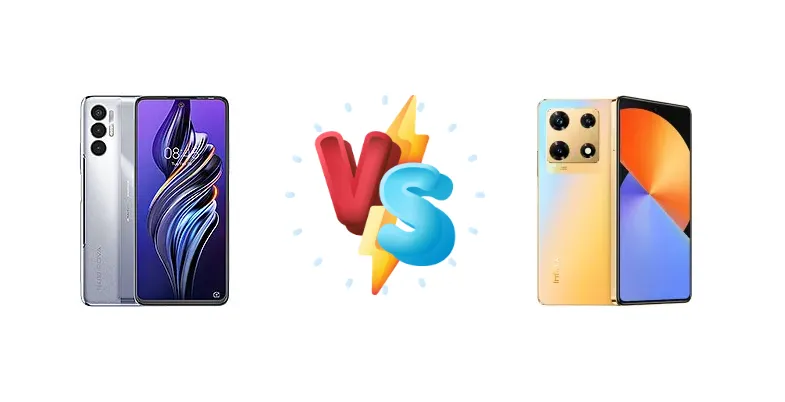
The budget smartphone market is fiercely competitive, and the Tecno Pova 3 and Infinix Note 30 Pro are two strong contenders. Both offer impressive features for their price point, but which one truly comes out on top? This comprehensive comparison will help you decide.
🏆 Quick Verdict
The Infinix Note 30 Pro edges out the Tecno Pova 3 thanks to its significantly faster charging, more efficient chipset, and potentially better display. While the Pova 3 offers a larger battery, the Note 30 Pro's overall performance and features make it the more compelling choice for most users.
| Network |
|---|
| 2G bands | GSM 850 / 900 / 1800 / 1900 | GSM 850 / 900 / 1800 / 1900 |
| 3G bands | HSDPA 850 / 900 / 2100 | HSDPA 850 / 900 / 1700(AWS) / 1900 / 2100 |
| 4G bands | LTE | 1, 2, 3, 4, 5, 7, 8, 12, 17, 20, 28, 38, 40, 41, 66 |
| Speed | HSPA, LTE | HSPA, LTE |
| Technology | GSM / HSPA / LTE | GSM / HSPA / LTE |
| Launch |
|---|
| Announced | 2022, May 25 | 2023, May 22 |
| Status | Available. Released 2022, May 25 | Available. Released 2023, May 22 |
| Body |
|---|
| Build | Glass front, plastic frame, plastic back | Glass front, plastic frame, glass back |
| Dimensions | 173.1 x 78.5 x 9.4 mm (6.81 x 3.09 x 0.37 in) | 162.7 x 76 x 8.2 mm (6.41 x 2.99 x 0.32 in) |
| SIM | Nano-SIM + Nano-SIM | Nano-SIM + Nano-SIM |
| Weight | 230 g (8.11 oz) | 203 g (7.16 oz) |
| | RGB notification light stripe on the back (Electric Blue model only) | IP53 |
| Display |
|---|
| Resolution | 1080 x 2460 pixels (~389 ppi density) | 1080 x 2400 pixels, 20:9 ratio (~395 ppi density) |
| Size | 6.9 inches, 113.1 cm2 (~83.2% screen-to-body ratio) | 6.67 inches, 107.4 cm2 (~86.9% screen-to-body ratio) |
| Type | IPS LCD, 90Hz | AMOLED, 1B colors, 120Hz, 900 nits (peak) |
| | - | * the display diagonal size and resolution is unconfirmed |
| Platform |
|---|
| CPU | Octa-core (2x2.0 GHz Cortex-A75 & 6x1.8 GHz Cortex-A55) | Octa-core (2x2.2 GHz Cortex-A76 & 6x2.0 GHz Cortex-A55) |
| Chipset | Mediatek MT6769H Helio G88 (12 nm) | Mediatek Helio G99 (6 nm) |
| GPU | Mali-G52 MC2 | Mali-G57 MC2 |
| OS | Android 11, HIOS | Android 13, XOS 13 |
| Memory |
|---|
| Card slot | microSDXC (dedicated slot) | microSDXC (dedicated slot) |
| Internal | 64GB 4GB RAM, 128GB 6GB RAM | 256GB 8GB RAM |
| Main Camera |
|---|
| Features | Quad-LED flash, HDR | Quad-LED flash, HDR, panorama |
| Single | 50 MP, (wide), PDAF
Auxiliary lenses | - |
| Triple | 50 MP, (wide), PDAF
0.08 MP, (depth)
0.08 MP | 108 MP, (wide), 1/1.67", PDAF
2 MP (macro)
Auxiliary lens |
| Video | 1440p@30fps, 1080p@30fps | 1440p@30fps, 1080p@30fps |
| Selfie camera |
|---|
| Features | Dual-LED flash | LED flash, HDR |
| Single | 8 MP, f/2.0 | 32 MP, f/2.0, (wide), 1/2.8" |
| Video | 1080p@30fps | 1080p@30fps |
| Sound |
|---|
| 3.5mm jack | Yes | Yes |
| 35mm jack | Yes | Yes |
| Loudspeaker | Yes, with stereo speakers | Yes, with dual speakers |
| | - | Sound by JBL
24-bit/192kHz audio |
| Comms |
|---|
| Bluetooth | Yes | Yes |
| NFC | Yes | Yes (market/region dependent) |
| Positioning | GPS, GALILEO, BDS | GPS |
| Radio | FM radio | FM radio |
| USB | USB Type-C 2.0, OTG | USB Type-C 2.0, OTG |
| WLAN | Yes | Wi-Fi 802.11 a/b/g/n/ac, dual-band, Wi-Fi Direct |
| Features |
|---|
| Sensors | Fingerprint (side-mounted), accelerometer, proximity, compass | Fingerprint (side-mounted), accelerometer, gyro, proximity, compass |
| Battery |
|---|
| Charging | 33W wired
10W reverse wired | 68W wired, PD3.0, 80% in 30 min
15W wireless
Reverse wireless |
| Type | 7000 mAh | 5000 mAh |
| Misc |
|---|
| Colors | Electric Blue, Tech Silver, Eco Black | Magic Black, Variable Gold |
| Models | LF7n | X678B |
| Price | About 150 EUR | - |
Tecno Pova 3
- Large Battery Capacity
- Affordable Price
- Large Display
- Slower Charging
- Older Chipset
- LCD Display (likely)
Infinix Note 30 Pro
- Faster Charging (68W)
- More Efficient Chipset (Helio G99)
- Wireless Charging
- Potentially Better Display (AMOLED, 120Hz)
- Smaller Battery Capacity
- Potentially Higher Price
Display Comparison
Both phones feature large displays, likely around 6.7-6.8 inches. The Infinix Note 30 Pro is expected to have a slightly better panel, potentially with a higher refresh rate (120Hz vs. Pova 3's likely 60Hz) and improved color accuracy. The Note 30 Pro may also include an AMOLED display, offering superior contrast and vibrant colors compared to the Pova 3's LCD.
Camera Comparison
Camera specs are often similar in this price range. Both likely feature a 50MP main sensor. However, image processing and software optimization can significantly impact image quality. The Note 30 Pro might have slightly better image processing due to its newer chipset and potentially improved software. Both will likely offer decent results in good lighting conditions, but struggle in low light.
Performance
The Infinix Note 30 Pro's Mediatek Helio G99 chipset, built on a 6nm process, provides a noticeable performance advantage over the Pova 3's Helio G88 (12nm). Expect smoother multitasking, faster app loading times, and better gaming performance on the Note 30 Pro. The G99's Cortex-A76 cores also contribute to improved responsiveness.
Battery Life
The Tecno Pova 3 boasts a larger battery capacity (likely 6000mAh) compared to the Infinix Note 30 Pro (likely around 5000mAh). However, the Note 30 Pro's 68W fast charging significantly reduces charging times, potentially offsetting the battery capacity difference. The Pova 3's 33W charging is considerably slower.
Buying Guide
The Tecno Pova 3 is ideal for users prioritizing long battery life and a large display for media consumption, especially those on a very tight budget. The Infinix Note 30 Pro is better suited for users who value faster charging, smoother performance, and a more modern design, and appreciate wireless charging capabilities.
Frequently Asked Questions
❓ Which phone has better gaming performance?
The Infinix Note 30 Pro's Helio G99 chipset offers significantly better gaming performance than the Tecno Pova 3's Helio G88.
❓ Is the Tecno Pova 3's battery life really that much better?
While the Pova 3 has a larger battery, the Note 30 Pro's faster charging means you'll spend less time plugged in. Real-world battery life will depend on usage patterns.