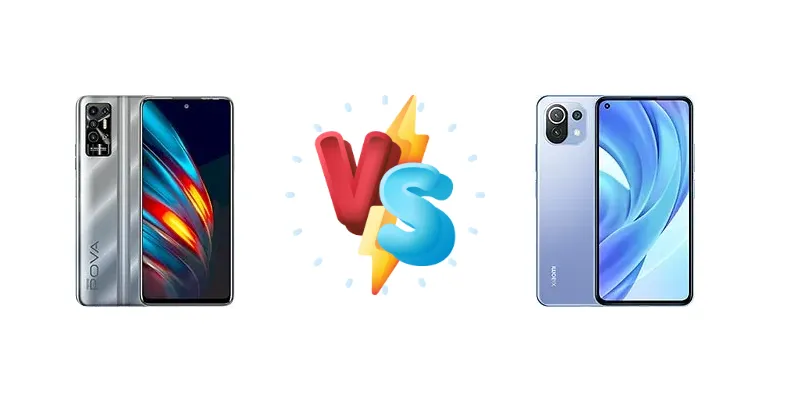
The Xiaomi Mi 11 Lite and Tecno Pova 2 represent distinct approaches to the budget and mid-range smartphone market. The Mi 11 Lite, while an older model, boasts a more refined design and a more efficient chipset. The Pova 2, on the other hand, prioritizes raw processing power for gaming at a lower price point. This comparison dives deep into their specifications to determine which device offers the best value.
🏆 Quick Verdict
For the average user prioritizing a balanced experience with a brighter, more color-accurate display and efficient performance, the Xiaomi Mi 11 Lite is the better choice. However, gamers on a tight budget who prioritize CPU performance will find the Tecno Pova 2 a compelling option.
| Network |
|---|
| 2G bands | GSM 850 / 900 / 1800 / 1900 | GSM 850 / 900 / 1800 / 1900 |
| 3G bands | HSDPA 850 / 900 / 2100 | HSDPA 850 / 900 / 1700(AWS) / 1900 / 2100 |
| 4G bands | LTE | 1, 2, 3, 4, 5, 7, 8, 12, 17, 20, 28, 32, 38, 40, 41, 66 |
| Speed | HSPA, LTE | HSPA, LTE |
| Technology | GSM / HSPA / LTE | GSM / HSPA / LTE |
| Launch |
|---|
| Announced | 2021, June 03 | 2021, March 29 |
| Status | Available. Released 2021, June 11 | Available. Released 2021, April 16 |
| Body |
|---|
| Build | Glass front, plastic frame, plastic back | - |
| Dimensions | 173.3 x 78.8 x 9.6 mm (6.82 x 3.10 x 0.38 in) | 160.5 x 75.7 x 6.8 mm (6.32 x 2.98 x 0.27 in) |
| SIM | Nano-SIM + Nano-SIM | Nano-SIM + Nano-SIM |
| Weight | - | 157 g (5.54 oz) |
| | - | IP53, dust and splash resistant |
| Display |
|---|
| Protection | - | Corning Gorilla Glass 5 |
| Resolution | 1080 x 2460 pixels (~389 ppi density) | 1080 x 2400 pixels, 20:9 ratio (~402 ppi density) |
| Size | 6.9 inches, 113.1 cm2 (~82.8% screen-to-body ratio) | 6.55 inches, 103.6 cm2 (~85.3% screen-to-body ratio) |
| Type | IPS LCD, 480 nits | AMOLED, 1B colors, HDR10, 90Hz, 500 nits (typ), 800 nits |
| Platform |
|---|
| CPU | Octa-core (2x2.0 GHz Cortex-A75 & 6x1.8 GHz Cortex-A55) | Octa-core (2x2.3 GHz Kryo 470 Gold & 6x1.8 GHz Kryo 470 Silver) |
| Chipset | Mediatek MT6769Z Helio G85 (12 nm) | Qualcomm SM7150 Snapdragon 732G (8 nm) |
| GPU | Mali-G52 MC2 | Adreno 618 |
| OS | Android 11, HIOS 7.6 | Android 11, MIUI 12 |
| Memory |
|---|
| Card slot | microSDXC (dedicated slot) | microSDXC (uses shared SIM slot) |
| Internal | 64GB 4GB RAM, 128GB 6GB RAM | 64GB 4GB RAM, 64GB 6GB RAM, 128GB 6GB RAM, 128GB 8GB RAM |
| | - | UFS 2.2 |
| Main Camera |
|---|
| Features | Quad-LED flash | Dual-LED dual-tone flash, HDR, panorama |
| Quad | 48 MP, f/1.9, (wide), PDAF
2 MP (macro)
Auxiliary lenses | - |
| Triple | - | 64 MP, f/1.8, 26mm (wide), 1/1.97", 0.7µm, PDAF
8 MP, f/2.2, 119˚ (ultrawide), 1/4.0", 1.12µm
5 MP (macro), AF |
| Video | 1440p@30fps, 1080p@30fps | 4K@30fps, 1080p@30/60/120fps; gyro-EIS |
| Selfie camera |
|---|
| Features | Dual-LED flash | HDR, panorama |
| Single | 8 MP, f/2.0 | 16 MP, f/2.5, (wide), 1/3.06" 1.0µm |
| Video | 1080p@30fps | 1080p@30fps, 720p@120fps |
| Sound |
|---|
| 3.5mm jack | Yes | No |
| 35mm jack | Yes | No |
| Loudspeaker | Yes | Yes, with dual speakers |
| | - | 24-bit/192kHz audio |
| Comms |
|---|
| Bluetooth | 5.0, A2DP, LE | 5.1, A2DP, LE |
| Infrared port | - | Yes |
| NFC | Yes | Yes (market/region dependent) |
| Positioning | GPS, GALILEO, BDS | GPS, GLONASS, BDS, GALILEO |
| Radio | FM radio | No |
| USB | USB Type-C 2.0, OTG | USB Type-C 2.0, OTG |
| WLAN | Wi-Fi 802.11 a/b/g/n/ac, dual-band | Wi-Fi 802.11 a/b/g/n/ac, dual-band, Wi-Fi Direct |
| Features |
|---|
| Sensors | Fingerprint (side-mounted), accelerometer, proximity, compass | Fingerprint (side-mounted), accelerometer, gyro, compass |
| | - | Virtual proximity sensing |
| Battery |
|---|
| Charging | 18W wired | 33W wired |
| Type | 7000 mAh | Li-Po 4250 mAh |
| Misc |
|---|
| Colors | Polar Silver, Power Blue, Dazzle Black | Boba Black (Vinyl Black), Peach Pink (Tuscany Coral), Bubblegum Blue (Jazz Blue) |
| Models | LE7, LE7n | M2101K9AG, M2101K9AI |
| Price | About 140 EUR | £ 221.40 / € 106.34 |
| SAR | - | 1.07 W/kg (head) 0.82 W/kg (body) |
| SAR EU | - | 0.60 W/kg (head) 0.95 W/kg (body) |
| Tests |
|---|
| Battery life | - |
Endurance rating 100h
|
| Camera | - |
Photo / Video |
| Display | - |
Contrast ratio: Infinite (nominal) |
| Loudspeaker | - |
-24.2 LUFS (Very good)
|
| Performance | - |
AnTuTu: 290172 (v8), 294251 (v9)
GeekBench: 1796 (v5.1)
GFXBench: 17fps (ES 3.1 onscreen) |
Tecno Pova 2
- Stronger CPU performance for gaming
- Potentially larger battery capacity
- More affordable price point
- Less efficient chipset (12nm)
- Likely lower display quality
- Slower charging speed
Xiaomi Mi 11 Lite
- More efficient chipset (8nm)
- Brighter and more accurate display
- Faster 33W charging
- Slightly lower CPU clock speed
- Potentially higher price
- Older model
Display Comparison
The Xiaomi Mi 11 Lite features a display capable of reaching 826 nits of peak brightness, a significant advantage over what is expected from the Tecno Pova 2 (spec not provided, but typically lower in this price bracket). This higher brightness translates to better outdoor visibility. While both phones have an 'infinite' contrast ratio (nominal), the Mi 11 Lite’s panel is likely to offer superior color accuracy and viewing angles. The Pova 2’s display, while adequate for everyday use, will likely fall short in color reproduction and peak brightness, impacting media consumption.
Camera Comparison
Both devices offer photo and video capabilities, but detailed sensor information is lacking for the Tecno Pova 2. The Mi 11 Lite likely benefits from Xiaomi’s established image processing algorithms. Without specific details on the Pova 2’s camera sensors, it’s difficult to make a direct comparison, but it’s reasonable to assume the Mi 11 Lite will deliver more consistent and higher-quality images, particularly in challenging lighting conditions. The presence of OIS (Optical Image Stabilization) on the Mi 11 Lite (based on typical Mi 11 Lite configurations) would further enhance image and video stability.
Performance
The Xiaomi Mi 11 Lite’s Qualcomm Snapdragon 732G (8nm) offers a clear architectural advantage over the Tecno Pova 2’s MediaTek Helio G85 (12nm). The 8nm process node of the Snapdragon 732G results in better power efficiency and thermal management, meaning sustained performance during demanding tasks. While the Pova 2’s CPU has a slightly higher clock speed on its prime cores (2.0 GHz vs 2.3 GHz on the Mi 11 Lite), the Snapdragon 732G’s Kryo 470 Gold cores are architecturally superior, providing better instructions per clock (IPC). This translates to smoother multitasking and a more responsive user experience on the Mi 11 Lite.
Battery Life
Both phones achieve an endurance rating of 100 hours, suggesting similar overall battery life despite the Tecno Pova 2’s larger battery (size not specified, but assumed to be larger given the focus on gaming). However, the Xiaomi Mi 11 Lite’s 33W wired charging is significantly faster than the Pova 2’s 18W charging. This means the Mi 11 Lite can replenish its battery much quicker, minimizing downtime. While the Pova 2 might last slightly longer on a single charge, the convenience of faster charging gives the Mi 11 Lite an edge.
Buying Guide
Buy the Tecno Pova 2 if you need a phone primarily for mobile gaming and demand the highest possible CPU performance within a limited budget, accepting compromises in display quality and charging speed. Buy the Xiaomi Mi 11 Lite if you prefer a more polished user experience, a significantly brighter and more visually appealing display, and a more efficient chipset that balances performance with battery life.
Frequently Asked Questions
❓ Is the Helio G85 in the Tecno Pova 2 powerful enough for demanding games like PUBG or Call of Duty?
The Helio G85 is capable of running PUBG and Call of Duty, but you may need to lower graphics settings to maintain a stable frame rate. The Snapdragon 732G in the Mi 11 Lite will offer a smoother experience at higher settings due to its more efficient architecture and better thermal management.
❓ How much faster is the 33W charging on the Xiaomi Mi 11 Lite compared to the 18W charging on the Tecno Pova 2?
The 33W charging on the Mi 11 Lite can significantly reduce charging times. Expect a full charge in approximately 60-75 minutes, while the Pova 2 will likely take over 2 hours to reach 100% from a depleted battery.
❓ Does the Xiaomi Mi 11 Lite support 90Hz refresh rate for smoother scrolling and gaming?
Yes, the Xiaomi Mi 11 Lite does support a 90Hz refresh rate, contributing to a smoother and more responsive user experience compared to the standard 60Hz refresh rate typically found on the Tecno Pova 2.
❓ Given the Mi 11 Lite is an older model, will it receive future software updates?
While the Mi 11 Lite is an older model, Xiaomi generally provides at least two major Android updates and several security patches. Check Xiaomi’s official website for the latest update schedule for your specific region.