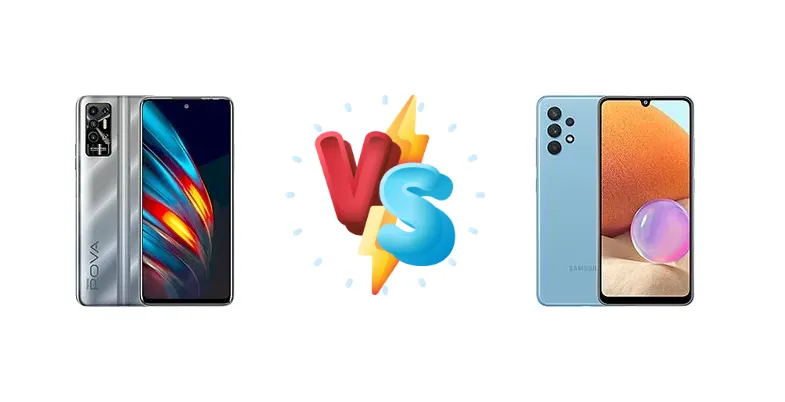
The Tecno Pova 2 and Samsung Galaxy A32 represent compelling options in the sub-$200 smartphone market. While both aim to deliver essential features, they take slightly different approaches. The Pova 2 leans towards gaming and fast charging, while the A32 prioritizes display quality and Samsung’s established software ecosystem. This comparison dissects their key differences to help you choose the right device.
🏆 Quick Verdict
For the average user prioritizing a brighter, more color-accurate display and a trusted brand, the Samsung Galaxy A32 is the better choice. However, gamers and those needing faster charging will find the Tecno Pova 2 a more compelling option, despite its slightly less refined software experience.
| Network |
|---|
| 2G bands | GSM 850 / 900 / 1800 / 1900 | GSM 850 / 900 / 1800 / 1900 |
| 3G bands | HSDPA 850 / 900 / 2100 | HSDPA 850 / 900 / 1900 / 2100 |
| 4G bands | LTE | 1, 2, 3, 5, 7, 8, 20, 28, 38, 40, 41 |
| Speed | HSPA, LTE | HSPA, LTE |
| Technology | GSM / HSPA / LTE | GSM / HSPA / LTE |
| Launch |
|---|
| Announced | 2021, June 03 | 2021, February 25 |
| Status | Available. Released 2021, June 11 | Available. Released 2021, February 25 |
| Body |
|---|
| Build | Glass front, plastic frame, plastic back | Glass front (Gorilla Glass 5), plastic frame, plastic back |
| Dimensions | 173.3 x 78.8 x 9.6 mm (6.82 x 3.10 x 0.38 in) | 158.9 x 73.6 x 8.4 mm (6.26 x 2.90 x 0.33 in) |
| SIM | Nano-SIM + Nano-SIM | · Nano-SIM· Nano-SIM + Nano-SIM |
| Weight | - | 184 g (6.49 oz) |
| Display |
|---|
| Protection | - | Corning Gorilla Glass 5 |
| Resolution | 1080 x 2460 pixels (~389 ppi density) | 1080 x 2400 pixels, 20:9 ratio (~411 ppi density) |
| Size | 6.9 inches, 113.1 cm2 (~82.8% screen-to-body ratio) | 6.4 inches, 98.9 cm2 (~84.6% screen-to-body ratio) |
| Type | IPS LCD, 480 nits | Super AMOLED, 90Hz, 800 nits (HBM) |
| Platform |
|---|
| CPU | Octa-core (2x2.0 GHz Cortex-A75 & 6x1.8 GHz Cortex-A55) | Octa-core (2x2.0 GHz Cortex-A75 & 6x1.8 GHz Cortex-A55) |
| Chipset | Mediatek MT6769Z Helio G85 (12 nm) | Mediatek MT6769V/CU Helio G80 (12 nm) |
| GPU | Mali-G52 MC2 | Mali-G52 MC2 |
| OS | Android 11, HIOS 7.6 | Android 11, upgradable to Android 13, One UI 5 |
| Memory |
|---|
| Card slot | microSDXC (dedicated slot) | microSDXC (dedicated slot) |
| Internal | 64GB 4GB RAM, 128GB 6GB RAM | 64GB 4GB RAM, 64GB 6GB RAM, 128GB 4GB RAM, 128GB 6GB RAM, 128GB 8GB RAM |
| Main Camera |
|---|
| Features | Quad-LED flash | LED flash, panorama, HDR |
| Quad | 48 MP, f/1.9, (wide), PDAF
2 MP (macro)
Auxiliary lenses | 64 MP, f/1.8, 26mm (wide), PDAF
8 MP, f/2.2, 123˚, (ultrawide), 1/4.0", 1.12µm
5 MP (macro)
Auxiliary lens |
| Single | - | 20 MP, f/2.2, (wide) |
| Video | 1440p@30fps, 1080p@30fps | 1080p@30fps |
| Selfie camera |
|---|
| Features | Dual-LED flash | - |
| Single | 8 MP, f/2.0 | 20 MP, f/2.2, (wide) |
| Video | 1080p@30fps | 1080p@30fps |
| Sound |
|---|
| 3.5mm jack | Yes | Yes |
| 35mm jack | Yes | Yes |
| Loudspeaker | Yes | Yes |
| Comms |
|---|
| Bluetooth | 5.0, A2DP, LE | 5.0, A2DP, LE |
| NFC | Yes | Yes (market/region dependent) |
| Positioning | GPS, GALILEO, BDS | GPS, GLONASS, BDS, GALILEO |
| Radio | FM radio | FM radio, RDS, recording |
| USB | USB Type-C 2.0, OTG | USB Type-C 2.0, OTG |
| WLAN | Wi-Fi 802.11 a/b/g/n/ac, dual-band | Wi-Fi 802.11 a/b/g/n/ac, dual-band, Wi-Fi Direct |
| Features |
|---|
| Sensors | Fingerprint (side-mounted), accelerometer, proximity, compass | Fingerprint (under display, optical), accelerometer, gyro, compass |
| | - | Virtual proximity sensing |
| Battery |
|---|
| Charging | 18W wired | 15W wired |
| Type | 7000 mAh | Li-Ion 5000 mAh |
| Misc |
|---|
| Colors | Polar Silver, Power Blue, Dazzle Black | Awesome Black, Awesome White, Awesome Blue, Awesome Violet |
| Models | LE7, LE7n | SM-A325F, SM-A325F/DS, SM-A325M, SM-A325N |
| Price | About 140 EUR | € 124.99 / £ 89.38 |
| SAR EU | - | 0.45 W/kg (head) 1.30 W/kg (body) |
| Tests |
|---|
| Battery life | - |
Endurance rating 119h
|
| Camera | - |
Photo / Video |
| Display | - |
Contrast ratio: Infinite (nominal) |
| Loudspeaker | - |
-30.3 LUFS (Below average)
|
| Performance | - |
AnTuTu: 286666 (v8)
GeekBench: 1277 (v5.1)
GFXBench: 8.1fps (ES 3.1 onscreen) |
Tecno Pova 2
- Faster 18W charging for quicker top-ups
- Slightly more powerful Helio G85 chipset for gaming
- Potentially better value for money
- Less refined software experience
- Display specifications are less detailed
Samsung Galaxy A32
- Brighter and more vibrant display for media consumption
- Trusted Samsung brand and software ecosystem
- Potentially better image processing
- Slower 15W charging
- Slightly less powerful Helio G80 chipset
Display Comparison
The Samsung Galaxy A32 boasts a significantly brighter display, reaching a measured 814 nits, compared to the Tecno Pova 2’s unspecified brightness. This higher peak brightness translates to better visibility outdoors under direct sunlight. While both utilize LCD panels, the A32’s infinite (nominal) contrast ratio suggests a more dynamic image. The Pova 2’s display specifications are less detailed, making it difficult to assess its color accuracy or viewing angles relative to the A32.
Camera Comparison
Both phones feature a 'Photo / Video' camera setup, but detailed sensor information is lacking. Without specifics on sensor size, aperture, or image processing algorithms, a direct comparison is difficult. The presence of a 2MP macro camera on the A32 is unlikely to provide significant photographic value. The Pova 2’s camera performance will likely focus on providing acceptable image quality in good lighting conditions, while the A32 may benefit from Samsung’s established image processing pipeline for more consistent results. The lack of OIS on either device suggests limited low-light performance.
Performance
Both devices are powered by Mediatek Helio G series chips, but the Tecno Pova 2 features the Helio G85, while the Galaxy A32 uses the Helio G80. Although both CPUs share the same core configuration (2x2.0 GHz Cortex-A75 & 6x1.8 GHz Cortex-A55), the G85 generally offers a slight performance edge due to higher clock speeds and a marginally improved GPU. However, the real-world difference will be minimal for everyday tasks. Both phones will likely exhibit similar performance in standard benchmarks, but the Pova 2 may maintain slightly higher frame rates in demanding games. Neither device specifies RAM speed, but LPDDR4X is the likely standard for both, limiting overall memory bandwidth.
Battery Life
Both the Tecno Pova 2 and Samsung Galaxy A32 achieve an endurance rating of 119 hours, indicating comparable battery life under similar usage patterns. However, the Pova 2 offers 18W wired charging, while the A32 is limited to 15W. This 3W difference translates to faster charging times for the Pova 2, potentially reducing the time spent tethered to a wall outlet. While both have similar battery capacity (not specified), the faster charging of the Pova 2 is a tangible benefit for users who frequently need to top up their battery.
Buying Guide
Buy the Tecno Pova 2 if you need a phone primarily for mobile gaming, value fast charging speeds, and don't mind a less polished software experience. Buy the Samsung Galaxy A32 if you prefer a brighter, more vibrant display for media consumption, prioritize a well-known brand with a smoother software experience, and aren't as concerned with maximizing gaming performance or charging speed.
Frequently Asked Questions
❓ Does the Mediatek Helio G80 in the Galaxy A32 struggle with demanding games like PUBG or Call of Duty?
The Helio G80 is capable of running PUBG and Call of Duty, but you'll likely need to lower graphics settings to achieve smooth frame rates. It's not a dedicated gaming chip, so don't expect flagship-level performance. The Pova 2's G85 will offer a slight advantage, but both phones will require some compromise in graphical fidelity.
❓ Is the 15W charging on the Samsung Galaxy A32 noticeably slower than the 18W charging on the Tecno Pova 2?
Yes, the 18W charging on the Pova 2 will charge the phone faster, though the difference isn't massive. Expect roughly a 30-60 minute difference for a full charge, depending on battery capacity. For users who frequently need to quickly top up their battery, the Pova 2's faster charging is a significant benefit.
❓ How does Samsung's One UI compare to Tecno's HiOS in terms of software updates and features?
Samsung's One UI generally receives more frequent software updates and security patches than Tecno's HiOS. One UI also offers a more polished and feature-rich experience, with a wider range of customization options. HiOS, while improving, often includes pre-installed bloatware and a less refined user interface.