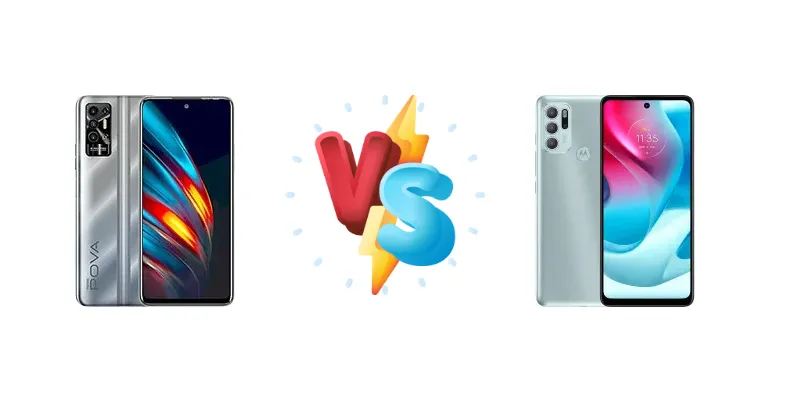
The Tecno Pova 2 and Motorola Moto G60S represent compelling options in the increasingly competitive budget smartphone space. Both target users seeking capable performance without breaking the bank, but they diverge in key areas like chipset choice and charging technology. This comparison dissects these differences to determine which device delivers the best overall experience.
🏆 Quick Verdict
For the average user prioritizing fast charging and slightly better overall performance, the Motorola Moto G60S is the stronger choice. Its Helio G95 chipset and 50W charging significantly outperform the Tecno Pova 2’s Helio G85 and 18W charging, making it ideal for gamers and those on the go.
| Network |
|---|
| 2G bands | GSM 850 / 900 / 1800 / 1900 | GSM 850 / 900 / 1800 / 1900 |
| 3G bands | HSDPA 850 / 900 / 2100 | HSDPA 850 / 900 / 1700(AWS) / 1900 / 2100 |
| 4G bands | LTE | 1, 2, 3, 4, 5, 7, 8, 12, 13, 17, 28, 40, 66 |
| Speed | HSPA, LTE | HSPA, LTE |
| Technology | GSM / HSPA / LTE | GSM / HSPA / LTE |
| Launch |
|---|
| Announced | 2021, June 03 | 2021, August 12 |
| Status | Available. Released 2021, June 11 | Available. Released 2021, August 12 |
| Body |
|---|
| Build | Glass front, plastic frame, plastic back | Glass front, plastic frame, plastic back |
| Dimensions | 173.3 x 78.8 x 9.6 mm (6.82 x 3.10 x 0.38 in) | 169.7 x 75.9 x 9.6 mm (6.68 x 2.99 x 0.38 in) |
| SIM | Nano-SIM + Nano-SIM | Nano-SIM + Nano-SIM |
| Weight | - | 212 g (7.48 oz) |
| | - | Water repellent design |
| Display |
|---|
| Resolution | 1080 x 2460 pixels (~389 ppi density) | 1080 x 2460 pixels (~395 ppi density) |
| Size | 6.9 inches, 113.1 cm2 (~82.8% screen-to-body ratio) | 6.8 inches, 109.8 cm2 (~85.3% screen-to-body ratio) |
| Type | IPS LCD, 480 nits | IPS LCD, 120Hz, HDR10, 450 nits (typ), 562 nits (HBM) |
| Platform |
|---|
| CPU | Octa-core (2x2.0 GHz Cortex-A75 & 6x1.8 GHz Cortex-A55) | Octa-core (2x2.05 GHz Cortex-A76 & 6x2.0 GHz Cortex-A55) |
| Chipset | Mediatek MT6769Z Helio G85 (12 nm) | Mediatek MT6785V/CD Helio G95 (12 nm) |
| GPU | Mali-G52 MC2 | Mali-G76 MC4 |
| OS | Android 11, HIOS 7.6 | Android 11 |
| Memory |
|---|
| Card slot | microSDXC (dedicated slot) | microSDXC (uses shared SIM slot) |
| Internal | 64GB 4GB RAM, 128GB 6GB RAM | 128GB 4GB RAM, 128GB 6GB RAM |
| | - | UFS 2.1 |
| Main Camera |
|---|
| Features | Quad-LED flash | LED flash, HDR, panorama |
| Quad | 48 MP, f/1.9, (wide), PDAF
2 MP (macro)
Auxiliary lenses | 64 MP, f/1.7, 26mm (wide), PDAF
8 MP, f/2.2, 119˚, (ultrawide)
5 MP (macro)
Auxiliary lens |
| Video | 1440p@30fps, 1080p@30fps | 4K@30/120fps, 1080p@30/60/240fps |
| Selfie camera |
|---|
| Features | Dual-LED flash | LED flash, HDR |
| Single | 8 MP, f/2.0 | 16 MP, f/2.2, (wide) |
| Video | 1080p@30fps | 4K@30fps, 1080p@30/60/240fps |
| Sound |
|---|
| 3.5mm jack | Yes | Yes |
| 35mm jack | Yes | Yes |
| Loudspeaker | Yes | Yes |
| Comms |
|---|
| Bluetooth | 5.0, A2DP, LE | 5.0, A2DP, LE |
| NFC | Yes | Yes |
| Positioning | GPS, GALILEO, BDS | GPS, GLONASS, GALILEO |
| Radio | FM radio | FM radio |
| USB | USB Type-C 2.0, OTG | USB Type-C 2.0, OTG |
| WLAN | Wi-Fi 802.11 a/b/g/n/ac, dual-band | Wi-Fi 802.11 a/b/g/n/ac, dual-band, Wi-Fi Direct |
| Features |
|---|
| Sensors | Fingerprint (side-mounted), accelerometer, proximity, compass | Fingerprint (rear-mounted), accelerometer, gyro, proximity |
| Battery |
|---|
| Charging | 18W wired | 50W wired, QC4 |
| Type | 7000 mAh | Li-Po 5000 mAh |
| Misc |
|---|
| Colors | Polar Silver, Power Blue, Dazzle Black | Green, Blue |
| Models | LE7, LE7n | XT2133-2, XT2133-1 |
| Price | About 140 EUR | About 200 EUR |
Tecno Pova 2
- Potentially lower price point
- More power-efficient chipset (Helio G85)
- Simple and straightforward software experience
- Slower 18W charging
- Less powerful processor (Helio G85)
- Likely less refined camera performance
Motorola Moto G60S
- Faster 50W charging with QC4
- More powerful processor (Helio G95)
- Potentially better gaming performance
- May be slightly more expensive
- Potentially less battery efficiency
- Motorola's software can include bloatware
Display Comparison
Neither device boasts a standout display. Both likely utilize LCD panels, common in this price bracket. While specific details like peak brightness and color gamut coverage are unavailable, the focus here is on processing power, not visual fidelity. Bezels are expected to be moderate on both, and color accuracy will likely be standard for the segment. The absence of high refresh rates (90Hz or 120Hz) is typical for phones in this price range.
Camera Comparison
Without detailed sensor information, a direct camera comparison is difficult. However, it’s safe to assume both phones feature multi-camera setups with a primary sensor, ultrawide, and potentially macro/depth sensors. The G60S, being the slightly more premium offering, *may* have a larger primary sensor, allowing for better low-light performance. Image processing will likely differ, with Motorola potentially leaning towards a more natural look, while Tecno might opt for more saturated colors. The presence of Optical Image Stabilization (OIS) is unlikely on either device, given the price point. The often-included 2MP macro lenses on both are largely marketing features and offer limited practical benefit.
Performance
The core difference lies in the chipsets. The Motorola Moto G60S features the Mediatek Helio G95 (12nm), utilizing two Cortex-A76 cores clocked at 2.05 GHz, alongside six Cortex-A55 cores at 2.0 GHz. This represents a step up from the Tecno Pova 2’s Helio G85 (12nm) with its two Cortex-A75 cores at 2.0 GHz and six Cortex-A55 cores at 1.8 GHz. The A76 cores in the G95 offer a noticeable architectural advantage over the A75 cores in the G85, translating to better single-core performance and improved responsiveness in applications. While both use 12nm fabrication, the G95’s core design provides a performance edge. The G60S is likely to exhibit less throttling under sustained load, making it more suitable for extended gaming sessions.
Battery Life
The Motorola Moto G60S’s 50W wired charging with Quick Charge 4 (QC4) support is a significant advantage. This allows for a much faster 0-100% charge time compared to the Tecno Pova 2’s 18W charging. While battery capacity isn’t specified, the faster charging speed of the G60S mitigates any potential disadvantage from a slightly smaller battery. Users who frequently find themselves needing to top up their phone quickly will greatly benefit from the G60S’s charging capabilities. The G85 in the Pova 2 is more power efficient, but the charging speed difference is more impactful.
Buying Guide
Buy the Tecno Pova 2 if you prioritize a lower initial cost and are less concerned with peak performance or rapid charging. It’s a solid option for everyday tasks and light gaming. Buy the Motorola Moto G60S if you value faster processing speeds for gaming and demanding apps, and if the convenience of 50W fast charging is a high priority. It’s the better choice for power users and mobile gamers.
Frequently Asked Questions
❓ Will the Motorola Moto G60S experience significant throttling during prolonged gaming sessions?
While the Helio G95 is a capable chipset, some throttling is expected under sustained load. However, the G95’s architecture and potentially better thermal management in the Moto G60S should result in less severe throttling compared to the Tecno Pova 2’s Helio G85.
❓ Is the 18W charging on the Tecno Pova 2 slow enough to be a major inconvenience?
For casual users, 18W charging is adequate. However, users accustomed to faster charging speeds will find it noticeably slower than the 50W charging on the Moto G60S. A full charge will take considerably longer, potentially requiring overnight charging.
❓ Does the Motorola Moto G60S support high frame rates in popular games like PUBG Mobile?
The Helio G95 is capable of running PUBG Mobile at high frame rates (60fps). However, achieving consistently smooth performance at the highest settings will depend on the device's thermal management and the specific game settings chosen. Expect to potentially need to lower graphics settings for optimal performance.
❓ How does the software experience differ between the Tecno Pova 2 and Motorola Moto G60S?
Tecno's HiOS is known for its customization options and features, but can also include pre-installed apps. Motorola typically offers a near-stock Android experience with minimal bloatware, appealing to users who prefer a cleaner interface. Motorola also generally provides faster software updates.