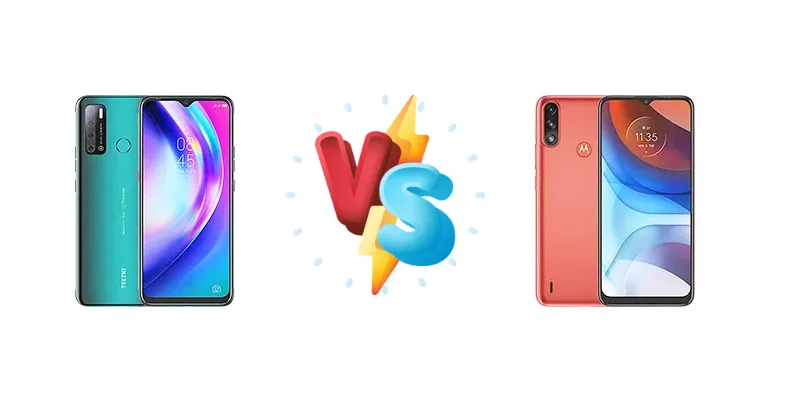
The Tecno Pouvoir 4 and Motorola Moto E7i Power represent the extreme end of the budget smartphone spectrum. Both aim to deliver essential smartphone functionality at the lowest possible price, but they take different approaches to achieving this. This comparison dissects their core components to reveal which device offers the best value for users prioritizing performance and longevity.
🏆 Quick Verdict
For the average user, the Tecno Pouvoir 4 is the better choice. While both phones are firmly in the entry-level category, the Pouvoir 4’s Mediatek Helio A22, built on a 12nm process, offers superior efficiency and a more responsive experience compared to the Motorola’s older, 28nm Unisoc SC9863A chipset.
| Network |
|---|
| 2G bands | GSM 850 / 900 / 1800 / 1900 | GSM 850 / 900 / 1800 / 1900 |
| 3G bands | HSDPA 850 / 900 / 2100 | HSDPA 850 / 900 / 1700(AWS) / 1900 / 2100 |
| 4G bands | 1, 3, 7, 8, 20, 28 | LTE |
| Speed | HSPA 42.2/5.76 Mbps, LTE Cat4 150/50 Mbps | HSPA, LTE |
| Technology | GSM / HSPA / LTE | GSM / HSPA / LTE |
| Launch |
|---|
| Announced | 2020, July 07. Released 2020, July 23 | 2021, February 23 |
| Status | Discontinued | Available. Released 2021, March 15 |
| Body |
|---|
| Build | Glass front, plastic back, plastic frame | Glass front, plastic back, plastic frame |
| Dimensions | 174.9 x 79.6 x 9.2 mm (6.89 x 3.13 x 0.36 in) | 165.1 x 75.9 x 9.2 mm (6.5 x 2.99 x 0.36 in) |
| SIM | Dual SIM | Nano-SIM + Nano-SIM |
| Weight | - | 200 g (7.05 oz) |
| | - | Water-repellent design |
| Display |
|---|
| Resolution | 720 x 1640 pixels (~256 ppi density) | 720 x 1600 pixels, 20:9 ratio (~270 ppi density) |
| Size | 7.0 inches, 116.4 cm2 (~83.6% screen-to-body ratio) | 6.51 inches, 102.3 cm2 (~81.7% screen-to-body ratio) |
| Type | IPS LCD, 480 nits (typ) | IPS LCD, 380 nits (typ) |
| Platform |
|---|
| CPU | Octa-core 2.0 GHz Cortex-A53 | Octa-core (4x1.6 GHz Cortex-A55 & 4x1.2 GHz Cortex-A55) |
| Chipset | Mediatek MT6761 Helio A22 (12 nm) | Unisoc SC9863A (28 nm) |
| GPU | PowerVR GE8320 | IMG8322 |
| OS | Android 10, HIOS 6.0 | Android 10 (Go edition) |
| Memory |
|---|
| Card slot | microSDXC (dedicated slot) | microSDXC (uses shared SIM slot) |
| Internal | 32GB 3GB RAM | 32GB 2GB RAM |
| | eMMC 5.1 | eMMC 5.1 |
| Main Camera |
|---|
| Dual | - | 13 MP, f/2.0, 26mm (wide), 1/3.1", 1.12µm, PDAF
2 MP (macro) |
| Features | Quad-LED flash | LED flash, HDR, panorama |
| Quad | 13 MP, f/1.8, (wide), AF
2 MP (macro)
Auxiliary lenses | - |
| Video | 1080p@30fps | 1080p@30fps |
| Selfie camera |
|---|
| Features | Dual-LED flash | HDR |
| Single | 8 MP, f/2.0, 26mm (wide) | 5 MP, f/2.2, 27mm (wide), 1.12µm |
| Video | - | 1080p@30fps |
| Sound |
|---|
| 3.5mm jack | Yes | Yes |
| 35mm jack | Yes | Yes |
| Loudspeaker | Yes, with stereo speakers | Yes |
| Comms |
|---|
| Bluetooth | 5.0, A2DP, LE | 4.2, A2DP |
| NFC | No | No |
| Positioning | GPS | GPS, GLONASS, GALILEO |
| Radio | FM radio | Unspecified |
| USB | microUSB 2.0 | USB Type-C 2.0 |
| WLAN | Wi-Fi 802.11 a/b/g/n, dual-band | Wi-Fi 802.11 b/g/n |
| Features |
|---|
| Sensors | Fingerprint (rear-mounted), accelerometer, proximity | Fingerprint (rear-mounted), accelerometer, proximity |
| Battery |
|---|
| Charging | - | 10W wired |
| Type | 6000 mAh | Li-Ion 5000 mAh |
| Misc |
|---|
| Colors | Cosmic Shine, Ice Jadeite, Fascinating Purple | Tahiti Blue, Coral Red |
| Models | LC7, LC7S | XT2097-13 |
| Price | - | About 120 EUR |
Tecno Pouvoir 4
- More efficient processor (Helio A22, 12nm)
- Potentially smoother multitasking
- Likely better sustained performance
- Charging speed specifications unavailable
- Camera performance likely basic
Motorola Moto E7i Power
- 10W wired charging included
- Potentially longer standby time due to lower performance
- Simple and straightforward user experience
- Less efficient processor (Unisoc SC9863A, 28nm)
- Slower app loading and multitasking
- Limited ISP capabilities may impact camera quality
Display Comparison
Neither device boasts a standout display. Details regarding panel type, resolution, and brightness are unavailable, but given the price point, both likely utilize LCD panels with 720p+ resolutions. The focus here isn't on visual fidelity. However, the absence of information on PWM dimming rates is concerning; users sensitive to flicker may want to investigate further before purchasing either device.
Camera Comparison
Camera performance is expected to be basic on both devices. Specific sensor details are lacking, but the market segment suggests low-resolution sensors. Focusing on megapixel counts alone is misleading; image quality will heavily depend on software processing. Without detailed specifications, it’s difficult to declare a clear winner, but the Unisoc chipset in the Moto E7i Power is known to have limited ISP capabilities, potentially hindering image processing quality.
Performance
The core difference lies in the chipsets. The Tecno Pouvoir 4’s Mediatek Helio A22 (12nm) features an octa-core Cortex-A53 CPU clocked at 2.0 GHz. This newer architecture and smaller manufacturing process translate to better power efficiency and potentially higher sustained performance than the Motorola Moto E7i Power’s Unisoc SC9863A (28nm). The Moto E7i Power uses a split core configuration – four Cortex-A55 cores at 1.6 GHz and four at 1.2 GHz. While the A55 is a more efficient core than the A53, the larger 28nm node negates much of that benefit. The Helio A22 will likely handle multitasking and app loading with less lag.
Battery Life
The Motorola Moto E7i Power includes 10W wired charging, a feature absent from readily available specifications for the Tecno Pouvoir 4. While the Pouvoir 4 may have a larger battery capacity (details unavailable), the slower charging speed of the E7i Power suggests a longer time to reach a full charge. However, the more efficient Helio A22 in the Pouvoir 4 could translate to longer overall battery life despite potentially having a similar or slightly smaller battery capacity.
Buying Guide
Buy the Tecno Pouvoir 4 if you need a phone that feels reasonably snappy for basic tasks like messaging, social media, and light web browsing, and you value a slightly more efficient processor. Buy the Motorola Moto E7i Power if your absolute priority is maximizing battery life and you primarily use your phone for calls, texts, and very occasional, undemanding app usage, and you are willing to trade performance for that longevity.
Frequently Asked Questions
❓ Will the Unisoc SC9863A in the Moto E7i Power struggle with popular apps like WhatsApp and Facebook?
The Unisoc SC9863A is a very basic chipset. While it *can* run apps like WhatsApp and Facebook, expect noticeable lag when switching between them or performing more demanding tasks within the apps, such as loading images or videos. The Tecno Pouvoir 4’s Helio A22 will provide a smoother experience.
❓ Is the 10W charging on the Moto E7i Power significantly slower than what's available on more expensive phones?
Yes, 10W charging is considerably slower than the 18W, 33W, or even 65W charging found on many modern smartphones. Expect a full charge to take several hours, potentially 3-5 hours from a completely depleted battery. The Tecno Pouvoir 4's charging speed is unknown, but it may be similar or slower.
❓ Can either of these phones handle basic mobile gaming?
Both phones can handle very basic 2D games, but don't expect a good experience with more demanding titles. Frame rates will be low, and you may encounter stuttering and lag. The Helio A22 in the Tecno Pouvoir 4 will offer slightly better performance in gaming, but it's still not ideal.