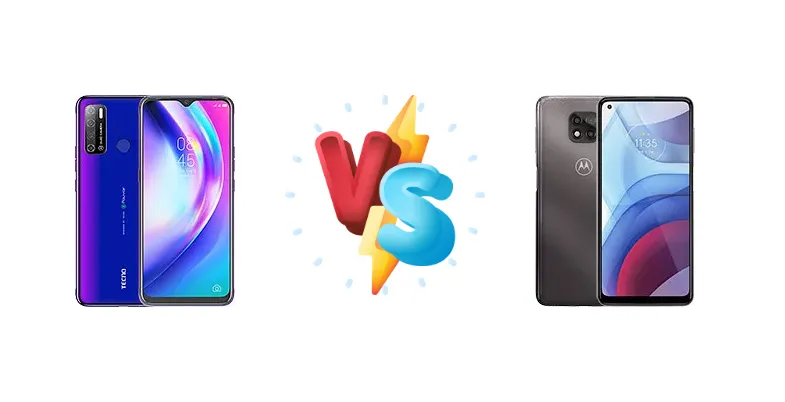
The sub-$200 smartphone market is fiercely competitive. The Tecno Pouvoir 4 Pro and Motorola Moto G Power (2021) both aim to deliver maximum value, but they take different approaches. The Pouvoir 4 Pro emphasizes fast charging, while the Moto G Power prioritizes a Qualcomm chipset and potentially longer software support. This comparison dissects their key differences to determine which phone best suits your needs.
🏆 Quick Verdict
For most users, the Motorola Moto G Power (2021) is the better choice. Its Snapdragon 662 chipset, built on an 11nm process, offers a noticeable performance advantage over the Tecno Pouvoir 4 Pro’s Helio P22, translating to smoother multitasking and a more responsive user experience. While the Pouvoir 4 Pro’s 18W charging is faster, the G Power’s overall efficiency and Qualcomm’s reputation for software updates give it the edge.
| Network |
|---|
| 2G bands | GSM 850 / 900 / 1800 / 1900 | GSM 850 / 900 / 1800 / 1900 |
| 3G bands | HSDPA 850 / 900 / 2100 | HSDPA 850 / 900 / 1700(AWS) / 1900 / 2100 |
| 4G bands | 1, 3, 7, 8, 20, 28 | 1, 2, 3, 4, 5, 7, 8, 12, 13, 14, 17, 25, 26, 29, 30, 38, 41, 66, 71 |
| Speed | HSPA 42.2/5.76 Mbps, LTE Cat4 150/50 Mbps | HSPA, LTE |
| Technology | GSM / HSPA / LTE | GSM / CDMA / HSPA / EVDO / LTE |
| | - | CDMA2000 1xEV-DO |
| Launch |
|---|
| Announced | 2020, July 07. Released 2020, July 23 | 2021, January 08 |
| Status | Discontinued | Available. Released 2021, January 14 |
| Body |
|---|
| Build | Glass front, plastic back, plastic frame | Glass front, plastic back, plastic frame |
| Dimensions | 174.9 x 79.6 x 9.2 mm (6.89 x 3.13 x 0.36 in) | 165.3 x 75.9 x 9.5 mm (6.51 x 2.99 x 0.37 in) |
| SIM | Dual SIM | Nano-SIM |
| Weight | - | 206.5 g (7.30 oz) |
| | - | Water-repellent coating |
| Display |
|---|
| Resolution | 720 x 1640 pixels (~256 ppi density) | 720 x 1600 pixels, 20:9 ratio (~266 ppi density) |
| Size | 7.0 inches, 116.4 cm2 (~83.6% screen-to-body ratio) | 6.6 inches, 105.2 cm2 (~83.8% screen-to-body ratio) |
| Type | IPS LCD, 480 nits (typ) | IPS LCD |
| Platform |
|---|
| CPU | Octa-core (4x2.0 GHz & 4x1.5 GHz) | Octa-core (4x2.0 GHz Kryo 260 Gold & 4x1.8 GHz Kryo 260 Silver) |
| Chipset | Mediatek MT6762 Helio P22 (12 nm) | Qualcomm SM6115 Snapdragon 662 (11 nm) |
| GPU | PowerVR GE8320 | Adreno 610 |
| OS | Android 10, HIOS 6.0 | Android 10 |
| Memory |
|---|
| Card slot | microSDXC (dedicated slot) | microSDXC (dedicated slot) |
| Internal | 64GB 4GB RAM, 128GB 6GB RAM | 32GB 3GB RAM, 64GB 4GB RAM |
| | - | eMMC 5.1 |
| Main Camera |
|---|
| Features | Quad-LED flash | LED flash, HDR, panorama |
| Quad | 16 MP, f/1.9, (wide), AF
5 MP (macro)
Auxiliary lenses | - |
| Triple | - | 48 MP, f/1.7, (wide), 1/2.0", 0.8µm, PDAF
2 MP (macro)
Auxiliary lens |
| Video | 1080p@30fps | 1080p@30/60fps, gyro-EIS |
| Selfie camera |
|---|
| Features | Dual-LED flash | HDR |
| Single | 16 MP, f/2.0, 27mm (wide) | 8 MP, f/2.0, 1.12µm |
| Video | - | 1080p@30fps, gyro-EIS |
| Sound |
|---|
| 3.5mm jack | Yes | Yes |
| 35mm jack | Yes | Yes |
| Loudspeaker | Yes, with stereo speakers | Yes |
| Comms |
|---|
| Bluetooth | 5.0, A2DP, LE | 5.0, A2DP, LE |
| NFC | No | No |
| Positioning | GPS | GPS, GLONASS, GALILEO |
| Radio | FM radio | FM radio |
| USB | microUSB 2.0 | USB Type-C 2.0 |
| WLAN | Wi-Fi 802.11 a/b/g/n, dual-band | Wi-Fi 802.11 a/b/g/n/ac, dual-band, Wi-Fi Direct |
| Features |
|---|
| Sensors | Fingerprint (rear-mounted), accelerometer, proximity | Fingerprint (side-mounted), accelerometer, gyro, proximity, compass, barometer |
| Battery |
|---|
| Charging | 18W wired | 15W wired |
| Type | 6000 mAh | Li-Po 5000 mAh |
| Misc |
|---|
| Colors | Ice Jadeite, Misty Grey, Fascinating Purple | Flash Gray, Polar Silver |
| Price | - | About 60 EUR |
Tecno Pouvoir 4 Pro
- Faster 18W wired charging
- Potentially lower price point
- May include additional software features specific to Tecno
- Less powerful Helio P22 chipset
- Likely less efficient power consumption
- Potentially limited software update support
Motorola Moto G Power (2021)
- More powerful Snapdragon 662 chipset
- Better power efficiency for longer battery life
- Stronger software support from Motorola
- Superior image processing capabilities
- Slower 15W wired charging
- May be slightly more expensive
Display Comparison
Neither device boasts a standout display. Both likely utilize LCD panels, common in this price bracket. The key difference lies under the hood: processing power impacts UI responsiveness. While neither spec sheet details refresh rates or peak brightness, the Moto G Power’s more powerful chipset will contribute to smoother animations and potentially better image processing for photos displayed on the screen. Bezels are expected to be substantial on both, reflecting their budget positioning.
Camera Comparison
Camera performance is likely to be similar, with both phones targeting basic photography needs. Without detailed sensor size information, it’s difficult to make definitive claims. However, Qualcomm’s image signal processor (ISP) within the Snapdragon 662 generally provides better image processing capabilities than MediaTek’s equivalent in the Helio P22. This means the Moto G Power is likely to produce more detailed and vibrant photos, especially in challenging lighting conditions. The prevalence of 2MP macro/depth sensors on both devices suggests limited utility; focusing on the main sensor’s quality is more important.
Performance
The core battleground is the chipset. The Motorola Moto G Power (2021) leverages the Qualcomm Snapdragon 662 (11nm), a significantly more modern and efficient design than the Tecno Pouvoir 4 Pro’s MediaTek Helio P22 (12nm). The 11nm process node of the Snapdragon 662 allows for greater transistor density and improved power efficiency, meaning less heat generation and potentially less throttling during sustained workloads. While both CPUs feature octa-core configurations with similar peak clock speeds (2.0 GHz), the Snapdragon’s Kryo cores offer a more sophisticated architecture, resulting in superior single-core and multi-core performance. This translates to faster app loading times, smoother multitasking, and a more enjoyable gaming experience on the Moto G Power.
Battery Life
The Motorola Moto G Power (2021) typically features a large battery (5000 mAh), while the Tecno Pouvoir 4 Pro’s capacity is not specified but is likely comparable. However, the Snapdragon 662’s superior power efficiency offsets any potential capacity difference. The Moto G Power’s 15W charging is slower than the Pouvoir 4 Pro’s 18W, but the Snapdragon’s efficiency means you may not need to charge as frequently. The 18W charging on the Tecno is beneficial for quick top-ups, but the overall battery life and sustained performance favor the Motorola.
Buying Guide
Buy the Tecno Pouvoir 4 Pro if you absolutely prioritize the fastest possible charging speeds and frequently need to top up your battery throughout the day. Buy the Motorola Moto G Power (2021) if you value a more responsive and efficient processor for everyday tasks, better long-term software support, and a generally smoother user experience, even if it means slightly slower charging.
Frequently Asked Questions
❓ Will the Tecno Pouvoir 4 Pro struggle with demanding apps like PUBG Mobile?
Yes, the Helio P22 chipset is not ideally suited for graphically intensive games like PUBG Mobile. You’ll likely experience noticeable lag and frame drops, even on lower settings. The Motorola Moto G Power (2021) with its Snapdragon 662 will provide a significantly smoother gaming experience.
❓ How long will it take to fully charge each phone from 0%?
The Tecno Pouvoir 4 Pro’s 18W charging should reach 100% in approximately 2-2.5 hours. The Motorola Moto G Power (2021)’s 15W charging will likely take closer to 3-3.5 hours. However, the Moto G Power’s more efficient chipset means you may not need to fully charge it as often.
❓ Which phone is more likely to receive Android updates?
Motorola generally provides more consistent and timely Android updates compared to Tecno. While neither brand is known for rapid updates, the Moto G Power (2021) has a higher probability of receiving at least one major Android version update and security patches.