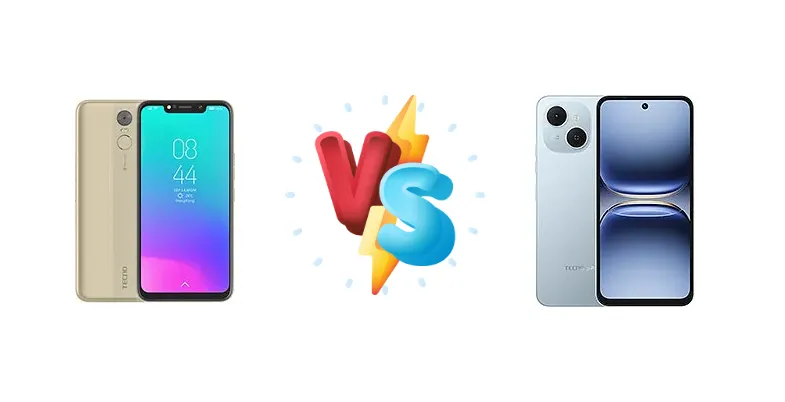
Tecno consistently targets the value-conscious smartphone market, and the Pouvoir 3 and Spark 40C exemplify this strategy. The Pouvoir 3, while older, remains available and offers a baseline experience. The Spark 40C represents a more recent iteration, boasting a significantly upgraded chipset. This comparison dissects the core differences to determine which device delivers the best bang for your buck.
🏆 Quick Verdict
For most users, the Tecno Spark 40C is the clear winner. Its Helio G81 chipset provides a substantial performance leap over the Pouvoir 3’s MT6739WA, enabling smoother multitasking and a more enjoyable gaming experience. While the Pouvoir 3 may offer slightly longer battery life due to its lower power chipset, the 40C’s 18W charging mitigates this difference.
| Network |
|---|
| 2G bands | GSM 850 / 900 / 1800 / 1900 | GSM 850 / 900 / 1800 / 1900 |
| 3G bands | HSDPA 850 / 900 / 2100 | HSDPA 900 / 2100 |
| 4G bands | 1, 3, 7, 20, 28 | LTE |
| Speed | HSPA 42.2/5.76 Mbps, LTE Cat4 150/50 Mbps | HSPA, LTE |
| Technology | GSM / HSPA / LTE | GSM / HSPA / LTE |
| | 3, 7, 20 | - |
| Launch |
|---|
| Announced | 2019, June. Released 2019, June | 2025, July 19 |
| Status | Discontinued | Available. Released 2025, August |
| Body |
|---|
| Build | - | Glass front, plastic back, plastic frame |
| Dimensions | 157.6 x 76.7 x 8.5 mm (6.20 x 3.02 x 0.33 in) | 165.6 x 77 x 8.4 mm (6.52 x 3.03 x 0.33 in) |
| SIM | Dual SIM (Micro-SIM, dual stand-by) | Nano-SIM + Nano-SIM |
| Weight | 168 g (5.93 oz) | - |
| Display |
|---|
| Protection | NEG | - |
| Resolution | 720 x 1500 pixels (~268 ppi density) | 720 x 1600 pixels, 20:9 ratio (~263 ppi density) |
| Size | 6.2 inches, 96.7 cm2 (~80.0% screen-to-body ratio) | 6.67 inches, 107.4 cm2 (~84.2% screen-to-body ratio) |
| Type | IPS LCD | IPS LCD, 120Hz |
| Platform |
|---|
| CPU | Quad-core 1.3 GHz Cortex-A53 | Octa-core (2x2.0 GHz Cortex-A75 & 6x1.8 GHz Cortex-A55) |
| Chipset | Mediatek MT6739WA (28 nm) | Mediatek Helio G81 (12 nm) |
| GPU | PowerVR GE8100 | Mali-G52 MC2 |
| OS | Android 8.1 (Oreo), HIOS 4.1 | Android 15, HIOS 15.1 |
| Memory |
|---|
| Card slot | microSDXC (dedicated slot) | Unspecified |
| Internal | 32GB 2GB RAM | 128GB 4GB RAM, 128GB 8GB RAM, 256GB 8GB RAM |
| | eMMC 5.1 | - |
| Main Camera |
|---|
| Features | Dual-LED flash, HDR, panorama | Dual-LED flash, HDR |
| Single | 13 MP, AF | 13 MP, f/1.8, 27mm (wide), PDAF |
| Video | 1080p@30fps | 1080p@30fps |
| Selfie camera |
|---|
| Features | LED flash, HDR | - |
| Single | 13 MP, f/2.0 | 8 MP |
| Video | 1080p@30fps | Yes |
| Sound |
|---|
| 3.5mm jack | Yes | - |
| 35mm jack | Yes | Yes |
| Loudspeaker | Yes | Yes, with dual speakers |
| Comms |
|---|
| Bluetooth | 4.2, A2DP, LE | Yes |
| Infrared port | - | Yes |
| NFC | No | No |
| Positioning | GPS | GPS |
| Radio | FM radio | FM radio |
| USB | microUSB 2.0 | USB Type-C, OTG |
| WLAN | Wi-Fi 802.11 b/g/n | Yes |
| Features |
|---|
| Sensors | Fingerprint (rear-mounted), accelerometer, proximity | Fingerprint (side-mounted); unspecified sensors |
| Battery |
|---|
| Charging | - | 18W wired |
| Type | 5000 mAh, non-removable | 6000 mAh |
| Misc |
|---|
| Colors | Gold, Black, Blue | Veil White, Ripple Blue, Titanium Grey, Ink Black |
| Models | - | KM4k |
| Price | - | About 90 EUR |
Tecno Pouvoir 3
- Potentially longer battery life due to less powerful chipset
- May be available at a lower price point
- Simpler user experience for basic tasks
- Significantly slower performance
- Less capable for gaming and multitasking
- Older chipset with limited software support
Tecno Spark 40C
- Much faster performance with Helio G81
- 18W fast charging for quicker top-ups
- Improved gaming capabilities
- More modern chipset with better software support
- Potentially shorter battery life compared to Pouvoir 3
- May be slightly more expensive
Display Comparison
Neither device is expected to feature a high-end display. Given the market segment, both likely utilize IPS LCD panels. However, details on resolution and brightness are missing. The Spark 40C’s newer design may offer slightly slimmer bezels, but the core viewing experience will be similar. Color accuracy is unlikely to be a strong point on either device, focusing instead on affordability.
Camera Comparison
Camera performance is likely to be similar in real-world usage, with both devices targeting the entry-level segment. Details on sensor sizes and apertures are unavailable, but it’s safe to assume both feature basic camera setups. The Spark 40C may benefit from slightly improved image processing capabilities due to the more powerful chipset, but don’t expect flagship-level results. Any 2MP macro or depth sensors on either device should be considered marketing features rather than significant photographic tools.
Performance
The performance gap is the most significant differentiator. The Tecno Spark 40C’s MediaTek Helio G81, built on a 12nm process, is a substantial upgrade over the Pouvoir 3’s 28nm MediaTek MT6739WA. The G81’s octa-core configuration (2x2.0 GHz Cortex-A75 & 6x1.8 GHz Cortex-A55) provides significantly more processing power than the Pouvoir 3’s quad-core 1.3 GHz Cortex-A53. This translates to faster app launch times, smoother multitasking, and the ability to play more demanding games. The G81 also features a more capable GPU, improving graphics performance. The 12nm process also contributes to better thermal efficiency, reducing the likelihood of throttling under sustained load.
Battery Life
The Pouvoir 3 likely has a larger battery capacity to compensate for the less efficient MT6739WA chipset. However, the Spark 40C’s 18W wired charging is a major advantage. While the exact battery capacity of the Spark 40C is unknown, 18W charging will significantly reduce charging times compared to the Pouvoir 3, which likely supports a much slower charging rate. This means less downtime and more time using the device.
Buying Guide
Buy the Tecno Pouvoir 3 if your primary need is a very basic smartphone for essential tasks like calls, texts, and light social media, and you prioritize maximizing battery life above all else. Buy the Tecno Spark 40C if you want a phone capable of handling moderate gaming, smoother app switching, and faster charging, even if it means slightly reduced battery endurance.
Frequently Asked Questions
❓ Will the Helio G81 in the Spark 40C overheat during prolonged gaming sessions?
The Helio G81 is a relatively efficient chipset, and the 12nm process helps with thermal management. While some heat is inevitable during gaming, the Spark 40C is unlikely to experience severe overheating or significant performance throttling, unlike older, less efficient chipsets.
❓ Is the 18W charging on the Spark 40C a significant improvement over the Pouvoir 3’s charging speed?
Yes, 18W charging is a substantial upgrade. The Pouvoir 3 likely supports a 5W or 10W charging rate, meaning the Spark 40C will charge significantly faster – potentially cutting charging times in half or more. This is a major convenience factor.
❓ Can the Tecno Spark 40C handle popular games like PUBG Mobile or Call of Duty Mobile?
The Helio G81 is capable of running PUBG Mobile and Call of Duty Mobile at medium settings with playable frame rates. While it won’t deliver a flagship gaming experience, it provides a significantly better gaming experience than the Pouvoir 3’s MT6739WA, which would struggle with these titles.
❓ How does the software experience differ between the Pouvoir 3 and Spark 40C?
The Spark 40C will likely run a more recent version of Tecno’s HiOS based on Android, offering newer features and security updates. The Pouvoir 3 may be stuck on an older Android version with limited software support, potentially impacting app compatibility and security.