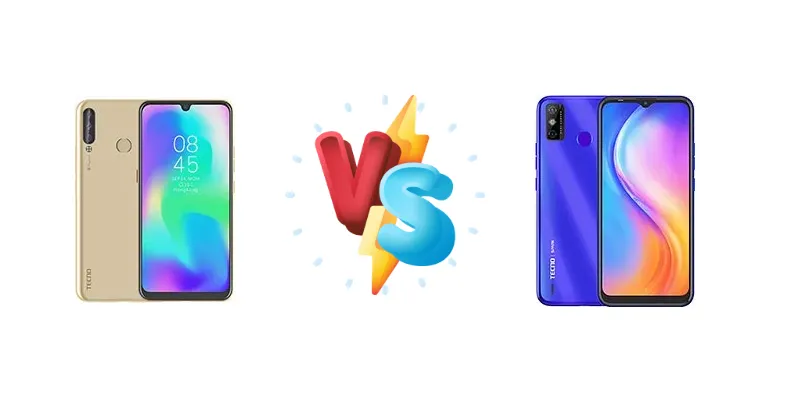
Tecno dominates the ultra-budget smartphone space, and the Pouvoir 3 Plus and Spark Go 2020 represent two compelling options. While both aim for affordability, they diverge significantly in their internal hardware, particularly in the chipset department. This comparison dissects those differences to determine which device delivers the best value for your money.
🏆 Quick Verdict
For most users, the Tecno Pouvoir 3 Plus is the superior choice. Its Mediatek Helio P22 chipset, featuring an octa-core CPU, provides a noticeable performance boost over the Spark Go 2020’s quad-core Helio A20. This translates to smoother multitasking and a more responsive user experience, justifying a potential price premium.
| Network |
|---|
| 2G bands | GSM 850 / 900 / 1800 / 1900 | GSM 850 / 900 / 1800 / 1900 |
| 3G bands | HSDPA 850 / 900 / 2100 | HSDPA 900 / 2100 |
| 4G bands | 1, 3, 7, 8, 20, 28 | 1, 3, 7, 8, 20, 28, 38, 40, 41 |
| Speed | HSPA 42.2/5.76 Mbps, LTE Cat4 150/50 Mbps | HSPA 42.2/5.76 Mbps, LTE Cat4 150/50 Mbps |
| Technology | GSM / HSPA / LTE | GSM / HSPA / LTE |
| | 3, 7, 20 | - |
| Launch |
|---|
| Announced | 2019, August. Released 2019, August | 2020, September 01. Released 2020, September 07 |
| Status | Discontinued | Discontinued |
| Body |
|---|
| Build | Glass front, plastic back, plastic frame | - |
| Dimensions | 159 x 76 x 9.2 mm (6.26 x 2.99 x 0.36 in) | 165.6 x 76.3 x 9.1 mm (6.52 x 3.00 x 0.36 in) |
| SIM | Nano-SIM + Nano-SIM | Nano-SIM + Nano-SIM |
| Weight | - | - |
| Display |
|---|
| Protection | - | Corning Gorilla Glass 3 |
| Resolution | 720 x 1548 pixels (~269 ppi density) | 720 x 1600 pixels, 20:9 ratio (~269 ppi density) |
| Size | 6.35 inches, 99.5 cm2 (~82.3% screen-to-body ratio) | 6.52 inches, 102.6 cm2 (~81.2% screen-to-body ratio) |
| Type | AMOLED | IPS LCD |
| Platform |
|---|
| CPU | Octa-core 2.0 GHz Cortex-A53 | Quad-core 1.8 GHz Cortex-A53 |
| Chipset | Mediatek MT6762 Helio P22 (12 nm) | Mediatek MT6761D Helio A20 (12 nm) |
| GPU | PowerVR GE8320 | PowerVR GE8320 |
| OS | Android 9.0 (Pie), HIOS 5.0 | Android 10 (Go edition), HIOS 6.2 |
| Memory |
|---|
| Card slot | microSDXC (dedicated slot) | microSDXC |
| Internal | 64GB 6GB RAM | 32GB 2GB RAM |
| | eMMC 5.1 | eMMC 5.1 |
| Main Camera |
|---|
| Dual | - | 13 MP, f/1.8, AF
Auxiliary lens |
| Features | Dual-LED flash, HDR, panorama | Dual-LED flash, panorama, HDR |
| Single | 32 MP, AF | - |
| Video | 1080p@30fps | 1080p@30fps |
| Selfie camera |
|---|
| Features | Dual-LED flash, HDR | LED flash |
| Single | 13 MP, 1/3.1", 1.12µm | 8 MP, f/2.0 |
| Video | 1080p@30fps | - |
| Sound |
|---|
| 3.5mm jack | Yes | Yes |
| 35mm jack | Yes | Yes |
| Loudspeaker | Yes | Yes |
| Comms |
|---|
| Bluetooth | 5.0, A2DP, LE | 4.2, A2DP |
| NFC | No | No |
| Positioning | GPS | GPS |
| Radio | FM radio | FM radio |
| USB | USB Type-C 2.0 | microUSB 2.0 |
| WLAN | Wi-Fi 802.11 b/g/n | Wi-Fi 802.11 b/g/n |
| Features |
|---|
| Sensors | Fingerprint (rear-mounted), accelerometer, proximity, compass | Fingerprint (rear-mounted), accelerometer, proximity |
| Battery |
|---|
| Type | 6000 mAh, non-removable | 5000 mAh |
| Misc |
|---|
| Colors | Gold, Black, Blue | Ice Jadeite, Aqua Blue, Sky Black |
| Models | LB8, LB8a | KE5S |
| Price | - | About 80 EUR |
Tecno Pouvoir 3 Plus
- Significantly faster processor for smoother multitasking.
- Octa-core CPU handles demanding apps better.
- More responsive user experience overall.
- Potentially higher price compared to the Spark Go 2020.
- May experience slightly faster battery drain under heavy load.
Tecno Spark Go 2020
- Lower price point makes it extremely accessible.
- Sufficient for basic tasks like calls and texts.
- Potentially longer battery life during light usage.
- Slow processor struggles with multitasking and demanding apps.
- Quad-core CPU feels sluggish compared to the Pouvoir 3 Plus.
- Limited gaming capabilities.
Display Comparison
Neither device boasts a standout display. Given the context data focuses on processing power, we can infer both likely utilize similar LCD panels with 720p+ resolutions, common in this price bracket. The absence of information regarding brightness or color accuracy suggests neither phone excels in these areas. Bezels are likely substantial on both, prioritizing cost reduction over a premium aesthetic.
Camera Comparison
Without detailed camera specifications, a direct comparison is difficult. However, it’s safe to assume both phones feature basic camera setups geared towards casual photography. Given the market segment, image processing will likely prioritize speed over quality. The absence of OIS or large sensors suggests low-light performance will be limited on both devices. Any additional cameras (often 2MP macro lenses) are likely included for marketing purposes and offer minimal practical benefit.
Performance
The core difference lies in the chipsets. The Tecno Pouvoir 3 Plus’s Mediatek Helio P22 (MT6762) is a significant upgrade over the Spark Go 2020’s Helio A20 (MT6761D). The P22’s octa-core Cortex-A53 CPU running at 2.0 GHz provides substantially more processing power than the A20’s quad-core Cortex-A53 at 1.8 GHz. This isn’t just about raw clock speed; the doubling of cores allows for better parallel processing, resulting in smoother app switching and improved responsiveness. While both are built on a 12nm process, the architectural advantage of the P22 is clear. Users engaging in anything beyond basic tasks will find the Pouvoir 3 Plus far more capable.
Battery Life
Battery life will depend heavily on usage patterns. While the mAh capacity isn’t specified, both phones likely feature batteries in the 3000-4000 mAh range, typical for this price point. The Pouvoir 3 Plus’s more powerful chipset *could* consume more power under heavy load, but its superior processing efficiency might offset this during lighter tasks. Charging wattage is also unknown, but likely falls in the 10W-15W range for both, resulting in relatively slow charging times.
Buying Guide
Buy the Tecno Pouvoir 3 Plus if you prioritize performance for social media, light gaming, and multitasking. The extra cores and higher clock speed will make a tangible difference in daily use. Buy the Tecno Spark Go 2020 if your needs are extremely basic – primarily calls, texts, and very light app usage – and you are seeking the absolute lowest possible price point. It’s a functional device for minimal smartphone requirements.
Frequently Asked Questions
❓ Will the Tecno Spark Go 2020 struggle with popular apps like WhatsApp and Facebook?
While the Spark Go 2020 can run WhatsApp and Facebook, the Helio A20’s quad-core processor may exhibit noticeable lag when switching between apps or loading media-heavy content. Users who frequently use these apps may find the Pouvoir 3 Plus’s octa-core processor a more fluid experience.
❓ Is the Tecno Pouvoir 3 Plus suitable for playing mobile games?
The Pouvoir 3 Plus is better suited for mobile gaming than the Spark Go 2020, but it’s still an entry-level gaming device. Expect to play less demanding titles at lower settings. More graphically intensive games may experience frame rate drops or require significant compromises in visual quality.
❓ How much of a difference will I actually notice between the Helio P22 and Helio A20 in everyday use?
The difference will be most apparent when multitasking, opening apps, and browsing the web. The Helio P22’s extra cores allow it to handle these tasks much more efficiently, resulting in a smoother and more responsive user experience. The Helio A20 will feel noticeably slower and more prone to lag.