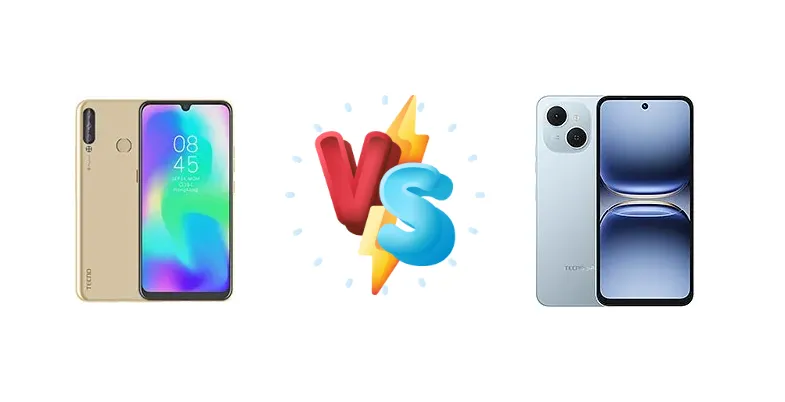
Tecno's Spark and Pouvoir lines consistently target the budget-conscious smartphone user. The Pouvoir 3 Plus, while established, now faces competition from the newer Spark 40C. This comparison dissects the key differences between these two devices, focusing on the significant chipset upgrade and its impact on real-world performance and usability.
🏆 Quick Verdict
For most users, the Tecno Spark 40C is the superior choice. Its Helio G81 chipset delivers a noticeable performance boost over the Pouvoir 3 Plus' Helio P22, making it better suited for gaming and multitasking. The addition of 18W charging further enhances its practicality, despite a likely similar battery capacity.
| Network |
|---|
| 2G bands | GSM 850 / 900 / 1800 / 1900 | GSM 850 / 900 / 1800 / 1900 |
| 3G bands | HSDPA 850 / 900 / 2100 | HSDPA 900 / 2100 |
| 4G bands | 1, 3, 7, 8, 20, 28 | LTE |
| Speed | HSPA 42.2/5.76 Mbps, LTE Cat4 150/50 Mbps | HSPA, LTE |
| Technology | GSM / HSPA / LTE | GSM / HSPA / LTE |
| | 3, 7, 20 | - |
| Launch |
|---|
| Announced | 2019, August. Released 2019, August | 2025, July 19 |
| Status | Discontinued | Available. Released 2025, August |
| Body |
|---|
| Build | Glass front, plastic back, plastic frame | Glass front, plastic back, plastic frame |
| Dimensions | 159 x 76 x 9.2 mm (6.26 x 2.99 x 0.36 in) | 165.6 x 77 x 8.4 mm (6.52 x 3.03 x 0.33 in) |
| SIM | Nano-SIM + Nano-SIM | Nano-SIM + Nano-SIM |
| Weight | - | - |
| Display |
|---|
| Resolution | 720 x 1548 pixels (~269 ppi density) | 720 x 1600 pixels, 20:9 ratio (~263 ppi density) |
| Size | 6.35 inches, 99.5 cm2 (~82.3% screen-to-body ratio) | 6.67 inches, 107.4 cm2 (~84.2% screen-to-body ratio) |
| Type | AMOLED | IPS LCD, 120Hz |
| Platform |
|---|
| CPU | Octa-core 2.0 GHz Cortex-A53 | Octa-core (2x2.0 GHz Cortex-A75 & 6x1.8 GHz Cortex-A55) |
| Chipset | Mediatek MT6762 Helio P22 (12 nm) | Mediatek Helio G81 (12 nm) |
| GPU | PowerVR GE8320 | Mali-G52 MC2 |
| OS | Android 9.0 (Pie), HIOS 5.0 | Android 15, HIOS 15.1 |
| Memory |
|---|
| Card slot | microSDXC (dedicated slot) | Unspecified |
| Internal | 64GB 6GB RAM | 128GB 4GB RAM, 128GB 8GB RAM, 256GB 8GB RAM |
| | eMMC 5.1 | - |
| Main Camera |
|---|
| Features | Dual-LED flash, HDR, panorama | Dual-LED flash, HDR |
| Single | 32 MP, AF | 13 MP, f/1.8, 27mm (wide), PDAF |
| Video | 1080p@30fps | 1080p@30fps |
| Selfie camera |
|---|
| Features | Dual-LED flash, HDR | - |
| Single | 13 MP, 1/3.1", 1.12µm | 8 MP |
| Video | 1080p@30fps | Yes |
| Sound |
|---|
| 3.5mm jack | Yes | - |
| 35mm jack | Yes | Yes |
| Loudspeaker | Yes | Yes, with dual speakers |
| Comms |
|---|
| Bluetooth | 5.0, A2DP, LE | Yes |
| Infrared port | - | Yes |
| NFC | No | No |
| Positioning | GPS | GPS |
| Radio | FM radio | FM radio |
| USB | USB Type-C 2.0 | USB Type-C, OTG |
| WLAN | Wi-Fi 802.11 b/g/n | Yes |
| Features |
|---|
| Sensors | Fingerprint (rear-mounted), accelerometer, proximity, compass | Fingerprint (side-mounted); unspecified sensors |
| Battery |
|---|
| Charging | - | 18W wired |
| Type | 6000 mAh, non-removable | 6000 mAh |
| Misc |
|---|
| Colors | Gold, Black, Blue | Veil White, Ripple Blue, Titanium Grey, Ink Black |
| Models | LB8, LB8a | KM4k |
| Price | - | About 90 EUR |
Tecno Pouvoir 3 Plus
- Potentially longer battery life (speculation based on Pouvoir line history)
- May be available at a lower price point due to its age
- Simple and straightforward user experience
- Significantly slower performance compared to the Spark 40C
- Slower charging speeds
- Less capable for gaming and multitasking
Tecno Spark 40C
- Faster and more responsive performance with the Helio G81
- 18W fast charging for quicker top-ups
- Better suited for gaming and demanding apps
- May be slightly more expensive than the Pouvoir 3 Plus
- Battery life may be comparable, not significantly better
- Likely similar display quality to the Pouvoir 3 Plus
Display Comparison
Neither device's display specifications are provided, so a direct comparison is limited. However, given the market positioning, both likely feature LCD panels with 720p+ resolution. The Spark 40C, being newer, *may* benefit from slightly improved color calibration or brightness, but this is speculative. Bezels are likely comparable, reflecting the budget nature of both phones. Without specific data, it's safe to assume display quality is not a major differentiating factor.
Camera Comparison
Without detailed camera specifications, a precise comparison is difficult. However, Tecno often equips its budget phones with multiple rear cameras, including low-resolution depth or macro sensors. It’s likely both phones feature a primary camera around 13MP. The Spark 40C, being newer, *may* benefit from improved image processing algorithms, resulting in better dynamic range and low-light performance. The absence of Optical Image Stabilization (OIS) is probable on both devices, relying instead on software stabilization. The usefulness of any 2MP macro lens on either phone is questionable, offering limited detail and often inferior results compared to the main sensor.
Performance
The core difference lies in the chipsets. The Tecno Spark 40C’s MediaTek Helio G81 represents a substantial upgrade over the Pouvoir 3 Plus’ Helio P22. The G81 utilizes a more modern CPU architecture – Cortex-A75 cores alongside A55 cores versus the P22’s all-Cortex-A53 setup. This translates to significantly faster single-core and multi-core performance. The A75 cores in the G81 provide a noticeable boost in responsiveness for app launching and general navigation. While both are built on a 12nm process, the G81’s architecture is more efficient, potentially leading to better sustained performance under load. Gamers will see a clear advantage on the Spark 40C, with smoother frame rates and the ability to handle more demanding titles.
Battery Life
The Pouvoir line historically emphasizes battery life, but the context data doesn't specify battery capacities for either device. Given the similar target market, capacities are likely in the 5000mAh range. However, the Spark 40C’s 18W wired charging is a significant advantage. The Pouvoir 3 Plus likely supports slower charging, potentially around 10W. This means the Spark 40C can replenish its battery much faster, reducing downtime. Even with a similar capacity, the G81’s more efficient architecture *could* translate to slightly better battery life during moderate usage.
Buying Guide
Buy the Tecno Pouvoir 3 Plus if your primary need is a very basic smartphone for essential tasks like calls, texts, and light social media, and you prioritize maximizing battery life over performance. Buy the Tecno Spark 40C if you want a more responsive experience for gaming, streaming, and multitasking, and value faster charging speeds for quicker top-ups.
Frequently Asked Questions
❓ Will the Tecno Spark 40C run PUBG Mobile smoothly?
The Helio G81 in the Spark 40C is capable of running PUBG Mobile at medium settings with reasonable frame rates. While it won't deliver a flagship-level experience, it's a significant improvement over the Pouvoir 3 Plus and should provide a playable experience for casual gamers.
❓ How long does it take to fully charge the Tecno Spark 40C with the 18W charger?
While a precise 0-100% charge time requires testing, the 18W charging should fully charge the Spark 40C in approximately 2-2.5 hours, assuming a battery capacity around 5000mAh. This is considerably faster than the Pouvoir 3 Plus, which likely takes over 3 hours with its slower charging.
❓ Is the difference in performance between the Helio P22 and Helio G81 noticeable for everyday tasks?
Yes, the difference is quite noticeable. The Helio G81's more powerful CPU cores and improved architecture result in snappier app launches, smoother scrolling, and a more responsive overall user experience. Everyday tasks like browsing, social media, and video playback will feel significantly faster on the Spark 40C.