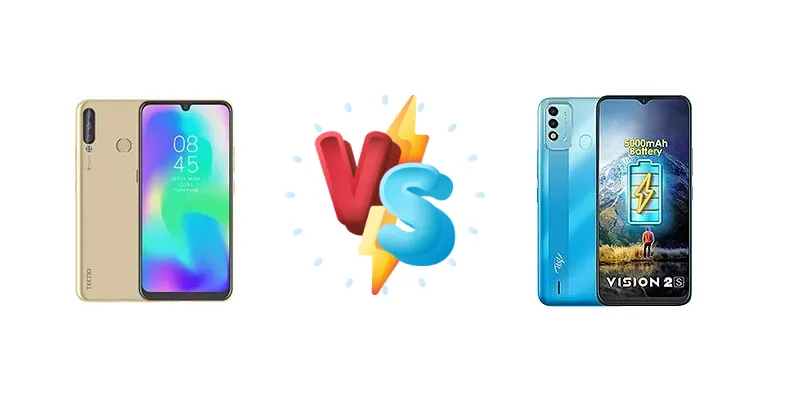
The Tecno Pouvoir 3 Plus and itel Vision 2S represent two approaches to the ultra-budget smartphone market. The Pouvoir 3 Plus, with its Mediatek Helio P22, prioritizes a balance of efficiency and processing power, while the Vision 2S leverages the Unisoc SC9863A and 18W charging to offer a quicker top-up experience. This comparison dissects their core differences to determine which device delivers the best value.
🏆 Quick Verdict
For the average user prioritizing sustained performance and a more mature chipset architecture, the Tecno Pouvoir 3 Plus is the better choice. While the itel Vision 2S boasts faster 18W charging, the older, less efficient Unisoc SC9863A chipset and its 28nm process will likely result in shorter battery life under load and potentially more heat.
| Network |
|---|
| 2G bands | GSM 850 / 900 / 1800 / 1900 | GSM 850 / 900 / 1800 / 1900 |
| 3G bands | HSDPA 850 / 900 / 2100 | HSDPA 850 / 900 / 2100 |
| 4G bands | 1, 3, 7, 8, 20, 28 | LTE |
| Speed | HSPA 42.2/5.76 Mbps, LTE Cat4 150/50 Mbps | HSPA, LTE |
| Technology | GSM / HSPA / LTE | GSM / HSPA / LTE |
| | 3, 7, 20 | - |
| Launch |
|---|
| Announced | 2019, August. Released 2019, August | 2021 |
| Status | Discontinued | Available. Released 2021 |
| Body |
|---|
| Build | Glass front, plastic back, plastic frame | - |
| Dimensions | 159 x 76 x 9.2 mm (6.26 x 2.99 x 0.36 in) | 166 x 76.3 x 8.9 mm (6.54 x 3.00 x 0.35 in) |
| SIM | Nano-SIM + Nano-SIM | Dual SIM |
| Weight | - | - |
| Display |
|---|
| Resolution | 720 x 1548 pixels (~269 ppi density) | 720 x 1600 pixels, 20:9 ratio (~269 ppi density) |
| Size | 6.35 inches, 99.5 cm2 (~82.3% screen-to-body ratio) | 6.52 inches, 102.6 cm2 (~81.0% screen-to-body ratio) |
| Type | AMOLED | IPS LCD |
| Platform |
|---|
| CPU | Octa-core 2.0 GHz Cortex-A53 | Octa-core (4x1.6 GHz Cortex-A55 & 4x1.2 GHz Cortex-A55) |
| Chipset | Mediatek MT6762 Helio P22 (12 nm) | Unisoc SC9863A (28 nm) |
| GPU | PowerVR GE8320 | IMG8322 |
| OS | Android 9.0 (Pie), HIOS 5.0 | Android 11 (Go edition) |
| Memory |
|---|
| Card slot | microSDXC (dedicated slot) | microSDXC |
| Internal | 64GB 6GB RAM | 32GB 2GB RAM |
| | eMMC 5.1 | - |
| Main Camera |
|---|
| Dual | - | 8 MP
0.3 MP |
| Features | Dual-LED flash, HDR, panorama | LED flash |
| Single | 32 MP, AF | - |
| Video | 1080p@30fps | 1080p@30fps |
| Selfie camera |
|---|
| Features | Dual-LED flash, HDR | - |
| Single | 13 MP, 1/3.1", 1.12µm | 5 MP |
| Video | 1080p@30fps | Yes |
| Sound |
|---|
| 3.5mm jack | Yes | - |
| 35mm jack | Yes | Yes |
| Loudspeaker | Yes | Yes |
| Comms |
|---|
| Bluetooth | 5.0, A2DP, LE | Yes |
| NFC | No | No |
| Positioning | GPS | GPS |
| Radio | FM radio | Unspecified |
| USB | USB Type-C 2.0 | microUSB |
| WLAN | Wi-Fi 802.11 b/g/n | Yes |
| Features |
|---|
| Sensors | Fingerprint (rear-mounted), accelerometer, proximity, compass | Fingerprint (rear-mounted), accelerometer |
| Battery |
|---|
| Charging | - | 18W wired |
| Type | 6000 mAh, non-removable | 5000 mAh |
| Misc |
|---|
| Colors | Gold, Black, Blue | Gradation Purple, Gradation Blue, Deep Blue |
| Models | LB8, LB8a | - |
Tecno Pouvoir 3 Plus
- More efficient chipset (12nm)
- Potentially better sustained performance
- Mature Mediatek platform
- Slower charging speeds (likely)
- Display specs unknown
itel Vision 2S
- Faster 18W wired charging
- Modern Cortex-A55 cores
- Potentially lower price
- Less efficient chipset (28nm)
- Unisoc chipset may have limited software support
- Potentially lower sustained performance
Display Comparison
Neither device's display specifications are provided, so a direct comparison is limited. However, given their price points, both likely utilize LCD panels with 720p+ resolutions. The itel Vision 2S's potential for a slightly more modern panel design cannot be ruled out, but the Tecno Pouvoir 3 Plus's display quality will likely be comparable, focusing on basic readability rather than color accuracy or high refresh rates.
Camera Comparison
Without detailed camera specifications, a meaningful comparison is difficult. Both phones likely feature basic camera setups geared towards social media sharing. The absence of information regarding sensor size or aperture makes it impossible to determine which phone captures better images. It's safe to assume both will struggle in low-light conditions, and any 2MP macro or depth sensors included are likely to offer minimal benefit to the overall photography experience.
Performance
The core difference lies in the chipsets. The Tecno Pouvoir 3 Plus’s Mediatek Helio P22 (12nm) utilizes eight Cortex-A53 cores clocked at 2.0 GHz. This 12nm fabrication process is significantly more efficient than the itel Vision 2S’s Unisoc SC9863A (28nm). The Vision 2S employs a heterogeneous core configuration – four Cortex-A55 cores at 1.6 GHz and four at 1.2 GHz. While the A55 architecture is more efficient *per core* than the A53, the larger process node and the split core configuration suggest the Helio P22 will deliver better sustained performance in demanding applications. The P22's larger cache and more consistent core speeds will benefit multitasking and light gaming.
Battery Life
Battery capacity isn't specified for either device, but the chipset efficiency plays a crucial role. The Tecno Pouvoir 3 Plus, powered by the 12nm Helio P22, will extract more usage from a given battery capacity than the itel Vision 2S with its 28nm Unisoc SC9863A. While the Vision 2S offers 18W wired charging – a significant advantage – this is offset by the less efficient chipset. Users who prioritize minimizing charging frequency will likely find the Pouvoir 3 Plus more appealing, even if it charges slower.
Buying Guide
Buy the Tecno Pouvoir 3 Plus if you need a phone that can handle everyday tasks smoothly and offers a more refined software experience thanks to the more established Mediatek platform. It's ideal for users who value consistent performance over the absolute fastest charging speeds. Buy the itel Vision 2S if you prioritize quick charging and frequently find yourself needing to top up your phone throughout the day, and are willing to accept potentially lower sustained performance and battery longevity.
Frequently Asked Questions
❓ Will the Unisoc SC9863A in the itel Vision 2S struggle with multitasking compared to the Helio P22?
The Unisoc SC9863A's 28nm process and split core configuration suggest it may exhibit more performance throttling under sustained load, potentially leading to slower app switching and a less fluid multitasking experience compared to the Tecno Pouvoir 3 Plus's Helio P22.
❓ How much faster is the 18W charging on the itel Vision 2S in real-world use?
While 18W charging is faster than standard 10W or 15W charging, the actual time saved depends on the battery capacity (which is unknown for both devices). However, the less efficient Unisoc chipset means you'll likely be needing that faster charging more often to compensate for quicker battery drain.
❓ Is the difference in chipset architecture (Cortex-A53 vs A55) significant for everyday tasks?
For basic tasks like browsing, social media, and messaging, the difference between Cortex-A53 and A55 cores is minimal. However, the A55 cores in the itel Vision 2S are paired with a less efficient process node, potentially negating some of their efficiency benefits.