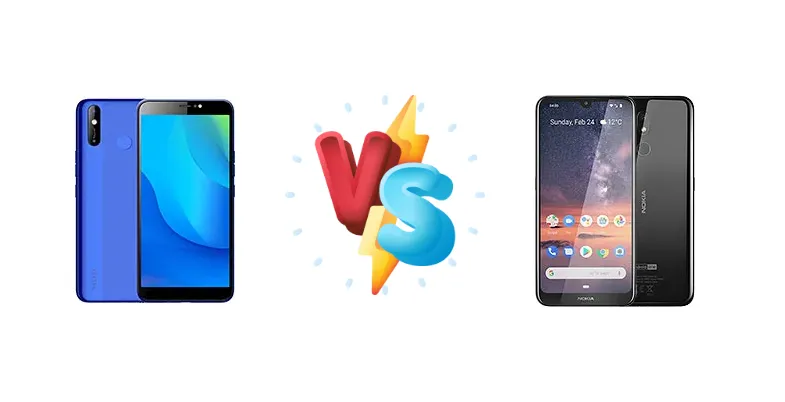
The Tecno Pouvoir 3 Air and Nokia 3.2 represent the extreme end of the smartphone price spectrum. Both aim to deliver a functional Android experience without breaking the bank, but they achieve this with different approaches to hardware. This comparison dissects their core components – specifically the Mediatek Helio A22 and Qualcomm Snapdragon 429 – to determine which offers the better value for budget-conscious consumers.
🏆 Quick Verdict
For the average user prioritizing consistent, if modest, performance, the Nokia 3.2 edges out the Tecno Pouvoir 3 Air. While the Helio A22 offers a slightly higher clock speed, the Snapdragon 429’s architecture and Qualcomm’s software optimizations result in a smoother overall experience, especially during multitasking. The Nokia 3.2 also benefits from 10W charging, a feature absent from the Tecno.
| Network |
|---|
| 2G bands | GSM 850 / 900 / 1800 / 1900 | GSM 850 / 900 / 1800 / 1900 |
| 3G bands | HSDPA 850 / 900 / 2100 | HSDPA 850 / 900 / 2100 |
| 4G bands | 1, 3, 5, 8, 38, 40, 41 | 1, 3, 5, 7, 8, 20, 28, 38, 40 - EMEA, APAC, MENA |
| Speed | HSPA 42.2/5.76 Mbps, LTE Cat4 150/50 Mbps | HSPA 42.2/5.76 Mbps, LTE Cat4 150/50 Mbps |
| Technology | GSM / HSPA / LTE | GSM / HSPA / LTE |
| | 3, 7, 20 | 1, 3, 5, 8, 40, 41 - India |
| Launch |
|---|
| Announced | 2019, August. Released 2019, August | 2019, February 24. Released 2019, May 22 |
| Status | Discontinued | Discontinued |
| Body |
|---|
| Build | - | Glass front, plastic back, plastic frame |
| Dimensions | 163 x 78.2 x 9.3 mm (6.42 x 3.08 x 0.37 in) | 159.4 x 76.2 x 8.6 mm (6.28 x 3.00 x 0.34 in) |
| SIM | Nano-SIM + Nano-SIM | Nano-SIM + Nano-SIM |
| Weight | - | 181 g (6.38 oz) |
| Display |
|---|
| Resolution | 480 x 960 pixels, 18:9 ratio (~179 ppi density) | 720 x 1520 pixels, 19:9 ratio (~269 ppi density) |
| Size | 6.0 inches, 92.9 cm2 (~72.9% screen-to-body ratio) | 6.26 inches, 97.8 cm2 (~80.5% screen-to-body ratio) |
| Type | IPS LCD | IPS LCD |
| Platform |
|---|
| CPU | Quad-core 2.0 GHz Cortex-A53 | Quad-core 1.8 GHz Cortex-A53 |
| Chipset | Mediatek MT6761 Helio A22 (12 nm) | Qualcomm SDM429 Snapdragon 429 (12 nm) |
| GPU | PowerVR GE8320 | Adreno 504 |
| OS | Android 9.0 Pie (Go edition), HIOS 5.0 | Android 9.0 (Pie), upgradable to Android 11, Android One |
| Memory |
|---|
| Card slot | microSDXC (dedicated slot) | microSDXC (dedicated slot) |
| Internal | 16GB 1GB RAM | 16GB 2GB RAM, 32GB 3GB RAM, 64GB 3GB RAM |
| | eMMC 5.1 | eMMC 5.1 |
| Main Camera |
|---|
| Features | LED flash | LED flash |
| Single | 8 MP, AF | 13 MP, f/2.2, 1/3.1", 1.12µm, AF |
| Video | 1080p@30fps | 1080p@30fps |
| Selfie camera |
|---|
| Features | LED flash | - |
| Single | 8 MP | 5 MP, f/2.2, 27mm (wide), 1/5.0", 1.12µm |
| Video | 1080p@30fps | - |
| Sound |
|---|
| 3.5mm jack | Yes | Yes |
| 35mm jack | Yes | Yes |
| Loudspeaker | Yes | Yes |
| Comms |
|---|
| Bluetooth | 5.0, A2DP, LE | 4.2, A2DP, LE, aptX |
| NFC | No | No |
| Positioning | GPS | GPS, GLONASS, BDS |
| Radio | FM radio | FM radio |
| USB | microUSB 2.0 | microUSB 2.0, OTG |
| WLAN | Wi-Fi 802.11 b/g/n | Wi-Fi 802.11 b/g/n |
| Features |
|---|
| Sensors | Fingerprint (rear-mounted), accelerometer | Fingerprint (rear-mounted, 32/3GB only), accelerometer, proximity |
| Battery |
|---|
| Charging | - | 10W wired |
| Type | 5000 mAh, non-removable | Li-Ion 4000 mAh, non-removable |
| Misc |
|---|
| Colors | Champagne Gold, Midnight Black, Aqua Blue | Black, Steel |
| Models | - | TA-1156, TA-1159, TA-1164 |
| Price | - | About 140 EUR |
| SAR EU | - | 0.24 W/kg (head) 1.63 W/kg (body) |
Tecno Pouvoir 3 Air
- Potentially lower price point
- Higher CPU clock speed (on paper)
- May offer larger storage options
- Less optimized chipset
- Likely slower charging
- Potentially less refined software experience
Nokia 3.2
- More efficient chipset
- 10W wired charging
- Potentially better software optimization
- Slightly lower CPU clock speed
- May be slightly more expensive
- Potentially smaller storage options
Display Comparison
Neither device boasts a standout display. Both likely utilize LCD panels, common in this price bracket. Without specific brightness or color gamut data, it’s difficult to declare a clear winner. However, Nokia’s reputation for color accuracy suggests a potentially more pleasant viewing experience, even if resolution and panel technology are comparable. Bezels are expected to be substantial on both, reflecting their budget nature.
Camera Comparison
Both phones likely feature basic camera setups geared towards casual photography. Without sensor size or aperture information, a direct comparison is challenging. It’s safe to assume both will struggle in low-light conditions. The presence of a 2MP macro lens on either device is largely a marketing gimmick, offering minimal practical benefit. Image processing will likely be the deciding factor, and Nokia’s software optimizations may yield slightly more pleasing results, but expectations should remain low.
Performance
The core difference lies in the chipsets. The Tecno Pouvoir 3 Air’s Mediatek Helio A22, with its quad-core 2.0 GHz Cortex-A53 CPU, appears stronger on paper than the Nokia 3.2’s Qualcomm Snapdragon 429 (quad-core 1.8 GHz Cortex-A53). However, clock speed isn’t everything. Qualcomm’s Snapdragon 429 benefits from architectural optimizations and a more mature software ecosystem. This translates to better sustained performance and smoother multitasking, even with the slightly lower clock speed. The Snapdragon 429’s GPU is also likely more efficient, offering a marginally better gaming experience. RAM configurations are crucial here, but absent from the provided data; however, the chipset difference will be the primary performance differentiator.
Battery Life
Battery capacity is not provided for either device, making a direct comparison difficult. However, the Nokia 3.2’s inclusion of 10W wired charging is a significant advantage. The Tecno Pouvoir 3 Air lacks any mention of charging speed, implying a slower, potentially micro-USB based charging solution. Even with a similar battery capacity, the Nokia 3.2 will offer a more convenient charging experience, reducing downtime.
Buying Guide
Buy the Tecno Pouvoir 3 Air if you need a phone primarily for very basic tasks like calls, texts, and light social media, and are willing to accept occasional slowdowns. Its lower price point makes it suitable for first-time smartphone users or as a temporary device. Buy the Nokia 3.2 if you prefer a more refined Android experience, even at a slightly higher cost, and value consistent performance for everyday tasks like browsing, email, and light app usage. The inclusion of 10W charging is a significant benefit for those who don't want to wait hours for a full charge.
Frequently Asked Questions
❓ Will the Tecno Pouvoir 3 Air struggle with popular apps like WhatsApp and Facebook?
While the Helio A22 can handle basic apps, the Tecno Pouvoir 3 Air may exhibit noticeable slowdowns when running multiple apps simultaneously or using more demanding features within those apps. The Snapdragon 429 in the Nokia 3.2 offers a smoother experience for these common tasks.
❓ How long will it take to fully charge the Nokia 3.2 with the 10W charger?
Without knowing the battery capacity, it's difficult to provide an exact time. However, 10W charging on a typical budget smartphone battery (around 3000-4000mAh) will likely take between 2.5 to 4 hours for a full charge from 0%.
❓ Is either phone suitable for playing mobile games like PUBG Mobile or Call of Duty Mobile?
Both phones will struggle with graphically intensive games like PUBG Mobile or Call of Duty Mobile. You'll likely need to play at the lowest settings with significant frame rate drops. The Snapdragon 429 in the Nokia 3.2 will offer a slightly better experience, but neither phone is designed for serious gaming.